overlaylink

Top 5 Books by Ernest Hemingway

June 18, 2021 | 3 min read

Are you interested in Hemingway but not sure where to start? Have you read some of his work but want to hear some more recommendations?

We’ve got you covered—here’s our pick of the top 10 books by Hemingway a brief overview. See if anything speaks to you.


If you’re just starting out and you want something lower commitment, try:

In Our Time

in our time ernest hemingway


In Our Timeis Hemingway’s first collection of short stories, featuring two most famous Nick Adams stories. (Nick Adams is a semi-autobiographical protagonist of two dozen short stories written through the 1920s and 30s.)

Hemingway’s short stories are the perfect way for you to experience his writing style across a span of plotlines and settings. In Our Timeaddresses themes like alienation, loss, grief, and separation.


If you’re new to Hemingway and want to start with a novel, try:

For Whom the Bell Tolls

for whom the bell tolls


Widely regarded as one of Hemingway’s best works, For Whom the Bell Tollsis a war story based on Hemingway’s time as a journalist during the Spanish Civil War.

For Whom the Bell Tollsexplores themes of honor, death, duty, nature, camaraderie, sacrifice, and more. The novel is also a love story and an ode to Spanish culture.


If you’re looking for Hemingway’s award-winning work, try:

The Old Man and the Sea

the old man and the sea hemingway


The last novel published before Hemingway’s death, The Old Man and the Seawon the author a Pulitzer Prize for Fiction. This novel follows an old fisherman who, after 84 days of failing to catch a fish, snags a giant marlin and struggles with it for three days.

The Old Man and the Seaaddresses pride, honor, glory, redemption, and more.


If you’re curious about what some critics call Hemingway’s most important novel, try:

The Sun Also Rises

the sun also rises hemingway


Chances are, if you’ve heard of Hemingway, you’ve heard of The Sun Also Rises.Many readers also use this novel as an entry point to Hemingway’s fiction.

The Sun Also Risesenters the hedonistic lives of the post-WWI European elite. Pay attention to Hemingway’s mastery of dialogue, sparse descriptions, and engrossing depiction of the Lost Generation.


If you want to read what established Hemingway as a major American writer, try:

A Farewell to Arms

a farewell to arms


Hemingway’s third book, A Farewell to Arms,is another war story. It follows an American lieutenant in the Italian army’s ambulance corps. (Like his protagonist, Hemingway was wounded by a mortar shell and fell in love. Hemingway was not a war veteran, despite popular belief, as he was wounded while volunteering as a Red Cross ambulance driver.)

A Farewell to Armsbecame Hemingway’s first bestseller and established him as one of the great modern American writers. The novel was adapted into


If you’re looking for a less “mainstream” recommendation, try:

To Have and Have Not

to have and have not hemingway


We didn’t lose count! We’re simply giving an honorable mention to To Have and Have Not.This novel, as perhaps obvious from the title, dives into society’s financial and social strata. To Have and Have Notfeatures a rich cast of characters—the working class on the docks, the rich who moored their boats, smuggled Chinese immigrants, and more.

This exciting tale was adapted into three films.


Will you be adding any of these titles to your list? Once you read them, or if you’ve already read them, let us know what you think.

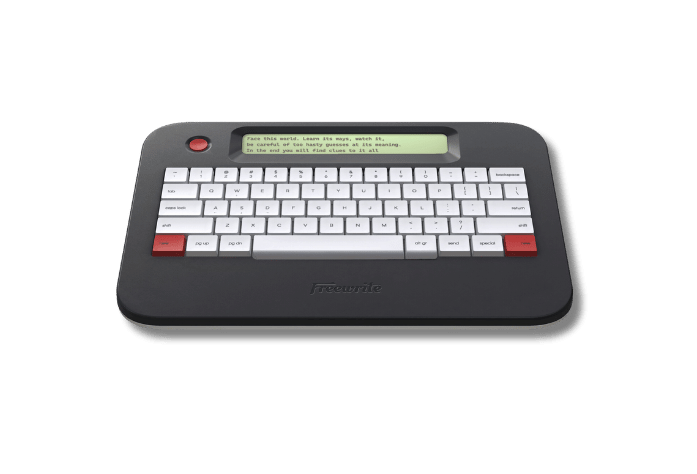
 

GET HEMINGWRITE


April 15, 2026 4 min read

Break up with Final Draft for good. Get the best screenplay workflow in Hollywood: Freewrite + Highland Pro.

April 01, 2026 0 min read
March 22, 2026 3 min read

If you're new here, freewriting is “an unfiltered and non-stop writing practice.” It’s sometimes known as stream-of-consciousness writing.

To do it, you simply need to write continuously, without pausing to rephrase, self-edit, or spellcheck. Freewriting is letting your words flow in their raw, natural state.

When writing the first draft of a novel, freewriting is the approach we, and many authors, recommend because it frees you from many of the stumbling blocks writers face.

This method helps you get to a state of feeling focused and uninhibited, so you can power through to the finish line.

How Freewriting Gives You Mental Clarity

Freewriting is like thinking with your hands. Some writers have described it as "telling yourself the story for the first time."

Writing for Inside Higher Ed, Steven Mintz says, “Writing is not simply a matter of expressing pre-existing thoughts clearly. It’s the process through which ideas are produced and refined.” And that’s the magic of putting pen to paper, or fingertips to keyboard. The way you learned to ride a bike by wobbling until suddenly you were pedaling? The way you learned certain skills by doing as well as revising? It works for writing, too.

The act of writing turns on your creative brain and kicks it into high gear. You’re finally able to articulate that complex idea the way you want to express it when you write, not when you stare at a blank page and inwardly think until the mythical perfect sentence comes to mind.

Writing isn’t just the way we express ideas, but it’s how we extract them in the first place. Writing is thinking.

Or, as Flannery O'Connor put it:

“I write because I don't know what I think until I read what I say.”

Writing isn’t just the way we express ideas, but it’s how we extract them in the first place. Writing is thinking.


Freewriting to Freethinking

But how and why does it work? Freewriting makes fresh ideas tumble onto the page because this type of writing helps you get into a meditative flow state, where the distractions of the world around you slip away.

Julie Cameron, acclaimed author of The Artist’s Way, proposed the idea that flow-state creativity comes from a divine source. And sure, it certainly feels like wizardry when the words come pouring out and scenes seem to arrange themselves on the page fully formed. But that magic, in-the-zone writing feeling doesn’t have to happen only once in a blue moon. It’s time to bust that myth.

By practicing regular freewriting and getting your mind (and hands) used to writing unfiltered, uncensored, and uninterrupted, you start freethinking and letting the words flow. And the science backs it up.

According to Psychology Today, the dorsolateral prefrontal cortex goes quiet during flow state. This part of the brain is in charge of “self-monitoring and impulse control” – in other words, the DLPFC is the tiny home of your loud inner critic. And while that mean little voice in your head takes a long-overdue nap, you’re free to write without doubt or negative self-talk.

“With this area [of the brain] deactivated, we’re far less critical and far more courageous, both augmenting our ability to imagine new possibilities and share those possibilities with the world.”

Freewriting helps us connect with ourselves and our own thoughts, stories, beliefs, fears, and desires. But working your creative brain is like working a muscle. It needs regular flexing to stay strong.

So, if freewriting helps us think and organize our thoughts and ideas, what happens if we stop writing? If we only consume and hardly ever create, do we lose the ability to think for ourselves? Up next, read "Are We Living through a Creativity Crisis?"


Learn More About Freewriting

Get the ultimate guide to boosting creativity and productivity with freewriting absolutely free right here.You'll learn how to overcome perfectionism, enhance flow, and reignite the joy of writing.

SYSF-book-mockup.webp