overlaylink

How to Be Your Own Best Editor While Remaining a Writer

June 29, 2017 | 8 min read


Today’s guest post is by Marsh Cassady. Marsh has Ph.D in theatre and is a former actor, director, and university professor. He is the author of fifty-seven published books and hundreds of shorter pieces. His plays have been performed in Canada, Mexico and the U.S., including Off-Broadway.


You’re not a writer! Well, at least for a time. You’re an editor.

For about eight years I was co-publisher of a small press and learned quickly what to look for in query letters, proposals, and in fiction and nonfiction. Yet I thought of myself mainly as a writer.

The weird thing was that when I wore my writer’s cap, I didn’t think like an editor anymore, and I found I was just as puzzled as any other writer about what would be acceptable to a publisher. Then one day, it was like the proverbial lightbulb exploded inside my head. Hey, dummy, I told myself, you’ve been an editor for a long time and, in fact, still are. So look at your own work through an editor’s eyes.

Seems pretty absurd that it took me so long to realize this and to approach my own writing as if it were a submission to the press or to the literary journal of which I was fiction editor. It’s a matter of roles, a matter of putting on a different cap. Of course, you’re still the same person—at least to a degree. Look at it this way. At work you may be an attorney and at home a mom, two vastly different roles. The same is true with writing and editing, each important but very much different from each other. In your role as an attorney you wouldn’t ground a client for staying out beyond curfew, nor would you threaten to take legal action against your three-year-old. So now is the time to hang up the writer’s cap and assume the role of editor.

What being an editor boils down to is being objective. View your own writing as it were done by someone else. Is this person you’re judging a good writer? What makes her or him good? What don’t you like about the style, the organization, the content? One thing that helps is to put away your writing for a few days or a week. When you take it out again, you have some distance between you and your work. You aren’t as emotionally involved with it now, so it’s easier to approach it objectively. The more you can distance yourself from the work, the better.

I knew a successful poet once who didn’t believe in revising her work. Whatever she wrote stayed the way she’d first written it. There also used to be a columnist for the San Diego Union Tribune who did the same. But most of us don’t work that way. Most of us have to revise our work at least two or three times—sometimes much more often until it meets our goals. In fact, in one of my books on writing I include an excerpt from my nonfiction that is my eighth revision! And still I continued to revise it extensively with handwritten changes from the top of the page to the bottom.

What are the sorts of things should you look for in editing your writing?

Is the work interesting?

Is the piece something you yourself would like to read? If not, why not? Is it that you don’t like the subject matter? Years ago in the writing workshop I used to lead a man came to the meeting one night and said he was writing a film script. He said he didn’t like the subject matter but thought it would be something that would sell. Nope! He was a good writer but not for this. He finally gave up because it was too much of a chore to continue. Of course, it’s possible to do a good job with a subject you hate, but why do it unless it’s part of your job and you have no choice?

Did you make the writing too formal, too dry, too prosaic? It’s important to hook the reader’s attention right away. Did you do that? Assume you’re an editor at a publishing company or magazine. Would you want to read through the entire piece you wrote? When I was a book editor, I knew within a page or two—sometimes less—whether I wanted to publish the book or not. Would you want to publish what you wrote?

Was your lead the most effective you can come up with? How does the rest of the piece hold up? If it’s nonfiction, have you included enough specifics—examples or illustrations or anecdotes to support what you say?

Is the writing easy to follow? Does it flow well?

Are there any bumps, any distractions? If so, what caused them? Maybe you need better transitions. Maybe you just need to explain things a little better—more interestingly, more succinctly. Or maybe you have some extraneous stuff that doesn’t support the central idea.

Is the piece well-organized?

There are many types of organization, from chronological to spatial to order of importance. Have you chosen a type of organization that fits well with the sort of piece you wrote? Have you considered the organization or just written haphazardly as the ideas come to mind? The latter rarely works for a finished piece—whether a personality profile piece, a column, or a how-to article. You need to follow a particular type of organization that is appropriate for what you’ve written? For instance, you probably wouldn’t choose spatial organization for a novel—though it is possible, with one section taking place in New York, the next in Los Angles, and the third in London. However, within each of these sections you’d probably want to use chronological order and maybe even start the first section earlier in time than the next and the next. And you probably wouldn’t use order of importance in discussing a historical event.

Is the writing coherent?

No matter what you’re writing, you need to be sure you’ve tied everything together. Each part, in some way, has to relate to the piece as a whole. In fiction this means everything has to be important to the plot and/or theme, either directly or indirectly. All elements need to support the central idea. And generally, the less important a character or a setting, the less space you should give them. However, I did also say “indirectly.” Don’t throw away a scene that points up the character, for instance or explains the reasons behind characters’ actions.

In nonfiction everything also should relate to the central idea. If you’re writing about a candidate’s stance on an issue, you wouldn’t usually talk about his hobby of collecting ceramic mugs from around the world.

Is the writing clear?

Is the writing easy to follow, or would the reader have to struggle to understand what you mean? Do you use language appropriate to your readers? For instance, you’d use different language for explaining what quarks are to a junior high class than you would to an adult education class. 

Is the dialogue natural and appropriate?

Does the dialogue reveal character?  Does it help create the proper atmosphere? If the scene is one of tension, does the dialogue reflect this? Does it help the reader understand the sort of universe you’ve created? Does the dialogue advance the plot? All dialogue should have a purpose; each word should be important for one reason or another.

Does your dialogue sound natural? Although dialogue resembles everyday speech, it is very much different but still has to appear natural. In conversation we change the subject often and abruptly. We ramble. We use a lot of extra words. Your characters can’t do that, unless it’s to point up a character trait, for instance.

Dialogue also has to be appropriate for each character, each of whom speaks in his or her own way. A recent immigrant from Russia would speak much differently than would a surfer dude. A person with a Ph.D. in physics would speak differently than would a short order cook—at least in most cases.

When writing dialogue, you need to consider everything important about the character—background, education, present circumstances, personality, and the emotional content of the scene.

Is the dialogue easy to follow? Even if your character has an accent, don’t make the writing difficult to follow. Readers today probably wouldn’t be happy to read pieces like Joel Chandler Harris’ Uncle Remus stories with lines like: “"One time," said Uncle Remus...way back yander, ’fo’ you wuz bomed, honey, en ’fo’ Mars John er Miss Sally wuz bomed-way back yander ’fo’ enny un us wuz bomed, de animils en de creeturs sorter ’lecshuneer roun’m ’mong deyselves, twel at las’ ’dey 'greed fer ter have ’sembly.”

Does any of the writing sound awkward?

I’m nearly finished reading a novel by one of my favorite authors, but I was disappointed to see that at several times in the book he used passive voice. So far as I remember, he never did this before. And it yanked me right out of the action. So avoid passive voice. It should be cut.  Oops. What I really mean is: You need to cut it out!

You also need to consider if the words you’ve chosen are the best you can come up with, that the work doesn’t sound too stilted, that what you write matches the overall style. An academic piece, for instance, would use a more formal style than a travel article.

Check for repetition.

Recently, I edited a book for a friend. In one paragraph of four lines I found three instances of the word “painting.” He objected to my editing out two of them. He said I was ruining his style. Uh, uh, uh! Repeating words or phrases calls attention to itself and detracts from the writing. Of course, this doesn’t apply to so-called invisible words like “the,” “an,” “a,” “and”, etc. But any time you repeat words like mouse or quark or sweetheart in close proximity to the original, you are risking alienating the reader. An exception, of course, is when you deliberately repeat a word for emphasis. The same, of course, is true of phrases. Unless there’s a good reason, beware of repeating phrases within several paragraphs of each other.

Don’t Overwrite.

Is there anything extraneous?  If so, cut it.  This is especially true in the matter of research. It’s been said that research is like an iceberg—two-thirds should be hidden beneath the surface. In other words, you should inspire confidence in the reader that you know your subject thoroughly, that you know much more than is included in the article, that you are the expert. On the other hand, you shouldn’t expect the reader to suffer through absolutely everything you’ve learned.

Proofreading

To many writers this is the most tedious part of getting a manuscript ready for publication, and it’s more complicated by the fact that when proofing our own writing, we often “see” what we expect to see and not what’s actually there. Also, proofing cannot be rushed. You have to be meticulous in doing it. One trick that can work well is to read the manuscript backward. This does away with expectations of what you think is there because now the material—though it doesn’t make sense—is completely new, and typos and small errors stand out more. For instance: “more. out stand errors small and typos and new, completely is.” When you do this, it forces you to slow down.

Read your writing aloud to yourself or to someone else.

When you read the piece aloud, you’ll be surprised at how many typos and other “pickies” you catch. This is because you’re forced to slow down and concentrate on each word. Thus, the little things that elude you in a silent readthrough now become much more apparent. Finally, if you can, put the manuscript away one more time and then back to it again in a day or a week.

Okay, now you’ve done your stint as an editor. Take off the editor’s cap, hang it up, and grab the writer’s cap from the rack. You are not an editor any longer—at least for now. Today you’re a writer. Good luck with the new piece.


Marsh CassadyMarsh Cassady has Ph.D in theatre and is a former actor, director, and university professor. He is the author of fifty-seven published books and hundreds of shorter pieces. His plays have been performed in Canada, Mexico and the U.S., including Off-Broadway. For about eight years he was co-publisher of a small press and a literary journal. He has also taught creative writing at the University of California, San Diego, and for thirty-five years led all-genre writing workshops.


November 29, 2025 4 min read

The Great Freewrite Séance: A Ghost'ly Charity Auction Full Terms & Conditions

These Terms and Conditions (“Terms”) govern participation in The Great Freewrite Séance: A Ghost'ly Charity Auction (“Auction”), organized by Freewrite (“Organizer,” “we,” “us,” or “our”). By registering for, bidding in, or otherwise participating in the Auction, you (“Participant,” “Bidder,” or “Winner”) agree to be bound by these Terms.

1. Auction Overview

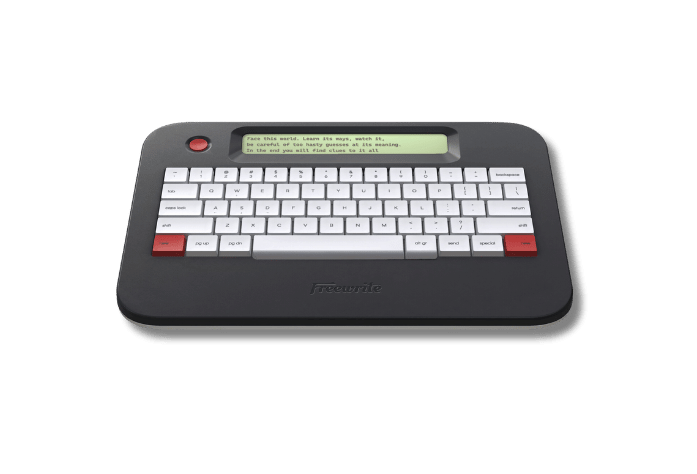
1.1. The Auction offers for sale a limited number of Freewrite Traveler Ghost Edition units (“Items” or “Ghost Traveler units”), each personally signed and drawn on by a featured author.

1.2. All proceeds, net of explicitly disclosed administrative costs, will be donated to the charity or charitable initiative (“Charity”) identified on each auction item’s page, as chosen by the respective author.

2. Eligibility

2.1. Participants must be at least 18 years old or the age of majority in their jurisdiction, whichever is higher.

2.2. Employees of Freewrite, the participating authors, or any affiliates directly involved in the Auction are not eligible to bid.

2.3. By participating, you represent that you are legally permitted to take part in online auctions and to pay for any bids you win.

3. Auction Registration

3.1. Participants must create an account on the auction platform or otherwise register using accurate, current, and complete information.

3.2. Freewrite reserves the right to verify identity and to disqualify any Participant who provides false or misleading information.

4. Bidding Rules

4.1. All bids are binding, final, and non-retractable.

4.2. Bidders are responsible for monitoring their bids; Freewrite is not liable for missed notifications or technical issues on the auction platform or the Participant’s device.

4.3. Freewrite reserves the right to:

  • set minimum bids or bid increments;
  • reject bids deemed in bad faith or intended to disrupt the Auction;
  • extend, pause, or cancel the Auction in case of technical difficulties, fraud, or events beyond reasonable control.

5. Winning Bids and Payment

5.1. The highest valid bid at the close of the Auction is the Winning Bid, and the corresponding Participant becomes the Winner.

5.2. Winners will receive payment instructions and must complete payment within 48 hours of the auction’s close unless otherwise stated.

5.3. Failure to complete payment on time may result in forfeiture, and Freewrite may offer the Item to the next highest bidder.

5.4. Accepted payment methods will be listed on the Auction platform. All payments must be made in the currency specified.

6. Item Description and Condition

6.1. Each Ghost Traveler unit is authentic, and the signatures, doodles, and messages are original works created by the participating author. These are authors, not artists. By bidding on the Item, you acknowledge that you are receiving a one-of-a-kind unit marked with unique art and messages and you agree to these terms and conditions.

6.2. Because Items are customized and signed by hand, variations, imperfections, or unique marks are to be expected. These are considered part of the Item’s character and not defects.

6.3. Items are provided “as-is” and “as-available.” Freewrite makes no warranties of merchantability or fitness for a particular purpose.

7. Shipping & Delivery

7.1. Shipping costs, import duties, and taxes may apply unless explicitly stated otherwise.

7.2. Freewrite will make reasonable efforts to ship Items within the estimated timeline but cannot guarantee delivery dates.

7.3. Title and risk of loss transfer to the Winner upon delivery to the carrier.

7.4. Freewrite is not responsible for delays, damage, or loss caused by the courier or customs agencies.

8. Charity Donation

8.1. Net proceeds from the Auction will be donated to the Charity designated on each Item page.

8.2. Donation amounts and recipients may be disclosed publicly unless prohibited by law.

8.3. Winners acknowledge that they are purchasing Items, not making a tax-deductible donation to Freewrite; therefore, Winners will not receive charitable tax receipts unless Freewrite explicitly states otherwise in compliance with applicable laws.

9. Intellectual Property

9.1. All trademarks, brand names, product names, and creative materials associated with Freewrite and the Ghost Traveler remain the exclusive property of Freewrite or their respective rights holders.

9.2. Participants may not reproduce, distribute, or publicly display the authors’ doodles without permission where such rights are applicable, except as allowed by law (e.g., resale of the physical Item).

10. Privacy

10.1. By participating, you consent to Freewrite’s collection, use, and storage of your personal data in accordance with our Privacy Policy.

10.2. Freewrite may publicly announce auction results, including Winner’s first name, last initial, city, state/country, and winning bid amount unless prohibited by law or unless you formally request anonymity when possible.

11. Prohibited Conduct

Participants may not:

  • engage in bid manipulation, fraud, or collusive bidding;
  • use automated systems (bots, scripts, scrapers) to place or monitor bids;
  • interfere with the Auction, platform, or other participants

Freewrite may ban or disqualify any Participant violating these rules.

12. Limitation of Liability

To the fullest extent permitted by law:

12.1. Freewrite is not liable for indirect, incidental, special, or consequential damages arising from the Auction or purchase of Items.

12.2. Freewrite’s total liability in connection with these Terms shall not exceed the amount of the Winning Bid actually paid by the Participant.

12.3. Freewrite is not responsible for technical malfunctions, internet outages, system failures, or other issues beyond its control.

13. Cancellation and Force Majeure

Freewrite may cancel, postpone, or modify the Auction due to unforeseen circumstances, including but not limited to natural disasters, system failures, strikes, or events affecting participating authors or the Charity.

14. Governing Law & Dispute Resolution

14.1. These Terms are governed by the laws of Michigan, without regard to conflict-of-law rules.

14.2. Any disputes arising under these Terms will be resolved through binding arbitration or the courts of the specified jurisdiction, as applicable.

14.3. Participants waive any right to participate in class-action lawsuits relating to the Auction.

15. Amendments

Freewrite may update these Terms at any time. Continued participation in the Auction after updates constitutes acceptance of the revised Terms.

16. Contact Information

For questions or concerns regarding the Auction or these Terms, contact: hello@getfreewrite.com.

November 25, 2025 1 min read

This is a great gratitude writing exercise to be done alone or in a group, with people of any age.

How to Play

    1. Designate someone to read out each prompt below. (Feel free to add your own prompts.)
    2. After each prompt is read, set a timer for one minute. (With younger kids, this can be shortened. For older folks who want to freewrite meaningfully, more time can be added.)
    3. Each person freewrites by finishing the sentence and elaborating until the timer goes off. (For little kids, this can be done verbally with an adult recording their answers. Hilarity will ensue.)
    4. Remeber that freewriting — allowing yourself to write with abandon — enables you to let go, tapping into your subconscious to explore your thoughts more deeply.
    5. When everyone is done with all the prompts, take turns going through some your answers. Some people may be eager to share. Others may not want to. Respect their decision.

The Prompts

  • I'm grateful for... [After you've finished this prompt, repeat it five times. Challenge yourself and others not to repeat a singe word with each new answer.]
  • The silliest thing I'm grateful for is...
  • The littlest thing I'm grateful for is...
  • The biggest thing I'm grateful for is...
  • The grossest thing I'm grateful for is...
  • One thing I love about myself is...
  • My favorite thing that happened this year was...
  • My hope for next year is...

This writing exercise has resulted in some sweet answers — and many hilarious ones, too. If you try it out, do let us know.

Write on.

November 21, 2025 4 min read

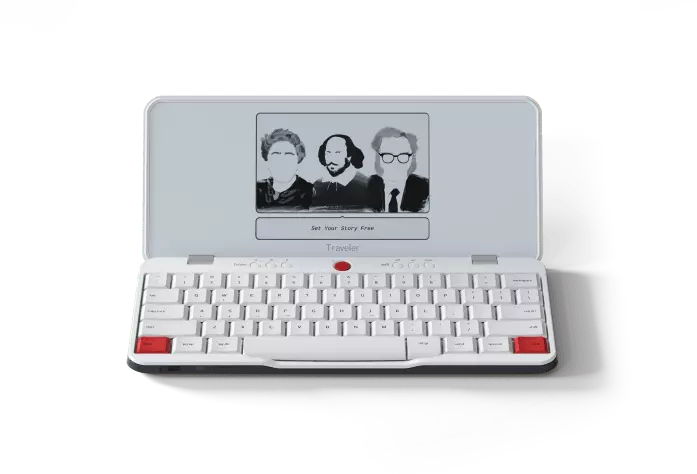
For the release of Sailfish, our new firmware update for Smart Typewriter Gen3 and Traveler, we created a brand-new boot-up animation to surprise and delight our writers.

We worked with talented Danish animator Mathias Lynge to bring our experience of the writer's journey to life.

We had a blast visualizing the writer's journey in this new way. Our engineers also had a blast (or something less than a blast) figuring out how to adjust this fun, playful animation to E Ink's very tricky specifications. Hello, refresh rate woes! But we think the result is pretty fun.

"The little animation made my day when I noticed. I love a good flourish."

- Freewrite user

The process of creating this animation was long and full of Zoom calls where we deeply discussed the writing process. We were struck through those conversations by how much overlap there is in creative processes of all disciplines.

So we sat down to chat with Mathias about his creative process and what it's like being a full-time animator.

ANNIE COSBY: Let's start with the basics. What kind of art do you make?

MATHIAS LYNGE: I'm a 2D animator and motion designer working freelance with a wide range of clients. The style varies depending on the project, but it’s usually either a hand-drawn look animated frame-by-frame on a drawing tablet, or a more digital, vectorized look made in After Effects.

While much of what I do is commercial work, I try to keep up with my own passion projects as well. That could be a 10-second Instagram loop of a nature scene, or an interesting character design I’ve sketched down with a pencil. It’s there that I get to sharpen my skills and try out new techniques, which often find their way into later client projects.

AC: You often share educational content on social media for other artists. Are you formally trained, or did you teach yourself?

ML: I’m mostly self-taught. I’ve been drawing for as long as I can remember, but it wasn’t until I went to university that I realized drawing could become a career.

When I first heard terms like “motion design” and “The 12 Principles of Animation” I was on a student exchange program at UCSB in California, where I had chosen a class called "Introduction to Animation." It was a big eye-opener for me, and from that point I was hooked.

But it’s mainly been online YouTube tutorials and my existing drawing experience that have taught me what I know.

Now, I have a big presence on social media, where I share my art as well as educational content centered around animation in Adobe After Effects, so I guess you could say that I'm also an animation influencer!

I’ve been drawing for as long as I can remember, but it wasn’t until I went to university that I realized drawing could become a career.

AC: That's actually how I first found your work. Do you have any specific artists who inspire you?

ML:In the world of 2D animation, I have a list of personal heroes that inspire me with their unique style: Reece Parker, Ariel Costa a.k.a. BlinkMyBrain, and Tony Babel, to name a few.

I also find a lot of inspiration from illustrators and painters I discover online, on platforms such as Pinterest. Last year I made a sparkling water animation that was heavily inspired by Cornwall-based artist Gordon Hunt. He makes these beautiful nature-inspired pointillist paintings that capture how light hits the ocean using colorful dots of paint. I tried to recreate that effect using After Effects to bring it to life, and it led me to a whole new way of animating within the program.

AC: Where else do you draw inspiration to create your work?

ML: I’m heavily inspired by the nature and cityscapes around me in Copenhagen, and I find that taking long walks through parks or down the streets of my neighborhood really sparks my imagination.

I’ll often carry around a sketchbook to quickly scribble down an idea or a loose sketch of something I find interesting, such as seeing how the light from a lamppost hits the surrounding leaves, or how the wind moves the tree in a certain way.

Then I’ll think to myself, “I wonder if I can recreate that motion using a specific technique in After Effects?”

I’m heavily inspired by the nature and cityscapes around me in Copenhagen...

AC: What does your daily routine look like as a full-time artist?

ML: It varies a lot, but I’m usually either working hard on a client project or tinkering away with a new animation tutorial for my social media channels.

I love being able to switch between the two, and when I’m going through a client dry spell, I find that staying creative and posting animation-related content helps keep me inspired while also putting things out into the world that may lead to my next client down the road.

AC: What's your #1 piece of advice for animators new to the industry?

ML: Keep experimenting and trying out new techniques. There’s no such thing as running out of creativity, and even though many of the things you try don’t necessarily go anywhere, it’s all experience that adds up and expands your toolbox. It’s a muscle that needs to be worked out regularly.

Plus, you’ll have more awesome animation to choose from when you’re putting together your next showreel or portfolio!

There’s no such thing as running out of creativity...

AC: What's one fun fact about you completely unrelated to animation?

ML:I’m a big sucker for history podcasts, especially if they are about ancient civilizations, such as The History of Rome by Mike Duncan.

I find it fascinating to hear how mankind was able to build such great empires without ever knowing what electricity, cars, or the internet are.

--

Follow along on Mathias's creative journey and find his free educational content on Instagram.

To learn more about working together, find him on LinkedIn or visit his website at www.mathiaslynge.com.

Learn more about Sailfish here.