








It’s such a liberating thought that there is no one way to express your creativity as a writer. As fast as this feeling comes, it’s replaced by the daunting task of putting pen to paper. Everybody has a story to tell. A story that the whole world needs to hear. If you’re struggling to get those words out, or you just want some inspiration, this collection of thoughts, musings, and writing tips should help.
"Everyone has a story to tell. Everyone is a writer. Some are written in the books, and some are confined to hearts." -Savi Sharma
We collected 25 time-tested writing tips from bestselling authors from today and days past.
--------------
25 Writing Tips From Famous Writers
1. “Show up, show up, show up, and after a while the muse shows up, too.” - Isabel Allende
The works of Isabel Allende have sold over 70 million copies and been translated into 35 different languages. The Chilean writer is famous for novels such asThe House of the Spirits (1982) andCity of the Beasts (2002). She brilliantly weaved together elements of myth and realism, often relating to her personal experiences as a woman.
Allende went on to say, “I need to tell a story. It’s an obsession. Each story is a seed inside of me that starts to grow and grow, like a tumor, and I have to deal with it sooner or later.”
2. “This is how you do it: you sit down at the keyboard and you put one word after another until it’s done. It’s that easy, and that hard.” - Neil Gaiman
Source:Pens, Rules, Finishing Things And Why Stephin Merrit Is Not Grouchy
Following the advice of Allende, Neil Gaiman suggests putting one foot in front of the other. When a young writer asked the author how to take the last steps towards finish his stories, Gaiman offered this advice, “How do you finish them? You finish them.” Gaiman’s work has been honored with many awards including the Newbury and Carnegie Medals.
3. “If you’re using dialogue, say it aloud as you write it. Only then will it have the sound of speech.” -John Steinbeck
A Pulitzer Prize winner and Nobel laureate John Steinbeck has written a plethora of wisdom. Even if you’re not an avid reader, you’re probably familiar with Steinbeck’s most significant works. His novels,The Grapes of Wrath andOf Mice and Men defined the American Great Depression. Reading your text aloud to yourself helps to ensure that it flows like a conversation.

4. “If it sounds like writing, I rewrite it.” -Elmore Leonard
Steinbeck and Leonard share similar writing wisdom. Whether you choose to read it aloud or rewrite it, take their advice and find a way to make your writing sound less like… writing.
5. “Protect the time and space in which you write. Keep everybody away from it, even the people who are most important to you.” -Zadie Smith
As writers, it’s crucial that we protect our personal space from the multitude of distractions we are faced with every day. Roommates, friends, family, work, and the neighbor's dog all can make it difficult to produce your best work. If you’re available to everybody and everything, you will feel drained and fatigued. When it comes to your work, you're not in the wrong for protecting your personal space.
6. “In the planning stage of a book, don’t plan the ending. It has to be earned by all that will go before it.” -Rose Tremain
Many writers will disagree with this quote. If you start with the end in mind, and that works for you, then maybe this advice isn’t for you. Rose Tremain, the English novelist suggests you earn the ending based on what you've developed beforehand.
7. “Always carry a notebook. And I mean always. The short-term memory only retains information for three minutes; unless it is committed to paper you can lose an idea for ever.” -Will Self
Will Self has authored ten novels, five short stories, three novellas, and five collections of non-fiction writing. The English novelist isn’t the only writer to carry a notebook at all times. Never forget that fleeting idea that could be your next great novel. Without writing them down, those forgotten thoughts will only come back to distract you and hold your mind prisoner.
Self is in good company. Richard Branson, the English business magnate, carries a notebook everywhere he goes. The billionaire considers himself a student of life.
8. "Simplicity is the ultimate sophistication." –Leonardo Da Vinci
You can find hundreds of writers who elect to use more straightforward language to get their point across. Sometimes, we assume that a bigger vocabulary means better writing, but that’s simply not true.
Here are a few more quotes to get the point across.
“Writing isn’t about using words to impress. It’s about using simple words in an impressive way.” - Sierra Bailey
“If you can’t explain it to a six-year-old, you don’t understand it yourself.” - Albert Einstein

9. "There is nothing to writing. All you do is sit down at a typewriter and bleed." - Ernest Hemingway
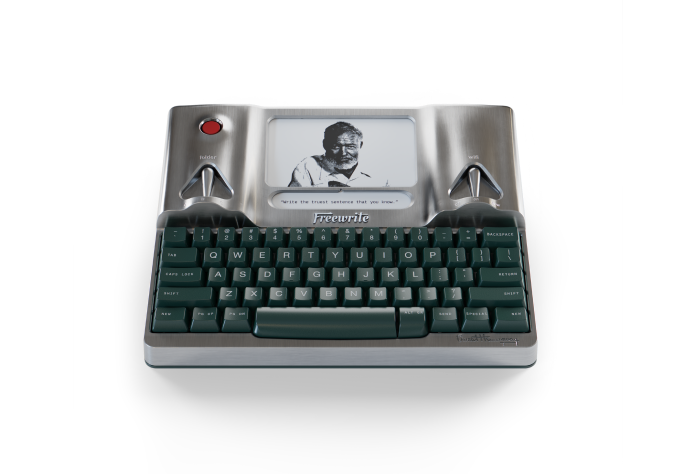
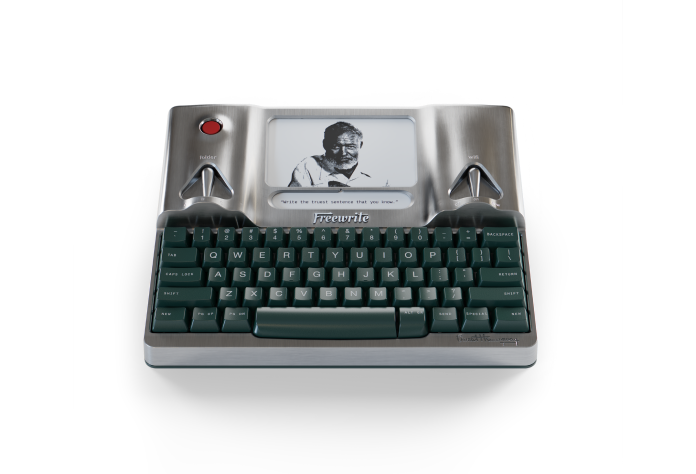
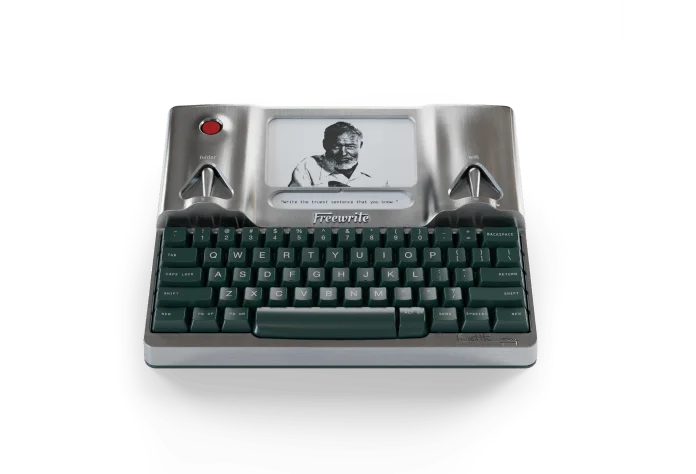
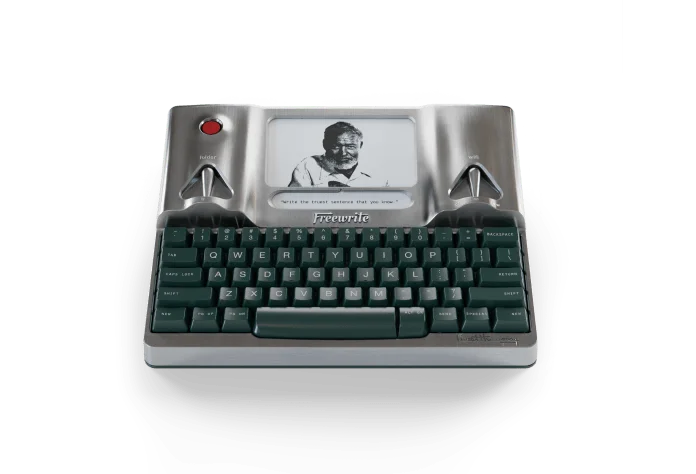
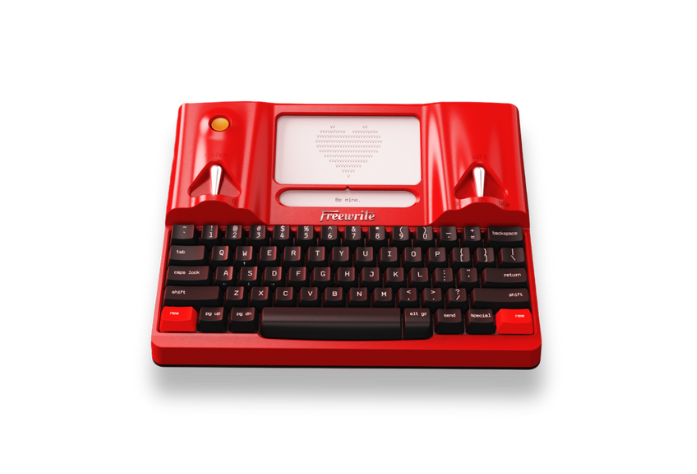
The goal of every writer is to find their flow state AND stay there. The Freewrite is a manifestation of Hemingway’s idea. Ernest Hemingway suggests you sit down at your writing device and, figuratively, bleed. Let the thoughts flow, regardless of how difficult that may be. Leave the editing for later.
10. “You can’t wait for inspiration, you have to go after it with a club.” -Jack London
Jack London went on to say, “and if you don’t get it, you will nonetheless get something that looks remarkably like it.” Jack London, an avid adventurer, found inspiration in all of his travels. He inspired generations of people to leave the comfort of home and explore the world. Don’t just sit back and wait for an idea to hit you. Go after it, and don’t forget your club!
11. “Forget the books you want to write. Think only of the book you are writing.” -Henry Miller
How many unfinished novels do you have sitting on your hard-drive, aging like fine wines?
We all do this.
Dream up a brilliant idea, get a few thousand words into it, only to be whisked away by the next distraction.
We all like to think that we’re capable multitaskers. However, multiple studies have shown that handling various tasks at once is not only damaging to the brain but also your career. Put your full creative energy into one project at a time.
12. “If you don’t have time to read, you don’t have the time — or the tools — to write. Simple as that.”Stephen King
Stephen King has published a whopping 56 books as of today (5/7/18). The award-winning author still finds the time to read 70 books a year. He takes advantage of every idle moment in lobbies, waiting rooms, and checkout lines.
What’s Stephen’s trick? Teach yourself to read in small sips as well as in long swallows.
Source:Stephen King: The Craft Of Writing Horror Stories

13. “Don’t tell me the moon is shining; show me the glint of light on broken glass.” -Anton Chekhov
I want you to close your eyes. Now imagine two scenes:
1. The moon is shining.
2. A glint of light from the moon shines on the broken glass.
Now, which one is more descriptive? Which scene is more enticing? I’d choose the latter, and I’m sure you would too. This quote is a classic case of “show, don’t tell.” Showing makes your writing far more interesting to read. Help move the reader along by adding some imagination and color to your passages.
14. "Never use a long word where a short one will do." - George Orwell
Eric Arthur Blair, better known by his pen name George Orwell, was an English writer famous for the novels1984andAnimal Farm. In the absence of skill, using long words makes you look pretentious. They also are awkward to read and interrupt the reader's flow.
15. "A short story must have a single mood and every sentence must build towards it." -Edgar Allen Poe
Edgar Allen Poe is most noted for his poem, "The Raven." In books, you have time to let the story develop and breathe. You can risk adding details that you deem necessary. When writing short stories, you must condense an entire story into a few pages. There isn’t any room for sentences that don't lead to the ending.
16. "Quantity produces quality. If you only write a few things, you're doomed." - Ray Bradbury
When I was 16 years old, I decided that I wanted to work in content creation and online marketing. I took it upon myself to watch every video and read every book pertaining to writing and copy-writing.
Eventually, I stumbled upon a video of Seth Godin offering advice to young college graduates. He left me with a lesson that I will NEVER forget. He said, “move fast and break things.”
That inspired me to start my first blog. It quickly grew to 5,000 monthly page views. My first blog posts were horrendous, but I quickly learned what worked and what didn’t. Bradbury offers similar advice. Spend every free minute writing, even if you don’t plan to share it with the world.
17. “Every sentence must do one of two things -- reveal character or advance the action." -Kurt Vonnegut
In his 50-year writing career, Vonnegut published 14 novels, three short story collections, five plays, and five works of non-fiction. Combine Vonnegut’s and Poe’s advice into a single statement, every sentence of a short story must do one of three things -- reveal character, advance the action, or build towards a single mood.
18. “The historian records, but the novelist creates.”E. M. Forster
Great novelists have the unique ability to invent their reality. E.M Foster, an English novelist, examined class difference and hypocrisy in early 20th century British society.A Room With A View, one of his most famous works, was turned into an award-winning movie in 1985.
19. “Read, read, read. Read everything - trash, classics, good and bad, and see how they do it. Just like a carpenter who works as an apprentice and studies the master. Read! You'll absorb it. Then write. If it's good, you'll find out. If it's not, throw it out of the window.” -William Faulkner
If I could offer you only one piece of advice for becoming a better writer, I would suggest this - read and write a lot. As you read and write more, you develop a better understanding of what is good and bad writing. William Faulkner, an American writer and Nobel Prize laureate had an insatiable drive to keep writing and was never completely satisfied with his work.

20. "You can fix anything but a blank page.” -Nora Roberts
Putting pen to paper is a recurring theme in this article. We’ve heard Hemingway, Faulkner, Bradbury, and now Roberts offer similar advice.
One of my favorite mentors, Jim Rohn, said, “Success leaves clues.” People who produce outstanding results do specific things to create those results. As writers, there are many ways to skin a cat, but the commonalities of successful writers remain.
21. “You have to get to a very quiet place inside yourself. And that doesn’t mean that you can’t have noise outside. I know some people who put jazz on, loudly, to write. I think each writer has her or his secret path to the muse.” -Maya Angelou
I know I’m not the only one to struggle with finding a quiet place inside myself. I’ve tried everything from locking myself into a dark room, to hiding my cell phone, and listening to my favorite music. My secret path to the muse is listening to Binaural Beats. As I write this article, I’m listening to the soothing sound ofDelta Waves for Deep Healing Sleep.
22. “When you’re stuck, and sure you’ve written absolute garbage, force yourself to finish and THEN decide to fix or scrap it - or you will never know if you can.” -Jodi Picoult
Jodi Picoult, an American writer, has sold over 14 million copies of her 24 novels. Until you push your own self perceived boundaries, you'll never know how far you can go.
23. “You have to actually write. Daydreaming about the book you’re going to write someday isn’t writing. It’s daydreaming. Open your word processor and start writing.” - Andy Weir
Les Brown, a world famous motivational speaker, has in my mind one of the most inspirational quotes of all-time.
“The graveyard is the richest place on earth, because it is here that you will find all the hopes and dreams that were never fulfilled, the books that were never written, the songs that were never sung, the inventions that were never shared, the cures that were never discovered, all because someone was too afraid to take that first step, keep with the problem, or determined to carry out their dream.” - Les Brown
If you want to be a writer, you have to write and write and write. It starts with one. One character, one word, then one page. They key is, you have to start.
24. “I went for years not finishing anything. Because, of course, when you finish something you can be judged.”-Erica Jong
Erica Jong is an American novelist and poet best known for her 1973 novel, Fear of Flying.She shared her battle with finishing her work. For many writers, their works are their most personal possessions. Take solace in the fact that there is somebody out there who needs your writing. Why take a chance that they may never get to read it?
25. “Ignore all proffered rules and create your own, suitable for what you want to say.” -Michael Moorcock
Source:Michael Moorcock’s rules for writers
A few years back, The Guardian asked some of the most esteemed contemporary authors for any golden rules and writing tips they bring to their practice. Michael Moorcock isn’t the first writer to operate under the idea of “writing what you want”. First, make yourself the audience by telling a story you would want to read. This is a fitting quote to leave for the end. Perhaps Mr.Moorcock has written the final rule on succeeding as a writer.
Did you find these writing tips useful? Now it’s your turn to take this inspiration and make it your own.
 Carlton Clark loves to write about business, baseball, and popular culture. A writer, marketer, and entrepreneur. At the age of 14, he founded the media company ballplayerplus.com. Currently, Carlton helps businesses share their stories through social media and blogging. When he’s not writing or creating content, Carlton coaches youth baseball at his local high school and plays guitar. You can find him online on Instagram @itscarltonclark, and on Twitter @carlton_mukasa