overlaylink

Mise à jour du micrologiciel Freewrite 1.6 : 16 nouvelles langues et 48 variantes de disposition de clavier ajoutées

février 22, 2023 | 2 lire la lecture

Bienvenue dans Freewrite Firmware 1.6, publié aujourd'hui, le 23 février 2023.

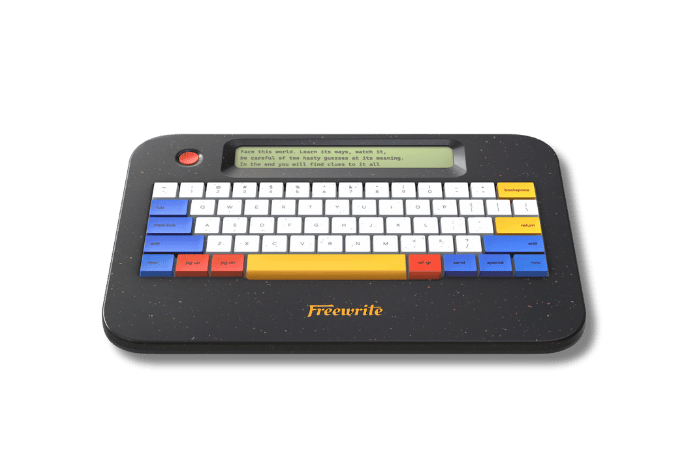
Ce firmware apporte une mise à jour majeure des langues et configurations de clavier prises en charge. Outre les 40 variantes prises en charge, nous avons ajouté 16 nouvelles langues et 48 nouvelles configurations de clavier, portant le total à 88 variantes de configuration et plus de 60 langues uniques.

Les variantes de disposition du clavier en écriture libre incluent désormais : (* = ajouté dans la version 1.6)

  1. Albanais*
  2. arabe
  3. Arménien*
  4. Azerbaïdjanais*
  5. Bambara*
  6. Biélorusse*
  7. Bosniaque*
  8. bulgare
  9. Phonétique bulgare*
  10. Canadien multilingue*
  11. chinois (simplifié)
  12. Chinois (traditionnel)
  13. Croate*
  14. tchèque
  15. danois
  16. Danois (Dvorak)*
  17. Néerlandais
  18. Anglais
  19. Anglais (Colemak)
  20. Anglais (Dvorak)
  21. Anglais (International AltGr)*
  22. Anglais international
  23. Espéranto*
  24. Estonien*
  25. Eurokey*
  26. Féroïen*
  27. Finlandais*
  28. Français
  29. Français (belge)
  30. Français (Bepo)
  31. Français (Canada)
  32. Français (Dvorak)*
  33. Français (Suisse)
  34. Géorgien*
  35. Allemand
  36. Allemand (Dvorak)*
  37. Allemand (suisse)*
  38. Néo allemand
  39. grec (moderne)
  40. Haoussa*
  41. hébreu
  42. hongrois
  43. Islandais*
  44. Irlandais*
  45. italien
  46. japonais
  47. Kazakh*
  48. coréen
  49. Kurde*
  50. Kirghize
  51. Lao*
  52. Letton (AltGr)
  53. Letton (apostrophe)
  54. Lingala*
  55. Lituanien*
  56. Macédonien*
  57. Malais*
  58. Maltais*
  59. Mongol*
  60. norvégien
  61. Norvégien (Dvorak)*
  62. Pachtoune, Pachtoune*
  63. Persan (farsi)*
  64. polonais
  65. Polonais (Programmeurs Dvorak)*
  66. Polonais (programmeurs)*
  67. Polonais (QWERTZ)*
  68. portugais
  69. Portugais (Brésil)*
  70. Portugais (Natif)*
  71. Roumain*
  72. russe
  73. Serbe (cyrillique)*
  74. Serbe (latin)*
  75. Slovaque*
  76. slovène
  77. Espagnol
  78. Espagnol (Dvorak)*
  79. Swahili*
  80. suédois
  81. Suédois (Dvorak)
  82. Tadjik*
  83. turc
  84. Turkmène*
  85. Ukrainien*
  86. ouzbek*
  87. vietnamien
  88. Wolof*

Astuce : Pour visualiser la disposition du clavier actif sur votre appareil, maintenez la barre d'espace enfoncée. C'est ce qu'on appelle l'affichage tête haute !

Pour plus d'aide, visitez notre rubrique d'assistance sur la façon de changer la langue sur votre appareil Freewrite .

Il existe également de nombreuses corrections de bugs sous le capot, notamment :

  • Performances améliorées pour les documents volumineux
  • Le voyant d'état fixe ne s'éteint pas en mode veille

Pour une liste complète des nouvelles fonctionnalités, améliorations et correctifs de la version 1.6.0, visitez la page Notes de version .

Pour vérifier manuellement une mise à jour du micrologiciel :

  • Option 1 : Appuyez sur droite [nouveau] + droite [maj] + F
  • Option 2 : maintenez le bouton d'alimentation enfoncé pendant 3 secondes (version 1.5.0 ou ultérieure) et sélectionnez « Mise à jour du micrologiciel » dans le menu de l'appareil

Si une mise à jour est disponible, votre appareil la téléchargera immédiatement. Pour effectuer la vérification manuelle, votre appareil doit utiliser la version 1.1.6 ou supérieure du firmware.

Pour des instructions plus détaillées, visitez nos rubriques d'assistance :

avril 15, 2026 4 lire la lecture

Break up with Final Draft for good. Get the best screenplay workflow in Hollywood: Freewrite + Highland Pro.

avril 01, 2026 0 lire la lecture
mars 22, 2026 3 lire la lecture

If you're new here, freewriting is “an unfiltered and non-stop writing practice.” It’s sometimes known as stream-of-consciousness writing.

To do it, you simply need to write continuously, without pausing to rephrase, self-edit, or spellcheck. Freewriting is letting your words flow in their raw, natural state.

When writing the first draft of a novel, freewriting is the approach we, and many authors, recommend because it frees you from many of the stumbling blocks writers face.

This method helps you get to a state of feeling focused and uninhibited, so you can power through to the finish line.

How Freewriting Gives You Mental Clarity

Freewriting is like thinking with your hands. Some writers have described it as "telling yourself the story for the first time."

Writing for Inside Higher Ed, Steven Mintz says, “Writing is not simply a matter of expressing pre-existing thoughts clearly. It’s the process through which ideas are produced and refined.” And that’s the magic of putting pen to paper, or fingertips to keyboard. The way you learned to ride a bike by wobbling until suddenly you were pedaling? The way you learned certain skills by doing as well as revising? It works for writing, too.

The act of writing turns on your creative brain and kicks it into high gear. You’re finally able to articulate that complex idea the way you want to express it when you write, not when you stare at a blank page and inwardly think until the mythical perfect sentence comes to mind.

Writing isn’t just the way we express ideas, but it’s how we extract them in the first place. Writing is thinking.

Or, as Flannery O'Connor put it:

“I write because I don't know what I think until I read what I say.”

Writing isn’t just the way we express ideas, but it’s how we extract them in the first place. Writing is thinking.


Freewriting to Freethinking

But how and why does it work? Freewriting makes fresh ideas tumble onto the page because this type of writing helps you get into a meditative flow state, where the distractions of the world around you slip away.

Julie Cameron, acclaimed author of The Artist’s Way, proposed the idea that flow-state creativity comes from a divine source. And sure, it certainly feels like wizardry when the words come pouring out and scenes seem to arrange themselves on the page fully formed. But that magic, in-the-zone writing feeling doesn’t have to happen only once in a blue moon. It’s time to bust that myth.

By practicing regular freewriting and getting your mind (and hands) used to writing unfiltered, uncensored, and uninterrupted, you start freethinking and letting the words flow. And the science backs it up.

According to Psychology Today, the dorsolateral prefrontal cortex goes quiet during flow state. This part of the brain is in charge of “self-monitoring and impulse control” – in other words, the DLPFC is the tiny home of your loud inner critic. And while that mean little voice in your head takes a long-overdue nap, you’re free to write without doubt or negative self-talk.

“With this area [of the brain] deactivated, we’re far less critical and far more courageous, both augmenting our ability to imagine new possibilities and share those possibilities with the world.”

Freewriting helps us connect with ourselves and our own thoughts, stories, beliefs, fears, and desires. But working your creative brain is like working a muscle. It needs regular flexing to stay strong.

So, if freewriting helps us think and organize our thoughts and ideas, what happens if we stop writing? If we only consume and hardly ever create, do we lose the ability to think for ourselves? Up next, read "Are We Living through a Creativity Crisis?"


Learn More About Freewriting

Get the ultimate guide to boosting creativity and productivity with freewriting absolutely free right here.You'll learn how to overcome perfectionism, enhance flow, and reignite the joy of writing.

SYSF-book-mockup.webp