overlaylink

4 conseils d'écriture tirés des lettres de Jane Austen

Annie Cosby
décembre 18, 2025 | 6 lire la lecture

C'est ce que j'écrirais peut-être si j'avais l'occasion de correspondre avec la mère de l'amour. (Ai-je poussé cette expérience de pensée trop loin ? Peut-être.)

Heureusement, on peut imaginer un peu ce qu'elle pourrait répondre à ma lettre (à part « Qui êtes-vous ? »). Car Jane Austen était une correspondante fidèle.

En plus de ses romans, elle a laissé derrière elle d’innombrables lettres personnelles regorgeant d’informations sur sa vie et son processus d’écriture.

Imaginez demander à Jane Austen de lire votre œuvre ? Je préférerais être obligée de danser toute la nuit avec M. Collins.

Bien sûr, ce sont des lettres personnelles, ce qui signifie que Jane n'a jamais eu l'intention d'enseigner l'écriture aux autres. Sauf peut-être sa nièce, Anna, qui a demandé au génie littéraire de lire son manuscrit . Imaginez demander à la Jane Austen de lire votre œuvre ? Je préférerais être obligée de danser toute la nuit avec M. Collins.

Mais nous, ses fidèles lecteurs, avons la chance que quelqu’un d’autre ait eu le courage de poser la question et que les réponses aient persisté à travers les siècles.

Voici XXXX conseils d’écriture que nous pouvons glaner dans les lettres d’un maître conteur :

1. Soyez concis.

Dans une lettre à Anna du 28 septembre 1814, Jane mettait en garde contre les descriptions excessives :

« Vous décrivez un endroit charmant, mais vos descriptions sont souvent trop détaillées pour être appréciées. Vous donnez trop de détails sur la main droite et la main gauche. »

C'est aussi l'un de mes faux pas d'écrivain. Décrire ce que font la main gauche et la main droite, alors que le lecteur peut vraiment imaginer ce passage par lui-même, merci beaucoup.

Ce conseil reflète parfaitement la prose épurée de Jane. Elle était convaincue qu'il était important de fournir suffisamment de détails pour créer un cadre et une atmosphère – qui parmi nous n'a pas été transporté par des visions de Pemberley ? – sans pour autant surcharger le rythme du récit ni perturber l'intérêt du lecteur.

Ses propres romans démontrent cet équilibre, offrant des descriptions vivantes mais concises qui soutiennent l’histoire tout en laissant les personnages et l’intrigue vraiment briller.

2. La révision est un mal nécessaire.

Austen était une réviseuse méticuleuse. Dans sa correspondance avec son éditeur, elle mentionne avoir apporté « de nombreuses corrections » à ses manuscrits avant leur soumission.

À sa sœur Cassandra, elle écrit à propos de la satisfaction d'améliorer son travail grâce à une édition soignée : « J'ai cependant réussi à élaguer et à recadrer avec tant de succès que j'imagine qu'il doit être plutôt plus court que « Sense & Sensibility » dans son ensemble. »

Cet engagement envers la révision a joué un rôle crucial dans le développement de son style de prose précis et économique.

Austen a compris qu'une bonne écriture n'est que rarement pleinement formée ; elle est plutôt élaborée grâce à un raffinement persistant et à la volonté de supprimer les éléments inutiles, même ceux auxquels l'écrivain peut être personnellement attaché.

« J'ai réussi à couper et à recadrer avec tant de succès que j'imagine que ce doit être plus court que « Sense & Sensibility » dans son ensemble. »

3. Soyez ouvert à la critique.

Non seulement Jane a offert des commentaires et des critiques ouverts à sa nièce, mais elle a également apprécié les critiques constructives et a maintenu un détachement sain de son travail.

Dans une lettre à Cassandre de janvier 1813, après avoir reçu des commentaires sur Orgueil et Préjugés , elle écrit :

« Je veux vous dire que j'ai ma propre enfant chérie de Londres... Je dois avouer que je la trouve aussi charmante que possible, et comment je pourrai supporter ceux qui ne l'aiment pas, du moins, je l'ignore. » XXXXXXX

Malgré sa fierté évidente pour son travail, cette reconnaissance ludique montre qu'Austen est consciente que tous les lecteurs n'apprécieraient pas son écriture.

Dans d'autres lettres, elle évoque des critiques précises qu'elle a reçues et se montre disposée à les prendre en compte, même lorsqu'elle a finalement maintenu ses choix. Cette ouverture d'esprit, tout en conservant confiance en sa vision, a été essentielle à son développement en tant qu'écrivaine.

Sa lettre du 29 janvier 1813 à Cassandra à propos d'Orgueil et Préjugés, la jugeant « trop légère, trop brillante et trop pétillante », témoignant de sa conscience des faiblesses potentielles de son propre travail. Sa lettre du 5 mars 1814 documentant les commentaires de sa famille sur Mansfield Park, où elle reconnaissait que beaucoup ne le trouvaient pas à la hauteur d'Orgueil et Préjugés. Sa lettre de décembre 1815 à son neveu à propos d'Emma, ​​où elle faisait preuve d'une remarquable conscience de soi en reconnaissant qu'elle créait une héroïne « que personne d'autre que moi n'aimerait beaucoup ».

Sa lettre du 1er avril 1816 en réponse aux critiques du bibliothécaire du prince régent, où elle refusait poliment mais fermement d'écrire « un roman historique » malgré la suggestion d'une personnalité influente.

Sa pratique de recueillir une « liste d’opinions » sur ses romans auprès d’amis et de connaissances démontre son intérêt actif pour les réponses des lecteurs.

4. Trouvez votre propre voix unique.

Lorsqu'elle conseillait sa nièce sur l'écriture, Austen la mettait en garde contre l'imitation :

« Vous rassemblez maintenant vos gens avec délice, les plaçant exactement dans un endroit qui est le délice de ma vie ; 3 ou 4 familles dans un village de campagne est exactement ce sur quoi travailler et j'espère que vous écrirez beaucoup plus, et que vous en ferez pleinement usage pendant qu'ils sont si favorablement disposés. »

Austen reconnaissait l'importance de développer une voix authentique plutôt que de copier les styles à la mode. Ses lettres révèlent une écrivaine sûre de son approche unique, même lorsqu'elle s'écartait des tendances littéraires de son époque.

Cette confiance lui a permis de créer son style narratif distinctif, combinant une observation sociale pointue, un discours indirect libre et une ironie subtile.

5. Rendez vos personnages réels.

Austen accordait une grande importance au développement des personnages. Dans une lettre à Anna datée du 9 septembre 1814, elle critiquait les personnages qui semblaient trop parfaits :

« La ruine de Devereux Forester par sa vanité est excellente ; mais je souhaiterais que vous ne le laissiez pas sombrer dans un « vortex de Dissipation ». Je n'ai rien contre la Chose, mais je ne supporte pas l'expression ; c'est un argot tellement romanesque – et si ancien – que j'ose dire qu'Adam l'a rencontré dès le premier roman qu'il a ouvert. »

Ce conseil souligne l'attachement d'Austen à des personnages naturels et crédibles, évitant les clichés mélodramatiques. Elle préférait les personnages aux défauts et aux motivations authentiques aux personnages littéraires préétablis. Dans la même lettre, elle encourage Anna à rendre ses personnages « vivants » grâce à des traits spécifiques et individuels plutôt qu'à des descriptions génériques.

« Je ne suis pas du tout d’humeur à écrire ; je dois continuer à écrire jusqu’à ce que je le sois. »

6. Écrivez quoi qu'il arrive.

Malgré de nombreuses responsabilités et interruptions domestiques, Austen conservait une pratique d'écriture disciplinée. Dans ses lettres, elle mentionne écrire sur un petit bureau en acajou du salon familial, souvent au milieu des activités domestiques.

À sa sœur, elle a décrit son emploi du temps d’écriture et le défi de trouver du temps sans interruption :

« Je ne suis pas du tout d’humeur à écrire ; je dois continuer à écrire jusqu’à ce que je le sois. »

La persévérance d'Austen face aux difficultés — y compris une vie privée limitée, des problèmes de santé et des rejets de publication initiaux — démontre peut-être son conseil le plus précieux de tous : les vrais écrivains écrivent, quelles que soient les circonstances ou l'humeur.

Son engagement dans une pratique régulière lui a permis d’achever six romans qui continuent de captiver les lecteurs plus de deux siècles plus tard.

--

En suivant l'exemple de Jane — en observant attentivement, en révisant méticuleusement, en trouvant sa voix authentique et en écrivant avec persévérance — les écrivains peuvent développer leur propre art d'une manière qui aurait pu leur valoir même l'approbation perspicace d'Austen.
décembre 10, 2025 6 lire la lecture

Singer-songwriter Abner James finds his creativity in the quiet freedom of analog tools. Learn how his creative process transcends different media.

Abner James went to school for film directing. But the success of the band he and his brother formed together, Eighty Ninety, knocked him onto a different trajectory.

The band has accrued more than 40 million streams since the release of their debut EP “Elizabeth," and their work was even co-signed by Taylor Swift when the singer added Eighty Ninety to her playlist "Songs Taylor Loves.”

Now, Abner is returning to long-form writing in addition to songwriting, and with a change in media comes an examination of the creative process. We sat down to chat about what's the same — and what's different. 

ANNIE COSBY: Tell us about your songwriting process.

ABNER JAMES: The way I tend to write my songs is hunched over a guitar and just seeing what comes. Sounds become words become shapes. It's a very physical process that is really about turning my brain off.

And one of the things that occurred to me when I was traveling, actually, was that I would love to be able to do that but from a writing perspective. What would happen if I sat down and approached writing in the same way that I approached music? In a more intuitive and free-form kind of way? What would that dig up?

AC: That's basically the ethos of Freewrite.

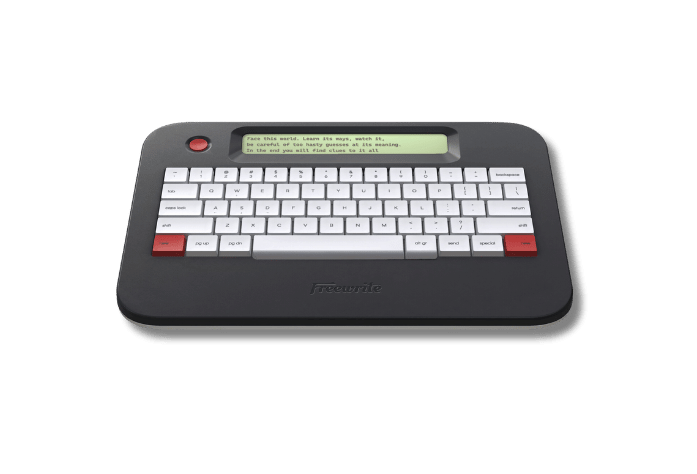
AJ: Yes. We had just put out a record, and I was thinking about how to get into writing for the next one. It occurred to me that regardless of how I started, I always finished on a screen. And I wondered: what's the acoustic guitar version of writing?

Where there's not blue light hitting me in the face. Even if I'm using my Notes app, it's the same thing. It really gets me into a different mindset.

 "I wondered: what's the acoustic guitar version of writing?"

I grew up playing piano. That was my first instrument. And I found an old typewriter at a thrift store, and I love it. It actually reminded me a lot of playing piano, the kind of physical, the feeling of it. And it was really fun, but pretty impractical, especially because I travel a fair amount.

And so I wondered, is there such a thing as a digital typewriter? And I googled it, and I found Freewrite.

AC: What about Freewrite helps you write?

AJ:I think, pragmatically, just the E Ink screen is a huge deal, because it doesn't exhaust me in the same way. And the idea of having a tool specifically set aside for the process is appealing in an aesthetic way but also a mental-emotional way. When it comes out, it's kind of like ... It's like having an office you work out of. It's just for that.

"The way I tend to write my songs is hunched over a guitar and just seeing what comes. Sounds become words become shapes. It's a very physical process that is really about turning my brain off."

And all of the pragmatic limitations — like you're not getting texts on it, and you're not doing all that stuff on the internet — that's really helpful, too. But just having the mindset....

When I pick up a guitar, or I sit down at the piano, it very much puts me into that space. Having a tool just for words does the same thing. I find that to be really cool and inspiring.

"When I pick up a guitar, or I sit down at the piano, it very much puts me into that space. Having a tool just for words does the same thing."

AC: So mentally it gets you ready for writing.

AJ: Yeah, and also, when you write a Microsoft Word, it looks so finished that it's hard to keep going. If every time I strummed a chord, I was hearing it back, mixed and mastered and produced...?

It's hard to stay in that space when I'm seeing it fully written out and formatted in, like, Times New Roman, looking all seriously back at me.

AC: I get that. I have terrible instincts to edit stuff over and over again and never finish a story.

AJ:  Also, the way you just open it and it's ready to go. So you don't have the stages of the computer turning on, that kind of puts this pressure, this tension on.

It's working at the edges in all these different ways that on their own could feel a little bit like it's not really necessary. All these amorphous things where you could look at it and be like, well, I don't really need any of those. But they add up to a critical mass that actually is significant.

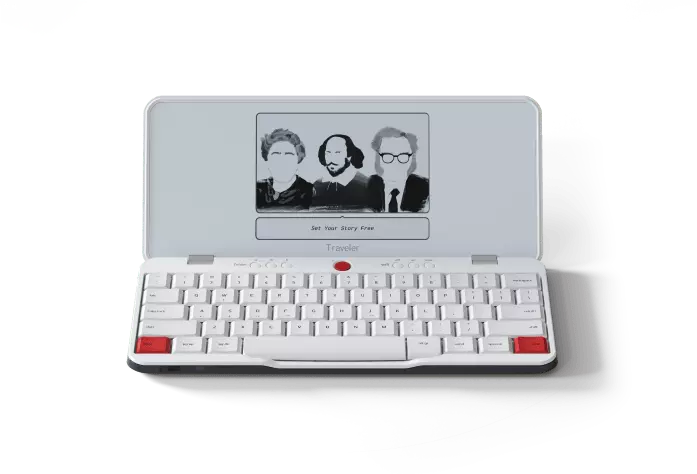
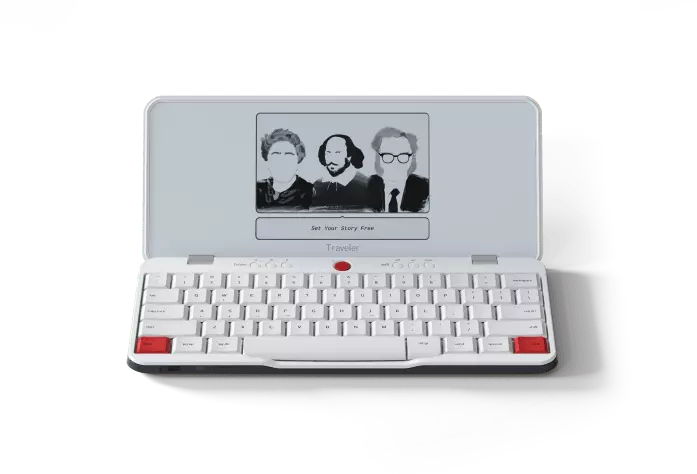
And sometimes, if I want to bring it on a plane, I've found it's replaced reading for me. Rather than pick up a book or bring a book on the plane, I bring Traveler and just kind of hang out in that space and see if anything comes up.

I've found that it's kind of like writing songs on a different instrument, you get different styles of music that you wouldn't have otherwise. I've found that writing from words towards music, I get different kinds of songs than I have in the past, which has been interesting.

In that way, like sitting at a piano, you just write differently than you do on a guitar, or even a bass, because of the things those instruments tend to encourage or that they can do.

It feels almost like a little synthesizer, a different kind of instrument that has unlocked a different kind of approach for me.

"I've found that it's kind of like writing songs on a different instrument, you get different styles of music that you wouldn't have otherwise... [Traveler] feels almost like a little synthesizer, a different kind of instrument that has unlocked a different kind of approach for me."

AC: As someone who doesn't know the first thing about writing music, that's fascinating. It's all magic to me.

AJ: Yeah.

AC: What else are you interested in writing?

AJ: I went to school for film directing. That was kind of what I thought I was going to do. And then my brother and I started the band and that kind of happened first and knocked me onto a different track for a little while after college.

Growing up, though, writing was my way into everything. In directing, I wanted to be in control of the thing that I wrote. And in music, it was the same — the songwriting really feels like it came from that same place. And then the idea of writing longer form, like fiction, almost feels just like the next step from song to EP to album to novel.

For whatever reason, that started feeling like a challenge that would be deeply related to the kinds of work that we do in the studio.

AC: Do you have any advice for aspiring songwriters?

AJ: This sounds like a cliche, but it's totally true: whatever success that I've had as a songwriter — judge that for yourself — but whatever success I have had, has been directly proportional to just writing the song that I wanted to hear.

What I mean by that is, even if you're being coldly, cynically, late-stage capitalist about it, it's by far the most success I've had. The good news is that you don't have to choose. And in fact, when you start making those little compromises, or even begin to inch in that direction, it just doesn't work. So you can forget about it.

Just make music you want to hear. And that will be the music that resonates with most people.

I think there's a temptation to have an imaginary focus group in your head of like 500 people. But the problem is all those people are fake. They're not real. None of those people are actually real people. You're a focus group of one, you're one real person. There are more real people in that focus group than in the imaginary one.

And I just don't think that we're that different, in the end. So that would be my advice.

AC: That seems like generally great creative advice. Because fiction writers talk about that too, right? Do you write to market or do you write the book you want to read. Same thing. And that imaginary focus group has been debilitating for me. I have to silence that focus group before I can write.

AJ: Absolutely.

"I think there's a temptation to have an imaginary focus group in your head of like 500 people. But the problem is all those people are fake... You're a focus group of one, you're one real person. There are more real people in that focus group than in the imaginary one."

--

Learn more about Abner James, his brother, and their band, Eighty Ninety, on Instagram.

novembre 29, 2025 4 lire la lecture

The Great Freewrite Séance: A Ghost'ly Charity Auction Full Terms & Conditions

These Terms and Conditions (“Terms”) govern participation in The Great Freewrite Séance: A Ghost'ly Charity Auction (“Auction”), organized by Freewrite (“Organizer,” “we,” “us,” or “our”). By registering for, bidding in, or otherwise participating in the Auction, you (“Participant,” “Bidder,” or “Winner”) agree to be bound by these Terms.

1. Auction Overview

1.1. The Auction offers for sale a limited number of Freewrite Traveler Ghost Edition units (“Items” or “Ghost Traveler units”), each personally signed and drawn on by a featured author.

1.2. All proceeds, net of explicitly disclosed administrative costs, will be donated to the charity or charitable initiative (“Charity”) identified on each auction item’s page, as chosen by the respective author.

2. Eligibility

2.1. Participants must be at least 18 years old or the age of majority in their jurisdiction, whichever is higher.

2.2. Employees of Freewrite, the participating authors, or any affiliates directly involved in the Auction are not eligible to bid.

2.3. By participating, you represent that you are legally permitted to take part in online auctions and to pay for any bids you win.

3. Auction Registration

3.1. Participants must create an account on the auction platform or otherwise register using accurate, current, and complete information.

3.2. Freewrite reserves the right to verify identity and to disqualify any Participant who provides false or misleading information.

4. Bidding Rules

4.1. All bids are binding, final, and non-retractable.

4.2. Bidders are responsible for monitoring their bids; Freewrite is not liable for missed notifications or technical issues on the auction platform or the Participant’s device.

4.3. Freewrite reserves the right to:

  • set minimum bids or bid increments;
  • reject bids deemed in bad faith or intended to disrupt the Auction;
  • extend, pause, or cancel the Auction in case of technical difficulties, fraud, or events beyond reasonable control.

5. Winning Bids and Payment

5.1. The highest valid bid at the close of the Auction is the Winning Bid, and the corresponding Participant becomes the Winner.

5.2. Winners will receive payment instructions and must complete payment within 48 hours of the auction’s close unless otherwise stated.

5.3. Failure to complete payment on time may result in forfeiture, and Freewrite may offer the Item to the next highest bidder.

5.4. Accepted payment methods will be listed on the Auction platform. All payments must be made in the currency specified.

6. Item Description and Condition

6.1. Each Ghost Traveler unit is authentic, and the signatures, doodles, and messages are original works created by the participating author. These are authors, not artists. By bidding on the Item, you acknowledge that you are receiving a one-of-a-kind unit marked with unique art and messages and you agree to these terms and conditions.

6.2. Because Items are customized and signed by hand, variations, imperfections, or unique marks are to be expected. These are considered part of the Item’s character and not defects.

6.3. Items are provided “as-is” and “as-available.” Freewrite makes no warranties of merchantability or fitness for a particular purpose.

7. Shipping & Delivery

7.1. Shipping costs, import duties, and taxes may apply unless explicitly stated otherwise.

7.2. Freewrite will make reasonable efforts to ship Items within the estimated timeline but cannot guarantee delivery dates.

7.3. Title and risk of loss transfer to the Winner upon delivery to the carrier.

7.4. Freewrite is not responsible for delays, damage, or loss caused by the courier or customs agencies.

8. Charity Donation

8.1. Net proceeds from the Auction will be donated to the Charity designated on each Item page.

8.2. Donation amounts and recipients may be disclosed publicly unless prohibited by law.

8.3. Winners acknowledge that they are purchasing Items, not making a tax-deductible donation to Freewrite; therefore, Winners will not receive charitable tax receipts unless Freewrite explicitly states otherwise in compliance with applicable laws.

9. Intellectual Property

9.1. All trademarks, brand names, product names, and creative materials associated with Freewrite and the Ghost Traveler remain the exclusive property of Freewrite or their respective rights holders.

9.2. Participants may not reproduce, distribute, or publicly display the authors’ doodles without permission where such rights are applicable, except as allowed by law (e.g., resale of the physical Item).

10. Privacy

10.1. By participating, you consent to Freewrite’s collection, use, and storage of your personal data in accordance with our Privacy Policy.

10.2. Freewrite may publicly announce auction results, including Winner’s first name, last initial, city, state/country, and winning bid amount unless prohibited by law or unless you formally request anonymity when possible.

11. Prohibited Conduct

Participants may not:

  • engage in bid manipulation, fraud, or collusive bidding;
  • use automated systems (bots, scripts, scrapers) to place or monitor bids;
  • interfere with the Auction, platform, or other participants

Freewrite may ban or disqualify any Participant violating these rules.

12. Limitation of Liability

To the fullest extent permitted by law:

12.1. Freewrite is not liable for indirect, incidental, special, or consequential damages arising from the Auction or purchase of Items.

12.2. Freewrite’s total liability in connection with these Terms shall not exceed the amount of the Winning Bid actually paid by the Participant.

12.3. Freewrite is not responsible for technical malfunctions, internet outages, system failures, or other issues beyond its control.

13. Cancellation and Force Majeure

Freewrite may cancel, postpone, or modify the Auction due to unforeseen circumstances, including but not limited to natural disasters, system failures, strikes, or events affecting participating authors or the Charity.

14. Governing Law & Dispute Resolution

14.1. These Terms are governed by the laws of Michigan, without regard to conflict-of-law rules.

14.2. Any disputes arising under these Terms will be resolved through binding arbitration or the courts of the specified jurisdiction, as applicable.

14.3. Participants waive any right to participate in class-action lawsuits relating to the Auction.

15. Amendments

Freewrite may update these Terms at any time. Continued participation in the Auction after updates constitutes acceptance of the revised Terms.

16. Contact Information

For questions or concerns regarding the Auction or these Terms, contact: hello@getfreewrite.com.

novembre 25, 2025 1 lire la lecture

This is a great gratitude writing exercise to be done alone or in a group, with people of any age.

How to Play

    1. Designate someone to read out each prompt below. (Feel free to add your own prompts.)
    2. After each prompt is read, set a timer for one minute. (With younger kids, this can be shortened. For older folks who want to freewrite meaningfully, more time can be added.)
    3. Each person freewrites by finishing the sentence and elaborating until the timer goes off. (For little kids, this can be done verbally with an adult recording their answers. Hilarity will ensue.)
    4. Remeber that freewriting — allowing yourself to write with abandon — enables you to let go, tapping into your subconscious to explore your thoughts more deeply.
    5. When everyone is done with all the prompts, take turns going through some your answers. Some people may be eager to share. Others may not want to. Respect their decision.

The Prompts

  • I'm grateful for... [After you've finished this prompt, repeat it five times. Challenge yourself and others not to repeat a singe word with each new answer.]
  • The silliest thing I'm grateful for is...
  • The littlest thing I'm grateful for is...
  • The biggest thing I'm grateful for is...
  • The grossest thing I'm grateful for is...
  • One thing I love about myself is...
  • My favorite thing that happened this year was...
  • My hope for next year is...

This writing exercise has resulted in some sweet answers — and many hilarious ones, too. If you try it out, do let us know.

Write on.