overlaylink

Historia vs. Trama: Diferencias definitivas entre ellas

octubre 03, 2017 | 6 lectura mínima


La publicación invitada de hoy es de Jackie Dever, editora asociada en Aionios Books , una pequeña editorial de modelo tradicional con sede en el sur de California.


Una tarde, hace unos años, mientras remaba alegremente por mi flujo de conciencia, una enorme roca apareció entre la niebla, levantándose tan rápido que no tuve tiempo de navegar. Mi barquito de papel se estrelló y se arrugó, dejando el SS Plot hecho un desastre desintegrado y roto en el río Great Story.

En esta prueba personal de historia versus trama, esta última salió hecha un desastre.

Incluso mientras los eventos que condujeron a la conclusión de la historia continuaban fluyendo más allá de esa maldita roca, mi inestable nave simplemente no podía rodear el monolito.

Afrontar la naturaleza de la imaginación puede ser intimidante. Pero la mitad de la batalla consiste en comprender los elementos. ¿Acaso la historia y la trama no son sinónimos? ¿Acaso no podemos contar con que ambos elementos se fusionen automáticamente, felizmente unidos en un emocionante torrente de prosa? Pues... no.

¿Cuál es la diferencia entre historia y trama?

Una historia es la cronología obligatoria de los acontecimientos presentes en cualquier narrativa. ¿Si no hay historia, no hay novela? Porque toda novela, por abstracta que sea, debe relatar acontecimientos de algún tipo.

Una trama expresa una razón e informa al lector sobre por qué una lista específica de eventos debe estar junta y qué es lo que la línea de tiempo pretende comunicar en última instancia.

El ejemplo clásico de E. M. Forster en sus conferencias reunidas, Aspectos de la novela , todavía lo expresa mejor:

«El rey murió y luego murió la reina» es una historia. «El rey murió y luego murió la reina de pena» es una trama.

Al leer una historia, explica Forster, nos preguntamos "¿y luego?". Al evaluar una trama, nos preguntamos "¿por qué?".

Historia vs. Trama - Paweł Furman ( Paweł Furman )

Estas preguntas a veces surgen al mismo tiempo, por lo que comprender sus orígenes por separado es complicado. Pero por muy natural que parezca que los componentes se apoyan mutuamente, en realidad es la habilidad del autor la que los hace parecer así. Esto significa que, siempre que yo, tú o Stephen King nos sentamos a escribir , debemos gestionar ambos. Debemos mantener a los lectores absortos en un patrón de maravillosas preguntas sobre ¿qué sigue? y ¿por qué?, mientras queramos su atención.

Cómo la trama apoya la historia

Nadie quiere preguntarse sin parar "¿Y luego? ¿Y luego? ¿Y luego?". Somos curiosos; necesitamos saber por qué . Por desgracia, cuando la trama falta o es accidentalmente discordante con la historia, la verdadera pregunta del lector es "¿eh?".

La trama ofrece los trucos ingeniosos que nos reafirman que la narración tiene un propósito. Establece la causa y el efecto que da a los lectores una sensación de acierto en la conclusión de la historia.

La misma historia se puede contar de múltiples maneras:

El rey murió, y luego la reina murió vengándolo en la batalla.

El rey murió, y luego la reina murió a causa de la enfermedad contagiosa que él le había contagiado cuando pronunció sus últimas palabras cerca de su rostro.

El rey murió, y luego la reina, ansiosa por liberar al amante a quien el rey había encerrado celosamente en el calabozo, resbaló en un adoquín helado y murió.

Cómo el lugar donde empiezas ayuda a determinar dónde terminarás

En cada nuevo proyecto de ficción , me inspiro ampliamente desde un punto de vista narrativo o argumental. Ambos puntos de partida tienen sus ventajas y sus desafíos.

Empezando con la historia

Cuando una historia me inspira, formulo una serie de eventos que conducen a una conclusión fija. Puede que no conozca con precisión las motivaciones de mis personajes ni la lógica de sus decisiones, pero puedo imaginar las paradas que harán en su viaje. En otras palabras, sabré que la muerte de la reina sigue a la del rey. ¿La relación entre los eventos? Por determinar.

Puede ser un gran alivio tener la historia lista primero. Cuando me siento cómodo con los parámetros, puedo entrenarme para alcanzar una meta tangible. Y disfruto del ejercicio intelectual de conectar eventos en una secuencia creíble.

Aun así, siempre hay una trampa. Incluso con un desenlace claro, necesito pruebas sólidas (es decir, una trama eficaz) para justificar mis acontecimientos.

Hace unos años, decidí escribir una historia sobre un hombre que vende una cabaña en la playa por un centavo. Disfruté cada escena que creé, pero al final, solo tuve un cuento de hadas débilmente concebido. El brío imaginativo me encantó, pero por mucho que me las ingenié, no logré que la trama siguiera el curso de la historia. ¡Falló!

Empezando con la trama

Cuando una trama despierta mi creatividad, conozco los sentimientos e intenciones de los personajes. Abordo mi escritura como un universitario recto pero sin rumbo: indagador, motivado, seguro de mis valores y razones fundamentales, pero sin tener ni idea de dónde demonios voy a terminar. De hecho, me preocupa menos dónde termino que por qué termino allí, así que el itinerario está sujeto a cambios. No todos los que vagan están perdidos.

Disfruto avanzando narrativamente por una ruta tan orgánica. Trazar mi camino hacia una historia me permite guiarme por las respuestas emocionales, no por la lista de paradas de un turista. Me deslizo por las cascadas impulsado por la ira, la hilaridad o la alegría desenfrenada. Y cuando ese sentimiento apasionado se sincroniza con la historia, alabo a mis musas y confío en las corrientes.

Pero cuando me dejo guiar solo por las conexiones emocionales, empiezo a desear haber reservado o al menos haber estudiado el mapa antes de partir. Siempre suena noble lanzarse a la aventura, confiar en que el instinto me lleve adonde necesito estar. La realidad solo me golpea cuando estoy temblando bajo la lluvia y no tengo ni idea de dónde puedo atracar para pasar la noche. Aunque demasiada previsibilidad es agobiante, es frustrante perder por completo mi brújula mental.

No hay una manera incorrecta de empezar

Es difícil clasificar cualquier explosión creativa de la vida real con tanta precisión como lo he hecho anteriormente. Destellos de ambos elementos suelen mezclarse en ese momento revelador. Pero comprender los elementos de cada uno —y cómo afectan al proceso de escritura— es siempre lo que me prepara para la aventura que me espera . ¿Tendré que centrarme extensamente en los porqués y los cómos de mis personajes para guiar mi trama? ¿O haré mejor en asegurarme de que sus motivaciones se vean satisfechas por los eventos que les permito vivir?

Todos escribimos de forma diferente. A medida que nos comprometemos con nuestra práctica de escritura, surgen patrones en nuestro proceso y estilo. Soy una escritora centrada en la narrativa. Mi principal dificultad es mover la trama de un momento a otro, validar mi historia con un núcleo lógico.

Historia vs. Trama - Toa Heftiba ( Toa Heftiba )

Sin embargo, independientemente de nuestras tendencias personales, reconocer los elementos conectados pero distintivos nos recuerda que, si es necesario, podemos experimentar. Puedes intentar combinar varias historias con una trama intrigante antes de que todo encaje. O puedes decidir ser paciente con una gran historia cuya trama carece de la solidez necesaria para seguir adelante, y explorar las orillas del río en busca de un nuevo punto de partida, un rumbo más adecuado.

Está bien desmontar y reorganizar, trasplantar ideas radicalmente. Esa constante reconfiguración es la fuente de una literatura diversa y brillante, incluso cuando los mismos temas se repiten a lo largo de los siglos. El amor y la muerte, la sorpresa, la resignación, la magia. Nada de esto se volverá trivial cuando hay un mundo tan grande por experimentar y tantas maneras de comunicar las ideas atemporales.

Abordaré los muchos ríos entrecruzados de mi ficción desde mil ángulos, colocándome alas mecánicas para lograr una perspectiva aérea o recorriendo una carretera paralela en un Modelo T tosiendo. Dondequiera que (y como sea) vayamos, que todos aprendamos a apreciar la vista.

¡Nos encantaría escuchar tus opiniones sobre las diferencias en los comentarios!


Jackie Dever Jackie Dever es editora y escritora en el sur de California. Ha editado blogs, materiales corporativos, textos académicos, novelas y biografías. Es editora asociada en Aionios Books , una pequeña editorial tradicional con sede en el sur de California. Recientemente terminó de corregir las memorias " A Few Minor Adjustments" , ganadora del Premio del Libro de San Diego en 2017. (Septiembre de 2017) por Cherie Kephart. Escribe en su blog sobre escritura y publicación, tendencias de estilo de vida millennial y deportes al aire libre.
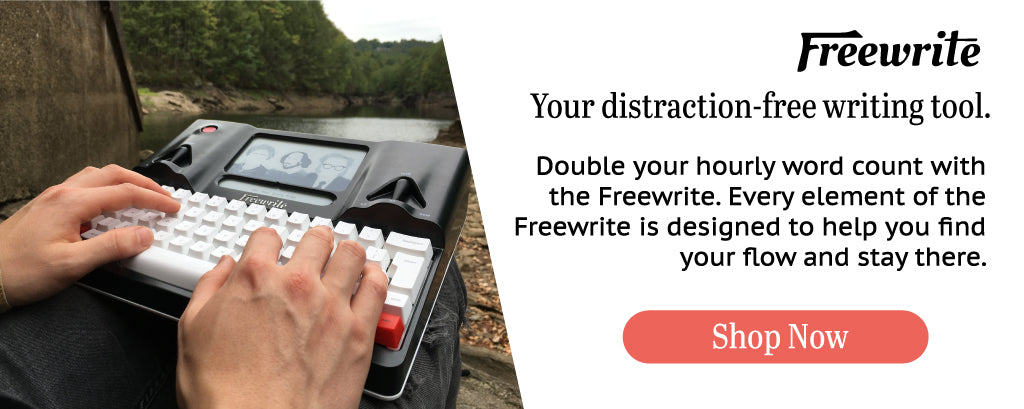
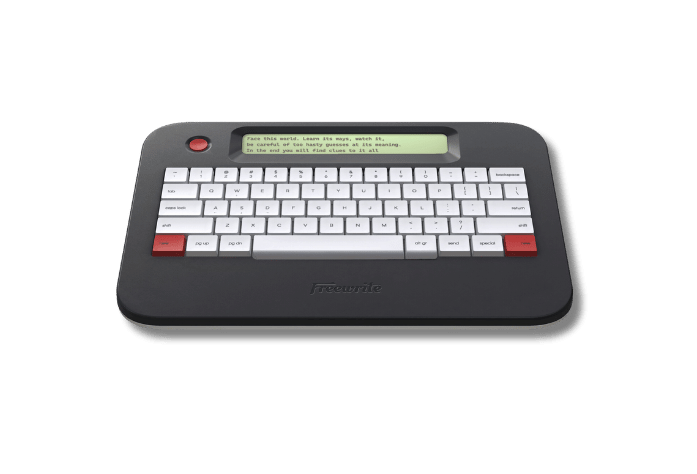
Freewrite: tu herramienta de escritura sin distracciones

diciembre 10, 2025 6 lectura mínima

Singer-songwriter Abner James finds his creativity in the quiet freedom of analog tools. Learn how his creative process transcends different media.

Abner James went to school for film directing. But the success of the band he and his brother formed together, Eighty Ninety, knocked him onto a different trajectory.

The band has accrued more than 40 million streams since the release of their debut EP “Elizabeth," and their work was even co-signed by Taylor Swift when the singer added Eighty Ninety to her playlist "Songs Taylor Loves.”

Now, Abner is returning to long-form writing in addition to songwriting, and with a change in media comes an examination of the creative process. We sat down to chat about what's the same — and what's different. 

ANNIE COSBY: Tell us about your songwriting process.

ABNER JAMES: The way I tend to write my songs is hunched over a guitar and just seeing what comes. Sounds become words become shapes. It's a very physical process that is really about turning my brain off.

And one of the things that occurred to me when I was traveling, actually, was that I would love to be able to do that but from a writing perspective. What would happen if I sat down and approached writing in the same way that I approached music? In a more intuitive and free-form kind of way? What would that dig up?

AC: That's basically the ethos of Freewrite.

AJ: Yes. We had just put out a record, and I was thinking about how to get into writing for the next one. It occurred to me that regardless of how I started, I always finished on a screen. And I wondered: what's the acoustic guitar version of writing?

Where there's not blue light hitting me in the face. Even if I'm using my Notes app, it's the same thing. It really gets me into a different mindset.

 "I wondered: what's the acoustic guitar version of writing?"

I grew up playing piano. That was my first instrument. And I found an old typewriter at a thrift store, and I love it. It actually reminded me a lot of playing piano, the kind of physical, the feeling of it. And it was really fun, but pretty impractical, especially because I travel a fair amount.

And so I wondered, is there such a thing as a digital typewriter? And I googled it, and I found Freewrite.

AC: What about Freewrite helps you write?

AJ:I think, pragmatically, just the E Ink screen is a huge deal, because it doesn't exhaust me in the same way. And the idea of having a tool specifically set aside for the process is appealing in an aesthetic way but also a mental-emotional way. When it comes out, it's kind of like ... It's like having an office you work out of. It's just for that.

"The way I tend to write my songs is hunched over a guitar and just seeing what comes. Sounds become words become shapes. It's a very physical process that is really about turning my brain off."

And all of the pragmatic limitations — like you're not getting texts on it, and you're not doing all that stuff on the internet — that's really helpful, too. But just having the mindset....

When I pick up a guitar, or I sit down at the piano, it very much puts me into that space. Having a tool just for words does the same thing. I find that to be really cool and inspiring.

"When I pick up a guitar, or I sit down at the piano, it very much puts me into that space. Having a tool just for words does the same thing."

AC: So mentally it gets you ready for writing.

AJ: Yeah, and also, when you write a Microsoft Word, it looks so finished that it's hard to keep going. If every time I strummed a chord, I was hearing it back, mixed and mastered and produced...?

It's hard to stay in that space when I'm seeing it fully written out and formatted in, like, Times New Roman, looking all seriously back at me.

AC: I get that. I have terrible instincts to edit stuff over and over again and never finish a story.

AJ:  Also, the way you just open it and it's ready to go. So you don't have the stages of the computer turning on, that kind of puts this pressure, this tension on.

It's working at the edges in all these different ways that on their own could feel a little bit like it's not really necessary. All these amorphous things where you could look at it and be like, well, I don't really need any of those. But they add up to a critical mass that actually is significant.

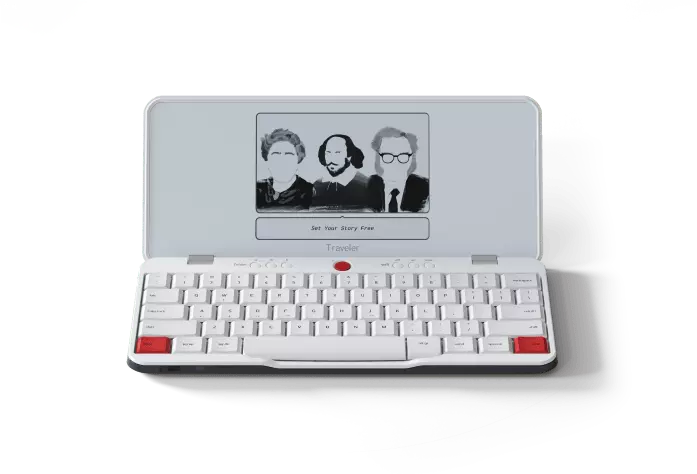
And sometimes, if I want to bring it on a plane, I've found it's replaced reading for me. Rather than pick up a book or bring a book on the plane, I bring Traveler and just kind of hang out in that space and see if anything comes up.

I've found that it's kind of like writing songs on a different instrument, you get different styles of music that you wouldn't have otherwise. I've found that writing from words towards music, I get different kinds of songs than I have in the past, which has been interesting.

In that way, like sitting at a piano, you just write differently than you do on a guitar, or even a bass, because of the things those instruments tend to encourage or that they can do.

It feels almost like a little synthesizer, a different kind of instrument that has unlocked a different kind of approach for me.

"I've found that it's kind of like writing songs on a different instrument, you get different styles of music that you wouldn't have otherwise... [Traveler] feels almost like a little synthesizer, a different kind of instrument that has unlocked a different kind of approach for me."

AC: As someone who doesn't know the first thing about writing music, that's fascinating. It's all magic to me.

AJ: Yeah.

AC: What else are you interested in writing?

AJ: I went to school for film directing. That was kind of what I thought I was going to do. And then my brother and I started the band and that kind of happened first and knocked me onto a different track for a little while after college.

Growing up, though, writing was my way into everything. In directing, I wanted to be in control of the thing that I wrote. And in music, it was the same — the songwriting really feels like it came from that same place. And then the idea of writing longer form, like fiction, almost feels just like the next step from song to EP to album to novel.

For whatever reason, that started feeling like a challenge that would be deeply related to the kinds of work that we do in the studio.

AC: Do you have any advice for aspiring songwriters?

AJ: This sounds like a cliche, but it's totally true: whatever success that I've had as a songwriter — judge that for yourself — but whatever success I have had, has been directly proportional to just writing the song that I wanted to hear.

What I mean by that is, even if you're being coldly, cynically, late-stage capitalist about it, it's by far the most success I've had. The good news is that you don't have to choose. And in fact, when you start making those little compromises, or even begin to inch in that direction, it just doesn't work. So you can forget about it.

Just make music you want to hear. And that will be the music that resonates with most people.

I think there's a temptation to have an imaginary focus group in your head of like 500 people. But the problem is all those people are fake. They're not real. None of those people are actually real people. You're a focus group of one, you're one real person. There are more real people in that focus group than in the imaginary one.

And I just don't think that we're that different, in the end. So that would be my advice.

AC: That seems like generally great creative advice. Because fiction writers talk about that too, right? Do you write to market or do you write the book you want to read. Same thing. And that imaginary focus group has been debilitating for me. I have to silence that focus group before I can write.

AJ: Absolutely.

"I think there's a temptation to have an imaginary focus group in your head of like 500 people. But the problem is all those people are fake... You're a focus group of one, you're one real person. There are more real people in that focus group than in the imaginary one."

--

Learn more about Abner James, his brother, and their band, Eighty Ninety, on Instagram.

noviembre 29, 2025 4 lectura mínima

The Great Freewrite Séance: A Ghost'ly Charity Auction Full Terms & Conditions

These Terms and Conditions (“Terms”) govern participation in The Great Freewrite Séance: A Ghost'ly Charity Auction (“Auction”), organized by Freewrite (“Organizer,” “we,” “us,” or “our”). By registering for, bidding in, or otherwise participating in the Auction, you (“Participant,” “Bidder,” or “Winner”) agree to be bound by these Terms.

1. Auction Overview

1.1. The Auction offers for sale a limited number of Freewrite Traveler Ghost Edition units (“Items” or “Ghost Traveler units”), each personally signed and drawn on by a featured author.

1.2. All proceeds, net of explicitly disclosed administrative costs, will be donated to the charity or charitable initiative (“Charity”) identified on each auction item’s page, as chosen by the respective author.

2. Eligibility

2.1. Participants must be at least 18 years old or the age of majority in their jurisdiction, whichever is higher.

2.2. Employees of Freewrite, the participating authors, or any affiliates directly involved in the Auction are not eligible to bid.

2.3. By participating, you represent that you are legally permitted to take part in online auctions and to pay for any bids you win.

3. Auction Registration

3.1. Participants must create an account on the auction platform or otherwise register using accurate, current, and complete information.

3.2. Freewrite reserves the right to verify identity and to disqualify any Participant who provides false or misleading information.

4. Bidding Rules

4.1. All bids are binding, final, and non-retractable.

4.2. Bidders are responsible for monitoring their bids; Freewrite is not liable for missed notifications or technical issues on the auction platform or the Participant’s device.

4.3. Freewrite reserves the right to:

  • set minimum bids or bid increments;
  • reject bids deemed in bad faith or intended to disrupt the Auction;
  • extend, pause, or cancel the Auction in case of technical difficulties, fraud, or events beyond reasonable control.

5. Winning Bids and Payment

5.1. The highest valid bid at the close of the Auction is the Winning Bid, and the corresponding Participant becomes the Winner.

5.2. Winners will receive payment instructions and must complete payment within 48 hours of the auction’s close unless otherwise stated.

5.3. Failure to complete payment on time may result in forfeiture, and Freewrite may offer the Item to the next highest bidder.

5.4. Accepted payment methods will be listed on the Auction platform. All payments must be made in the currency specified.

6. Item Description and Condition

6.1. Each Ghost Traveler unit is authentic, and the signatures, doodles, and messages are original works created by the participating author. These are authors, not artists. By bidding on the Item, you acknowledge that you are receiving a one-of-a-kind unit marked with unique art and messages and you agree to these terms and conditions.

6.2. Because Items are customized and signed by hand, variations, imperfections, or unique marks are to be expected. These are considered part of the Item’s character and not defects.

6.3. Items are provided “as-is” and “as-available.” Freewrite makes no warranties of merchantability or fitness for a particular purpose.

7. Shipping & Delivery

7.1. Shipping costs, import duties, and taxes may apply unless explicitly stated otherwise.

7.2. Freewrite will make reasonable efforts to ship Items within the estimated timeline but cannot guarantee delivery dates.

7.3. Title and risk of loss transfer to the Winner upon delivery to the carrier.

7.4. Freewrite is not responsible for delays, damage, or loss caused by the courier or customs agencies.

8. Charity Donation

8.1. Net proceeds from the Auction will be donated to the Charity designated on each Item page.

8.2. Donation amounts and recipients may be disclosed publicly unless prohibited by law.

8.3. Winners acknowledge that they are purchasing Items, not making a tax-deductible donation to Freewrite; therefore, Winners will not receive charitable tax receipts unless Freewrite explicitly states otherwise in compliance with applicable laws.

9. Intellectual Property

9.1. All trademarks, brand names, product names, and creative materials associated with Freewrite and the Ghost Traveler remain the exclusive property of Freewrite or their respective rights holders.

9.2. Participants may not reproduce, distribute, or publicly display the authors’ doodles without permission where such rights are applicable, except as allowed by law (e.g., resale of the physical Item).

10. Privacy

10.1. By participating, you consent to Freewrite’s collection, use, and storage of your personal data in accordance with our Privacy Policy.

10.2. Freewrite may publicly announce auction results, including Winner’s first name, last initial, city, state/country, and winning bid amount unless prohibited by law or unless you formally request anonymity when possible.

11. Prohibited Conduct

Participants may not:

  • engage in bid manipulation, fraud, or collusive bidding;
  • use automated systems (bots, scripts, scrapers) to place or monitor bids;
  • interfere with the Auction, platform, or other participants

Freewrite may ban or disqualify any Participant violating these rules.

12. Limitation of Liability

To the fullest extent permitted by law:

12.1. Freewrite is not liable for indirect, incidental, special, or consequential damages arising from the Auction or purchase of Items.

12.2. Freewrite’s total liability in connection with these Terms shall not exceed the amount of the Winning Bid actually paid by the Participant.

12.3. Freewrite is not responsible for technical malfunctions, internet outages, system failures, or other issues beyond its control.

13. Cancellation and Force Majeure

Freewrite may cancel, postpone, or modify the Auction due to unforeseen circumstances, including but not limited to natural disasters, system failures, strikes, or events affecting participating authors or the Charity.

14. Governing Law & Dispute Resolution

14.1. These Terms are governed by the laws of Michigan, without regard to conflict-of-law rules.

14.2. Any disputes arising under these Terms will be resolved through binding arbitration or the courts of the specified jurisdiction, as applicable.

14.3. Participants waive any right to participate in class-action lawsuits relating to the Auction.

15. Amendments

Freewrite may update these Terms at any time. Continued participation in the Auction after updates constitutes acceptance of the revised Terms.

16. Contact Information

For questions or concerns regarding the Auction or these Terms, contact: hello@getfreewrite.com.

noviembre 25, 2025 1 lectura mínima

This is a great gratitude writing exercise to be done alone or in a group, with people of any age.

How to Play

    1. Designate someone to read out each prompt below. (Feel free to add your own prompts.)
    2. After each prompt is read, set a timer for one minute. (With younger kids, this can be shortened. For older folks who want to freewrite meaningfully, more time can be added.)
    3. Each person freewrites by finishing the sentence and elaborating until the timer goes off. (For little kids, this can be done verbally with an adult recording their answers. Hilarity will ensue.)
    4. Remeber that freewriting — allowing yourself to write with abandon — enables you to let go, tapping into your subconscious to explore your thoughts more deeply.
    5. When everyone is done with all the prompts, take turns going through some your answers. Some people may be eager to share. Others may not want to. Respect their decision.

The Prompts

  • I'm grateful for... [After you've finished this prompt, repeat it five times. Challenge yourself and others not to repeat a singe word with each new answer.]
  • The silliest thing I'm grateful for is...
  • The littlest thing I'm grateful for is...
  • The biggest thing I'm grateful for is...
  • The grossest thing I'm grateful for is...
  • One thing I love about myself is...
  • My favorite thing that happened this year was...
  • My hope for next year is...

This writing exercise has resulted in some sweet answers — and many hilarious ones, too. If you try it out, do let us know.

Write on.