overlaylink

Freewrite 500 Runner-up: When a Place Remembers (2026)

Courtney Megan
septiembre 09, 2026 | 2 lectura mínima

We're thrilled to present one of the winning stories in the 2026 Freewrite 500 flash fiction competition: "When a Place Remembers" by Courtney Megan.

Light spills from unsteady hands, and it brings to life the shadows cast by the parts of me that wait and remember.

This isn’t the daylight that bleeds through my boarded windows. Daylight is flavored like the days before the boards. I remember a time drenched in sun.

This light is a diluted beam interrupting the dark. It sweeps across the sagging cabinet doors that protect the birds that sometimes come to nest within me. I remember when it wasn’t birds these cabinets held, but pastel-blue plates and plastic cups made to look like glass. I remember my kitchen’s cream-colored walls in permanent bloom with painted flowers, too; they’re yellowed now, blistered and peeling where the outside crept in.

A sneaker squeaks against linoleum, and the debris scattered on my floor stirs like hairs standing on end. Someone has come to visit! They make their way from my kitchen to the living room, and the damp shame of my disrepair creeps up my drywall. I remember the words Pardon the mess. Lady-of-the-House’s voice would jingle from the foyer, and she’d wave a hand toward the most welcoming, tidied part of me.

The light jiggles as it follows that same path. That part hasn’t been tidied in some time. It’s seasoned with my shed skin and puffs and plastic things. Pardon the mess.

My staircase-spine leads to my second level, and as the stranger’s blade of light slices a path upward, I … remember the sound a person makes as they tumble down my steps, like fingers strumming across a piano without strings. The stranger’s hand grasps at my banister as if to reassure me.

Light splashes against dusty frames of photos I’ve held tight to my hallway wall. The light briefly settles against a doorframe repeatedly tattooed in pencil with a name, number, and dashed line:

Emory, 9, —

Emory, 8, —

Emory, 7, —

I remember Emory. She and her radio would sing together, and I would hum along with the wires in my walls. For a moment, I’m afraid the stranger will go into this part of me and take the radio away, as other strangers have done with other parts of me that remember.

But I want to share what I remember. Maybe I’ve waited long enough?

Maybe, if she opens me, I’ll —

A noise interrupts us, and she fumbles with something in her hand before lifting it to her ear and speaking. “Y-yeah, I’m almost done.” The light swings, then bounces downstairs. She doesn’t grasp my banister this time. “Well … I mean, a little haunted, I guess?”

Haunted. That’s the word humans use for when a place remembers.

Her voice veers toward the kitchen. Her light sweeps through me again, answering a question I can’t hear. “Good bones, for sure.”

I can’t stop her from leaving through my side door. It’s swollen and can’t close properly. She steps beyond my reach and —

And I remember. I remember people leave.

If I wait long enough, they come home.

 

septiembre 09, 2026 2 lectura mínima

We're thrilled to present one of the winning stories in the 2026 Freewrite 500 flash fiction competition: "Poisoned" by Lisa Dotzauer.

septiembre 02, 2026 6 lectura mínima

Kentucky farmer and poet Wendell Berry entranced readers across the globe with his poems extolling the power of knowing the natural world. 

For writers who want to do the same, there’s deep knowledge to be gleaned from Berry.

agosto 26, 2026 5 lectura mínima

Freewriter Mike Somerby left a lucrative marketing career in e-commerce to start a print-only literary magazine by and for Montanans. Yes, you read that right.

We sat down with Mike to find out how ... and why.

Mike Somerby identifies as a writer — with some reservation.

"I think all who write are 'writers,'" he says, "even if the writing itself amounts to a simple letter to a friend or a personal journal entry."

We couldn't agree more. And we're thrilled that this particular writer writes his essays on Freewrite. Maybe that's why we felt comfortable asking him:

What inspires a professional brand marketer to leave his 9-5 and jump feet-first into the literary world of Bozeman, Montana?

Luckily, he was happy to tell us.

AC: Before we get into the lit mag, it actually isn't your first foray into the literary community, right?

MS: For about ten years — the lion's share of my professional chapter — I worked, in some capacity, as a brand marketer. Last spring, while enduring a particularly grueling stint as CMO for a Montanan e-commerce brand (yes, those exist), I found myself revisited by the remarks of an old journalism school professor: from his perspective, journalism students who apply their storytelling talents toward PR and marketing have crossed over to "the dark side."

While I find this a touch heavy-handed, I get the point, and I believe his notion resurfaced to meet the moment: we live in a world sorely hurting for analog (human) creativity and high-quality longform.

So I quit, traveled west with my dog in a 1986 U-Haul I'd converted into a camper, and plotted.

Step one: I founded Pulphead, a lounge (named after John Jeremiah Sullivan’s seminal 2011 essay collection) where Bozeman writers commune and grind out their prose until 2 a.m. Entry is a flat $5, which comes with unlimited drip coffee and tea.

Step two: leverage the Pulphead regulars and its online following to secure contributors for my new literary magazine, ANEMONE. Thus far, everything is going to plan.

We live in a world sorely hurting for analog (human) creativity and high-quality longform.

AC: Why do you think it's so important to create and preserve these spaces for authentic writing?

MS: Writing is a solitary act. Nonetheless, younger generations, in particular, struggle to forge IRL community in the way older generations might understand as an ordinary facet of being human.

By building a space that is as homey as it is supportive of their literary interests, we’re not only helping these individuals find their birds of a feather, but also providing them with a dojo that mandates setting aside blocks of time away from phones, home lives, and the other distractions. Win-win?

Incidentally, Livingston boasts the highest per-capita concentration of professional writers anywhere in the country. Couple this with another statistic — that Montana has more bookstores per capita than any other state — and it becomes clear southwest Montana is as fertile a place as any to invest in literature and its related industries.


AC: That's so interesting. What have you learned from being in community with creatives in Bozeman?

MS: In terms of writing, I've learned plenty. What has excited me most, however, is what I’ve learned from a small group of Indigenous women who come to the shop to write poetry and make beaded clothing in the traditions of their respective tribes (most notably, Crow, Cheyenne, Shoshone).

This is a group I’d otherwise have limited opportunity to engage with outside of Pulphead, and learning about their traditions, beliefs, hopes — even a little vocabulary — through firsthand conversation has proved incredibly edifying.

AC: And you mentioned you've seen Freewrites pop up in Pulphead. You use one, right?

MS: Yes. About seven years ago, not long after moving to Montana from New York, I purchased an Olivetti Lettera 32 typewriter from eBay. It appeared that a romanticizing of my newfound remoteness had rekindled my interest in writing.

I loved the mechanical feel and distraction-free interface, but the inability to edit line by line proved a notable annoyance for a mind habituated to modern computers. A few years down the road, some digging for alternatives led me to a blog post about smart/electronic typewriters. Voilà.

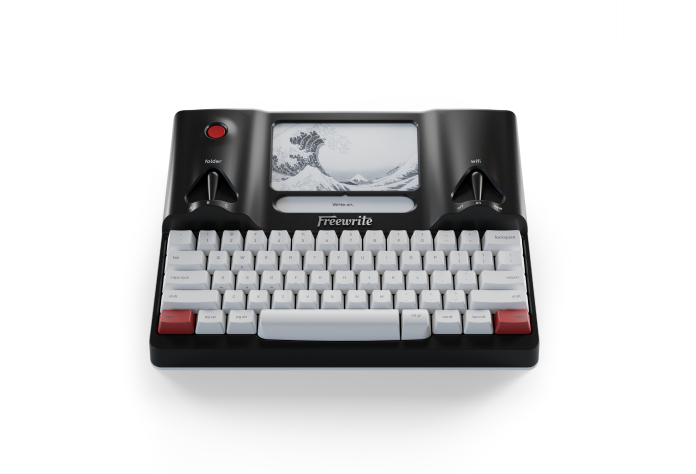
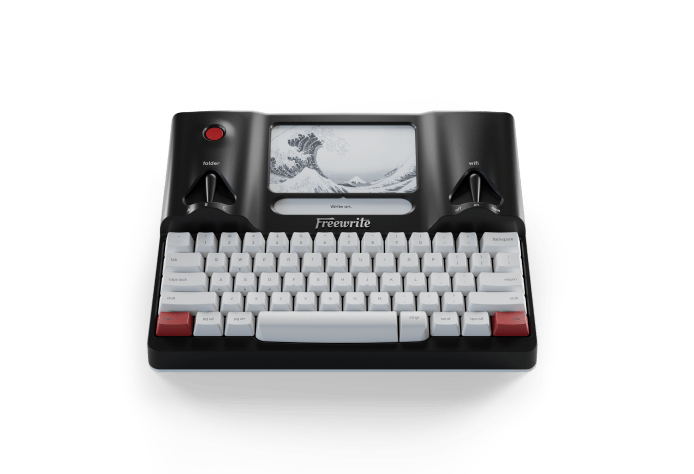
I purchased a Freewrite Gen3 Smart Typewriter, and I've been hooked ever since.

AC: That's awesome. So tell us about ANEMONE. What is it?

MS: ANEMONE is a print-only magazine (printed in a traditional broadsheet newspaper format). As for for theme, broadly, the world as told by Montanans. Short fiction, creative nonfiction, poetry, reportage, photography, and visiual illustrations comprise the submission categories.

AC: Print-only!

MS: Print is only dying because we let it.

AC: Is there a story about the name?

MS: Most people know the word anemone to describe a family of flowers — a 200-plus-species family of buttercups, comprising varieties both wild and domesticated. Dubbed “windflowers,” their delicate petals are said to blow open in the breeze; the ancient Greek word anemos means “wind.” I was drawn to the metaphorical value of beauty and how it can be revealed to us through an invisible force.

To add another layer, when I was a boy my father and I would spend weekends at the beaches north of San Francisco, where I was born and raised until I was seven. We would study the massive turqoise, kelly green, and purple sea anemones clinging to rocks left exposed by the receding Pacific tides (as to why, I can't say, outside of them looking funny, almost alien). A good memory.

Finally, “Anemone” is the name of an exquisite song by The Brian Jonestown Massacre, an irreverent and controversial rock band led by Anton Newcombe, an obsessive creative who rejects the surrender of culture and art to commercial interests. The track has a hold on me. It's like a portal to another era.

AC: Why do you think this sort of analog creativity is important?

MS:  I'm told the unending deluge of digital interface is leaving humans less and less capable of “deep work.” Will we ever know the difference?

Will we recognize what a society incapable of deep work looks like compared with those that came before it? Or will the transition manifest as a gradual degradation of quality, much as Coca-Cola was slowly, but surely, divorced from real sugar, such that to taste what Coke used to be like, one must order a Mexican Coke, still made with real cane sugar?

For me, analog perspective (and any creativity wrung from it) is rooted in continuity, tangibility, lived experience, slowness, spatial relation, nuance, emphasis on process, and grace for imperfection — antithetical to one of replicability, speed, binary outcomes, predictability, and optimization.

I prefer the former, and I suspect those who prefer the latter don't read or write much — life is a beautiful, taxing mess, and good writers find merit in this duality.

For me, analog perspective (and any creativity wrung from it) is rooted in continuity, tangibility, lived experience, slowness, spatial relation, nuance, emphasis on process, and grace for imperfection — antithetical to one of replicability, speed, binary outcomes, predictability, and optimization.

AC: Who is invited to submit to ANEMONE?

MS: We do limit submissions to Montanans, past and present, though we will feature writers from other states should the content of their writing bear an obvious relation to Montana — a requirement not imposed on Montanan writers.

All information regarding submissions can be found at www.anemonereview.com, along with all other facets of the magazine.