overlaylink

¿Estamos viviendo una crisis de creatividad?

Emily Pogue
agosto 14, 2024 | 5 lectura mínima

“Todas las grandes historias ya han sido contadas” es un sentimiento que muchos autores han tenido a las 11 de la noche (a menudo, con una copa de vino) después de desechar otro borrador.

Puede parecer imposible producir una versión original en la era de internet, las redes sociales y la inteligencia artificial. Y puede que haya algo de cierto en esa opinión.

Los investigadores han confirmado que nos estamos acercando a un territorio desconocido: una crisis de creatividad.

Las señales de advertencia

La creatividad puede manifestarse de diversas formas, por lo que puede ser difícil medir la "competencia creativa" de una persona. Sin embargo, una forma ampliamente aceptada de evaluar la creatividad de una persona es mediante las Pruebas de Pensamiento Creativo de Torrance .

Estas pruebas, que se han administrado a decenas de miles de estudiantes desde su desarrollo en la década de 1960, han podido predecir el éxito creativo con tres veces más precisión que las pruebas de coeficiente intelectual.

¿Qué podemos aprender entonces de casi 60 años de datos? Pues bien, según un estudio realizado por la Universidad William & Mary , no vamos por buen camino. En 1990, se observó un marcado descenso en las puntuaciones de los exámenes, siendo el sexto grado la edad promedio de este descenso.

¿A qué se debe esta repentina caída de la creatividad? La cronología sugiere que podría haber otro factor en juego.

La pérdida del aburrimiento

Si comparas el verano de un niño de hoy con el de hace treinta años, parecería que viven en planetas diferentes. Antes, las vacaciones de verano se dedicaban a crear casas de cartón para muñecas, trepar a los árboles del jardín y... bueno, a aburrirse.

Así es. En aquellos tiempos, estabas (casi) emocionado por volver a la escuela porque ya no te quedaba nada divertido que hacer en casa.

Compare eso con los niños de hoy, que están inundados de entretenimiento preenvasado, ya sea un juguete de alta tecnología, el iPad de papá o ver ese episodio de Bluey por octava vez.

Los adultos tampoco se libran de esta necesidad constante de estimulación. Si tenemos un momento libre (algo que, de por sí, es raro para muchos), esos minutos los ocupamos navegando por las redes sociales o viendo ese episodio de Friends por octava vez.

Atrás quedaron los días en que no hacíamos nada con los pulgares: hoy en día esos dígitos están demasiado ocupados en el teclado de nuestro teléfono.

Esta sobreestimulación y la casi extinción del aburrimiento tienen más consecuencias de las que imaginamos . Nuestro cerebro nunca tiene la oportunidad de descansar.

En este contexto, no es de extrañar que nuestra creatividad no sea tan fuerte como antes. Para empezar a retomar una mentalidad inventiva, puede ser útil dedicar tiempo a dejar volar la mente. Toma como ejemplo a Albert Einstein:pasaba horas simplemente flotando en su velero , dejando que su mente divagara y macerara ideas.

Aunque no todos tenemos veleros a mano, estos periodos de aburrimiento pueden ser bastante sencillos. Puedes dar un largo paseo sin auriculares, dejando que tus pensamientos fluyan libremente. O puedes pasar unos minutos extra en la ducha.

(Lea más sobre la pérdida del aburrimiento en los humanos modernos en nuestra entrevista con la autora e investigadora Celeste Headlee).

Después de estas experiencias relajantes, tu mente probablemente estará lista para algo de estimulación, y ahí es donde entra en juego nuestra siguiente recomendación para desarrollar tu músculo creativo.

La creatividad es simplemente conectar cosas

Una de las mentes más creativas de la historia reciente fue Steve Jobs. Llevó la innovación a un nivel disruptivo, cambiando para siempre la percepción que la gente tenía de las computadoras, la música y los dispositivos móviles.

En una entrevista de 1996 con Wired , Jobs habló de lo que significaba para él el pensamiento creativo:

La creatividad consiste simplemente en conectar cosas. Cuando les preguntas a las personas creativas cómo hicieron algo, se sienten un poco culpables porque en realidad no lo hicieron, simplemente vieron algo. Después de un tiempo, les pareció obvio.

Este es un aspecto importante de la creatividad que hay que reconocer. No hay un botón que la active o desactive en un abrir y cerrar de ojos. Surge de forma natural, a menudo sin mucho esfuerzo.

Pero hay opciones activas que podemos tomar para ayudar a que ese proceso natural ocurra de forma más fluida y frecuente.

Buscando nuevas experiencias

La diseñadora de UX Kelly Smith lleva la idea de "conexión" de Jobs un paso más allá al hacernos imaginar que nuestra mente tiene una pared llena de mil puntos, cada uno representando un conocimiento adquirido. Cada conexión entre puntos representa una idea creativa.

Después de un tiempo, habremos creado tantas combinaciones únicas como sea posible. Pero, si añadimos un solo punto más —una nueva información o experiencia—, habremos desbloqueado docenas de patrones que antes no estaban disponibles.

Y aquí radica la segunda forma de estimular nuestra creatividad: introducirnos en nuevas experiencias y perspectivas diferentes.

Como dice Jobs, las personas creativas más exitosas «fueron capaces de conectar experiencias vividas y sintetizar cosas nuevas... Mucha gente en nuestra industria [tecnológica] no ha tenido experiencias muy diversas. Por lo tanto, no tienen suficientes puntos para conectar y terminan con soluciones muy lineales sin una perspectiva amplia del problema».

No es ningún secreto que algunas de las personas creativas más exitosas poseen intereses y aficiones increíblemente versátiles. La actriz ganadora del Oscar, Susan Sarandon, ama tanto el ping pong que cofundó un próspero negocio de barras de ping pong . También está Mark Zuckerberg, cofundador de Facebook y aparente luchador de artes marciales mixtas (MMA) con gran talento.

Incluso algunos de los productos que usamos a diario fueron inventados por personas que disfrutaron de una amplia variedad de experiencias. Por ejemplo, George de Mestral era un ingeniero suizo que disfrutaba del senderismo en los Alpes. Después de una excursión, sintió curiosidad por cómo las rebabas se pegaban al pelaje de su perro. Observar los ganchos de la planta bajo un microscopio lo inspiró a replicar el proceso: en forma de VELCRO.

Si queremos mejorar nuestra creatividad, podemos trabajar activamente para añadir nuevos elementos a nuestra mente. Piensa en algún pasatiempo que hayas pensado probar, pero que aún no hayas probado. ¿Podrías programar un tiempo para intentarlo?

Aunque no lo persigas indefinidamente, estás creando nuevas posibilidades de combinación entre tus puntos de conocimiento. Estás preparando tu mente para el éxito creativo.

Encontrando inspiración en todos los aspectos de la vida

Crear nuevos puntos de vista no es exclusivo de las aficiones y el tiempo libre. Los aspirantes a escritores pueden estar tranquilos sabiendo que los trabajos que les permiten pagar las cuentas también pueden beneficiar su proceso creativo. Este fue el caso del legendario Stephen King, cuyo primer libro, Carrie, se inspiró después de limpiar el vestuario de chicas durante su tiempo como conserje escolar .

John Grisham también aprovechó su experiencia como abogado cuando cambió de carrera para dedicarse por completo a escribir novelas de suspense policial (y todos hemos visto lo bien que le fue).

(Lea el método del escritor Michael Archambault para llevar su cerebro a "citas" para mejorar su escritura).

Probar nuevos pasatiempos, inspirarse en experiencias laborales pasadas y encontrar tiempo para aburrirse son formas efectivas de comenzar a desarrollar su potencial creativo.

Después de todo, si Einstein pudo encontrar tiempo para no hacer nada, seguramente nosotros también podemos.

diciembre 30, 2025 3 lectura mínima

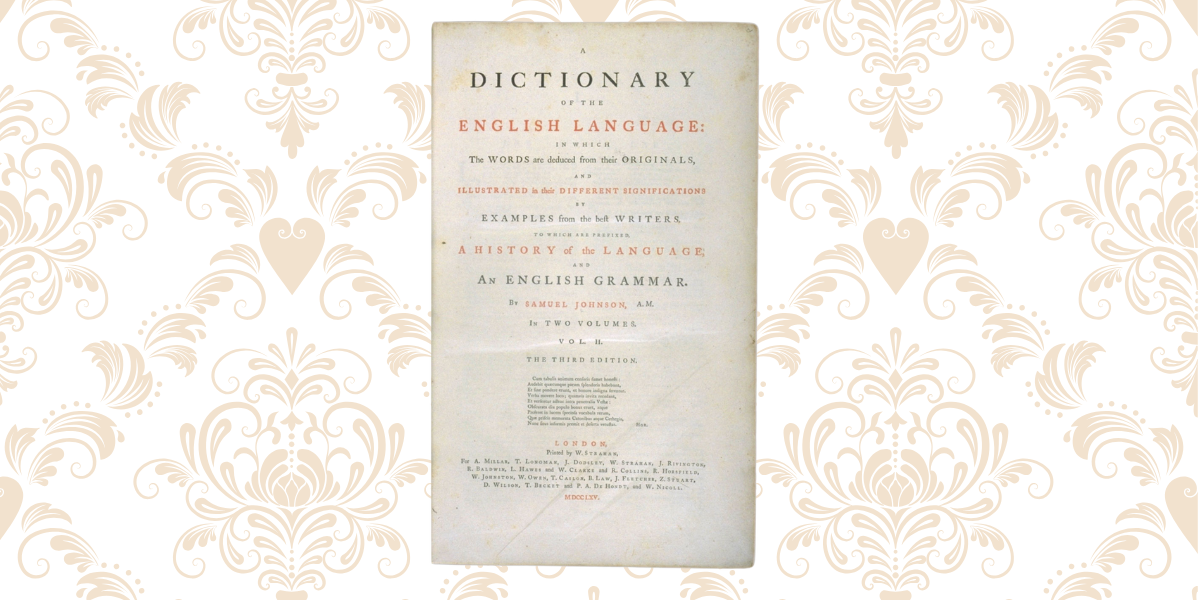
It’s Freewrite’s favorite time of year. When dictionaries around the world examine language use of the previous year and select a “Word of the Year.”

Of course, there are many different dictionaries in use in the English language, and they all have different ideas about what word was the most influential or saw the most growth in the previous year. They individually review new slang and culturally relevant vocabulary, examine spikes or dips in usage, and pour over internet trend data.

Let’s see what some of the biggest dictionaries decided for 2025. And read to the end for a chance to submit your own Word of the Year — and win a Freewrite gift card.

[SUBMIT YOUR WORD OF THE YEAR]


Merriam-Webster: "slop"

Merriam-Webster chose "slop" as its Word of the Year for 2025 to describe "all that stuff dumped on our screens, captured in just four letters."

The dictionary lists "absurd videos, off-kilter advertising images, cheesy propaganda, fake news that looks pretty real, junky AI-written books, 'workslop' reports that waste coworkers’ time … and lots of talking cats" as examples of slop.

The original sense of the word "slop" from the 1700s was “soft mud” and eventually evolved to mean "food waste" and "rubbish." 2025 linked the term to AI, and the rest is history.

Honorable mentions: conclave, gerrymander, touch grass, performative, tariff, 67.

Dictionary.com: "67"

The team at Dictionary.com likes to pick a word that serves as “a linguistic time capsule, reflecting social trends and global events that defined the year.”

For 2025, they decided that “word” was actually a number. Or two numbers, to be exact.

If you’re an old, like me, and don’t know many school-age children, you may not have heard “67” in use. (Note that this is not “sixty-seven,” but “six, seven.”)

Dictionary.com claims the origin of “67” is a song called “Doot Doot (6 7)” by Skrilla, quickly made infamous by viral TikTok videos, most notably featuring a child who will for the rest of his life be known as the “6-7 Kid.” But according to my nine-year-old cousin, the origins of something so mystical can’t ever truly be known.

(My third grade expert also demonstrated the accompanying signature hand gesture, where you place both hands palms up and alternately move up and down.)

And if you happen to find yourself in a fourth-grade classroom, watch your mouth, because there’s a good chance this term has been banned for the teacher’s sanity.

Annoyed yet? Don’t be. As Dictionary.com points out, 6-7 is a rather delightful example at how fast language can develop as a new generation joins the conversation.

Dictionary.com honorable mentions: agentic, aura farming, broligarchy, clanker, Gen Z stare, kiss cam, overtourism, tariff, tradwife.

Oxford Dictionary: "rage bait"

With input from more than 30,000 users and expert analysis, Oxford Dictionary chose "rage bait" for their word of the year.

Specifically, the dictionary pointed to 2025’s news cycle, online manipulation tactics, and growing awareness of where we spend our time and attention online.

While closely paralleling its etymological cousin "clickbait," rage bait more specifically denotes content that evokes anger, discord, or polarization.

Oxford's experts report that use of the term has tripled in the last 12 months.

Oxford Dictionary's honorable mentions:aura farming, biohack.

Cambridge Dictionary: "parasocial"

The Cambridge Dictionary examined a sustained trend of increased searches to choose "parasocial" as its Word of the Year.

Believe it or not, this term was coined by sociologists in 1956, combining “social” with the Greek-derived prefix para-, which in this case means “similar to or parallel to, but separate from.”

But interest in and use of the term exploded this year, finally moving from a mainly academic context to the mainstream.

Cambridge Dictionary's honorable mentions: slop, delulu, skibidi, tradwife

Freewrite: TBD

This year, the Freewrite Fam is picking our own Word of the Year.

Click below to submit what you think the Word of 2025 should be, and we'll pick one submission to receive a Freewrite gift card.

[SUBMIT HERE] 

--

Sources

diciembre 18, 2025 5 lectura mínima

¿Qué pueden enseñar las cartas personales de Jane Austen a los escritores?

diciembre 10, 2025 6 lectura mínima

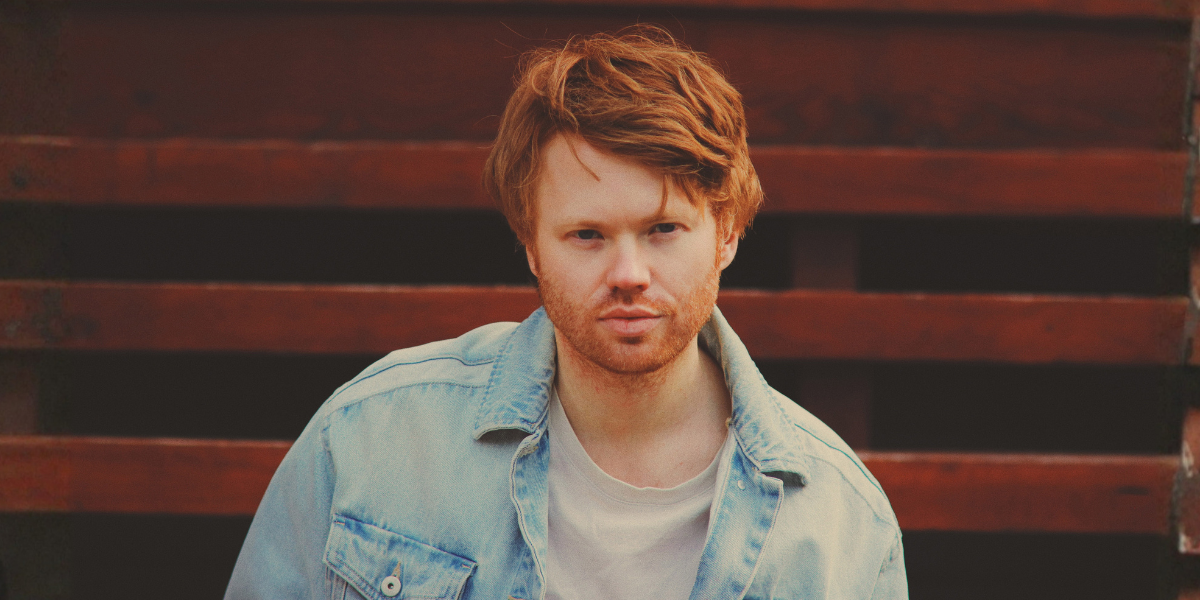
Singer-songwriter Abner James finds his creativity in the quiet freedom of analog tools. Learn how his creative process transcends different media.

Abner James went to school for film directing. But the success of the band he and his brother formed together, Eighty Ninety, knocked him onto a different trajectory.

The band has accrued more than 40 million streams since the release of their debut EP “Elizabeth," and their work was even co-signed by Taylor Swift when the singer added Eighty Ninety to her playlist "Songs Taylor Loves.”

Now, Abner is returning to long-form writing in addition to songwriting, and with a change in media comes an examination of the creative process. We sat down to chat about what's the same — and what's different. 

ANNIE COSBY: Tell us about your songwriting process.

ABNER JAMES: The way I tend to write my songs is hunched over a guitar and just seeing what comes. Sounds become words become shapes. It's a very physical process that is really about turning my brain off.

And one of the things that occurred to me when I was traveling, actually, was that I would love to be able to do that but from a writing perspective. What would happen if I sat down and approached writing in the same way that I approached music? In a more intuitive and free-form kind of way? What would that dig up?

AC: That's basically the ethos of Freewrite.

AJ: Yes. We had just put out a record, and I was thinking about how to get into writing for the next one. It occurred to me that regardless of how I started, I always finished on a screen. And I wondered: what's the acoustic guitar version of writing?

Where there's not blue light hitting me in the face. Even if I'm using my Notes app, it's the same thing. It really gets me into a different mindset.

 "I wondered: what's the acoustic guitar version of writing?"

I grew up playing piano. That was my first instrument. And I found an old typewriter at a thrift store, and I love it. It actually reminded me a lot of playing piano, the kind of physical, the feeling of it. And it was really fun, but pretty impractical, especially because I travel a fair amount.

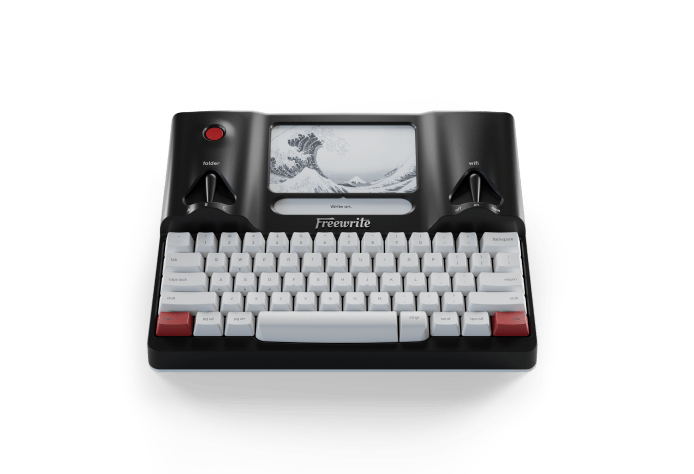
And so I wondered, is there such a thing as a digital typewriter? And I googled it, and I found Freewrite.

AC: What about Freewrite helps you write?

AJ:I think, pragmatically, just the E Ink screen is a huge deal, because it doesn't exhaust me in the same way. And the idea of having a tool specifically set aside for the process is appealing in an aesthetic way but also a mental-emotional way. When it comes out, it's kind of like ... It's like having an office you work out of. It's just for that.

"The way I tend to write my songs is hunched over a guitar and just seeing what comes. Sounds become words become shapes. It's a very physical process that is really about turning my brain off."

And all of the pragmatic limitations — like you're not getting texts on it, and you're not doing all that stuff on the internet — that's really helpful, too. But just having the mindset....

When I pick up a guitar, or I sit down at the piano, it very much puts me into that space. Having a tool just for words does the same thing. I find that to be really cool and inspiring.

"When I pick up a guitar, or I sit down at the piano, it very much puts me into that space. Having a tool just for words does the same thing."

AC: So mentally it gets you ready for writing.

AJ: Yeah, and also, when you write a Microsoft Word, it looks so finished that it's hard to keep going. If every time I strummed a chord, I was hearing it back, mixed and mastered and produced...?

It's hard to stay in that space when I'm seeing it fully written out and formatted in, like, Times New Roman, looking all seriously back at me.

AC: I get that. I have terrible instincts to edit stuff over and over again and never finish a story.

AJ:  Also, the way you just open it and it's ready to go. So you don't have the stages of the computer turning on, that kind of puts this pressure, this tension on.

It's working at the edges in all these different ways that on their own could feel a little bit like it's not really necessary. All these amorphous things where you could look at it and be like, well, I don't really need any of those. But they add up to a critical mass that actually is significant.

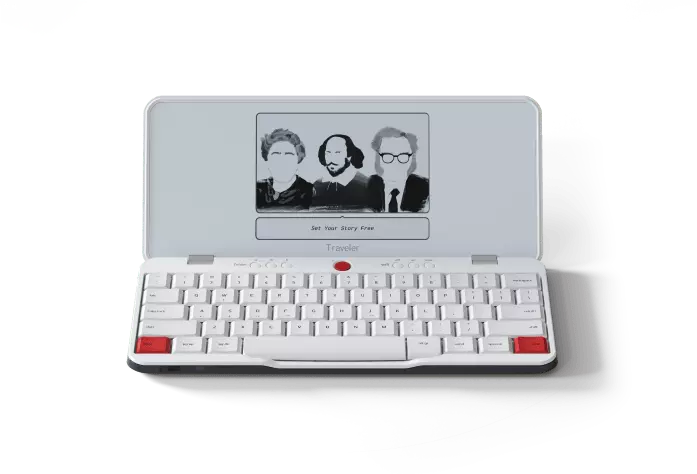
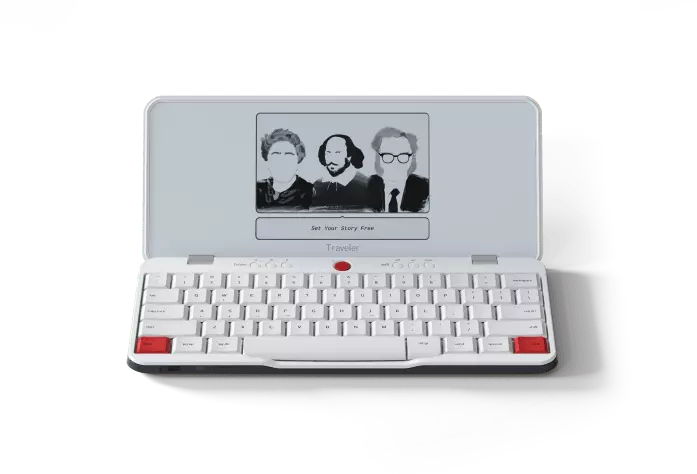
And sometimes, if I want to bring it on a plane, I've found it's replaced reading for me. Rather than pick up a book or bring a book on the plane, I bring Traveler and just kind of hang out in that space and see if anything comes up.

I've found that it's kind of like writing songs on a different instrument, you get different styles of music that you wouldn't have otherwise. I've found that writing from words towards music, I get different kinds of songs than I have in the past, which has been interesting.

In that way, like sitting at a piano, you just write differently than you do on a guitar, or even a bass, because of the things those instruments tend to encourage or that they can do.

It feels almost like a little synthesizer, a different kind of instrument that has unlocked a different kind of approach for me.

"I've found that it's kind of like writing songs on a different instrument, you get different styles of music that you wouldn't have otherwise... [Traveler] feels almost like a little synthesizer, a different kind of instrument that has unlocked a different kind of approach for me."

AC: As someone who doesn't know the first thing about writing music, that's fascinating. It's all magic to me.

AJ: Yeah.

AC: What else are you interested in writing?

AJ: I went to school for film directing. That was kind of what I thought I was going to do. And then my brother and I started the band and that kind of happened first and knocked me onto a different track for a little while after college.

Growing up, though, writing was my way into everything. In directing, I wanted to be in control of the thing that I wrote. And in music, it was the same — the songwriting really feels like it came from that same place. And then the idea of writing longer form, like fiction, almost feels just like the next step from song to EP to album to novel.

For whatever reason, that started feeling like a challenge that would be deeply related to the kinds of work that we do in the studio.

AC: Do you have any advice for aspiring songwriters?

AJ: This sounds like a cliche, but it's totally true: whatever success that I've had as a songwriter — judge that for yourself — but whatever success I have had, has been directly proportional to just writing the song that I wanted to hear.

What I mean by that is, even if you're being coldly, cynically, late-stage capitalist about it, it's by far the most success I've had. The good news is that you don't have to choose. And in fact, when you start making those little compromises, or even begin to inch in that direction, it just doesn't work. So you can forget about it.

Just make music you want to hear. And that will be the music that resonates with most people.

I think there's a temptation to have an imaginary focus group in your head of like 500 people. But the problem is all those people are fake. They're not real. None of those people are actually real people. You're a focus group of one, you're one real person. There are more real people in that focus group than in the imaginary one.

And I just don't think that we're that different, in the end. So that would be my advice.

AC: That seems like generally great creative advice. Because fiction writers talk about that too, right? Do you write to market or do you write the book you want to read. Same thing. And that imaginary focus group has been debilitating for me. I have to silence that focus group before I can write.

AJ: Absolutely.

"I think there's a temptation to have an imaginary focus group in your head of like 500 people. But the problem is all those people are fake... You're a focus group of one, you're one real person. There are more real people in that focus group than in the imaginary one."

--

Learn more about Abner James, his brother, and their band, Eighty Ninety, on Instagram.