overlaylink

Garabateando con Dostoievski

Taylor Rebhan
junio 11, 2024 | 8 lectura mínima

Fiódor Mijáilovich Dostoyevski. Autor de renombre mundial. Maestro de la novela psicológica. Jugador problemático. Preso político. ¿Prolífico... garabateador?

Al abrir los cuadernos de uno de los autores más queridos y venerados del mundo, encontrará palabras, por supuesto. Muchas de sus páginas están llenas de pequeñas frases en cursiva cirílica, dispuestas de una manera que solo el propio autor podría haber entendido (con lo que uno se identifica). La escritura se mueve de arriba abajo, se divide en burbujas y columnas poco pulcras, y sigue los errantes caminos de su mente.

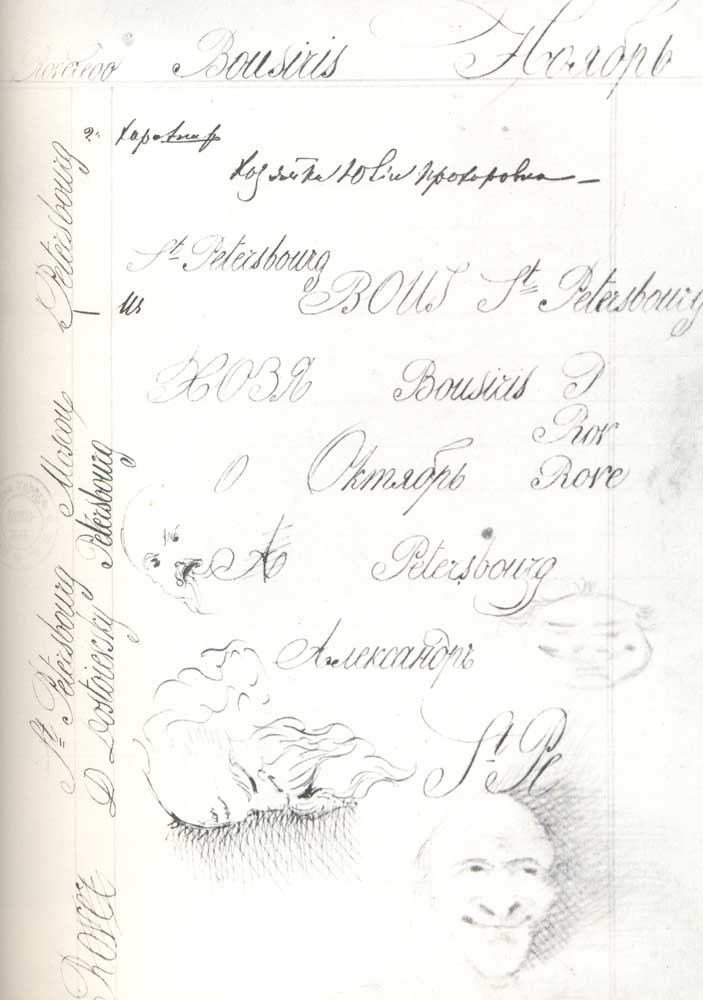
Pero escondidos entre los párrafos de notas, entre ladrillos y cemento mediante la práctica de caligrafía y caligrafía, hay cientos y cientos de garabatos .

Están dispersos por los manuscritos del autor, desde sus primeras obras hasta sus obras maestras y sus diarios personales. A lo largo de su carrera como escritor, Dostoievski escribió, dibujó y dibujó sin parar. Fue tan prolífico que sus dibujos han dado lugar a exposiciones enteras en museos y libros de erudición .

Quienes recordamos haber dibujado la famosa "S genial" en nuestras tareas de matemáticas (o, para los delincuentes, en nuestros escritorios) nos identificamos. Pero los garabatos de Dostoievski son más que simples garabatos y grafitis. No son toscos. De hecho, están lejos de serlo. La arquitectura está representada proporcionalmente. Los rostros son expresivos, no planos. Sus personajes a menudo parecen estar atrapados en medio de una emoción abrumadora. Al igual que en su escritura, Dostoievski tiene un estilo propio y único.

Entonces, ¿qué pueden enseñarnos los garabatos en el margen de este maestro escritor sobre los primeros borradores?

No busque más allá de su obra, quizás la más leída: Crimen y castigo .

Los primeros manuscritos se ciñen fielmente al producto final. De hecho, hay párrafos y secuencias enteras que prácticamente no han sufrido modificaciones desde el primer borrador hasta el último.

Pero un cambio importante moldeó drásticamente la estructura y el efecto de la novela.

Y podemos entenderlo mirando en un lugar inesperado: los garabatos en los márgenes.

Lección uno: Cambia tu punto de vista

Crimen y castigo se publicó en una revista en varias entregas a lo largo de un año: una novela por entregas. Aunque su publicación se realizó por etapas, Dostoievski tuvo la esencia de la historia en mente durante años.

La novela se centra en Rodión Raskolnikov, un exestudiante de veintitantos años de la Rusia del siglo XIX . Muy inteligente y sumido en la miseria, Raskolnikov cree erróneamente que puede justificar un crimen si sus motivos sirven a un bien mayor: salir de la indigencia para poder realizar grandes obras morales. Tras urdir su plan y justificarlo, se arma de valor para asesinar y robar a una anciana prestamista, lo que desencadena los acontecimientos de la novela.

Lo que comienza como un crimen amoral “perfecto” tanto en mente como en método, pronto se convierte en una pesadilla marcada por enfermedades físicas y mentales, persecución policial, paranoia casi constante, introspección espiritual, la casi disolución de su familia y, en última instancia, el castigo espiritual y psicológico al que Raskolnikov creía que sería inmune.

Esa es la novela en pocas palabras, y es lo que Dostoievski siempre quiso que fuera. Si has oído hablar de historias que se "revelan" a los autores y los sorprenden mientras escriben, ese no es el caso aquí. Él vio el arco argumental y simplemente necesitaba dejarlo.

Pero no era tan sencillo. Ir de A a B le preocupaba a Dostoievski hasta el punto de escribirle a un amigo que había quemado un primer borrador en la chimenea.

Pero había una solución a su lucha. Simplemente se escondía en los márgenes.

Dostoievski contaba la historia en sus dibujos mucho antes de descubrir cómo hacerlo por escrito.

Los borradores de Crimen y Castigo están repletos de dibujos. Algunos presentan a Raskolnikov, otros a personajes secundarios. Se alzan imponentes torres de iglesias y plazas. Incluso hay un autorretrato del propio Dostoievski.

Cada retrato lleva una expresión inolvidable.

Pensativo y reflexivo.

Ojos cerrados por el dolor.

Cejas fruncidas por la ira.

Incluso unos pocos Aparecen caras engreídas , sin duda de Luzhin y de varios de los otros personajes contrastantes de la novela.

Pero son los retratos de Raskolnikov los que constituyen la clave para desbloquear el cambio más importante desde el primer borrador hasta el producto final.

Dostoievski escribió originalmente Crimen y castigo en primera persona, a modo de confesión, comenzando solo después de que Raskolnikov asesinara al prestamista. Unas memorias, un diario, una confesión: una mezcla de ambas. Pero simplemente no funcionaba.

Y los garabatos muestran por qué.

Los dibujos de personajes secundarios podrían, en teoría, ser desde el punto de vista de Raskolnikov. Dostoievski simplemente esboza lo que ve nuestro protagonista.

Pero el angustiado joven Raskolnikov no podía verse a sí mismo como Dostoievski lo retrataba. Solo alguien más podía.

Ahí radica el gran avance: para demostrar verdaderamente su profundo estado psicológico, Raskolnikov tenía que ser visto a través de los ojos de otros. No solo de los suyos.

Así, Dostoievski optó por la narración en tercera persona, pero con un giro innovador. Continuó narrando los pensamientos íntimos de Raskolnikov en primera persona . Aún podemos experimentar de primera mano su paranoia, culpa y lucha.

Pero ahora, al retroceder en el tiempo, Raskolnikov también se humaniza. En lugar de simplemente experimentarlo a través del evento más dramático y traumático de su vida, lo vemos en tres dimensiones. Vemos sus profundas relaciones, su lealtad e incluso su humor a través de las personas que lo rodean.

Tomemos este momento del Capítulo VI, cuando lo vemos a través de los ojos de su mejor amigo, Dmitri Razoumikhin. Razoumikhin discute con un Raskolnikov delirante y visiblemente perturbado sobre sus planes. Raskolnikov se marcha abruptamente y emprende su propio camino.

En un momento breve pero hermosamente evocador permitido por la narración en tercera persona, nos quedamos con Razoumikhin en lugar de seguir a Raskolnikov:

Raskolnikov siguió caminando y dobló la esquina hacia la calle Sadovy. Razumihin lo observó pensativo. Luego, con un gesto de la mano, entró en la casa, pero se detuvo antes de llegar a las escaleras.
—Maldita sea —continuó casi en voz alta—. Hablaba con sensatez, pero... ¡Soy un tonto! ¡Como si los locos no hablaran con sensatez!... —Se golpeó la frente con el dedo—. ¿Y si... cómo podría dejarlo ir solo? Podría ahogarse... ¡Ay, qué error! No puedo. —Y corrió de vuelta para alcanzar a Raskolnikov, pero no había rastro de él.

Al quedarnos con Razoumikhim, percibimos su compasión y su genuino afecto por su amigo. Vemos a Raskolnikov a través de sus ojos. En lugar de un loco y asesino, vemos a un amigo atribulado e indefenso que no debe estar solo.

Sin la narración en tercera persona, jamás habríamos podido sentir el amor de Razoumikhim manifestado en frustración y preocupación. Solo tendríamos la confesión poco fiable de Raskolnikov.

El lector se identifica mucho más con las luchas de Raskolnikov cuando es complejo, y Dostoievski lo hace maravillosa y humanamente complejo a través de quienes lo rodean. En el capítulo III, experimentamos este momento de sus seres queridos:

Dicho esto, de repente le tendió la mano a su hermana, sonriendo sin mediar palabra. Pero en esa sonrisa había un destello de sincero afecto. Dunia lo captó al instante y le estrechó la mano con cariño, rebosante de alegría y agradecimiento. Era la primera vez que se dirigía a ella desde su discusión del día anterior. El rostro de la madre se iluminó de felicidad extática al ver esta reconciliación definitiva y tácita. «Sí, por eso lo amo», murmuró Razumihin, exagerando, para sí mismo, mientras giraba vigorosamente en su silla. «Tiene estos movimientos».

Y de repente, esperamos que Raskolnikov se salga con la suya. Que la anciana realmente se lo merecía, después de todo. Simpatizamos con su filosofía descabellada, la que lo llevó a cometer no uno, sino dos asesinatos brutales.

Con este magistral golpe de caracterización en la narración en tercera persona, Dostoievski traslada la tensión desde el interior de la novela a nuestros propios corazones y mentes.

Lección dos: De la idea a la historia

Dostoievski es famoso por escribir novelas filosóficas, es decir, historias que exploran ideas sobre la mejor manera de vivir. Crimen y castigo no es la excepción. Declaró explícitamente que se propuso explorar los peligros de una filosofía de moda en la época, a la que llamó «radicalismo». Se trataba de un movimiento posmoderno, possignificado y posreligioso que se estaba popularizando en las esferas literaria e intelectual de la Rusia del siglo XIX . En él, no existía una verdad inmutable: todas las experiencias vitales eran subjetivas, tanto moral como éticamente.

En Crimen y castigo , Dostoievski intentó retratar lo que podría suceder cuando un hombre llevaba estas ideas hasta su conclusión lógica.

Para algunos escritores, un acontecimiento desencadena creativamente su historia. Para otros, es un personaje. Para otros, es un lugar.

Para Dostoievski, fue una idea.

Escribió para probar, refutar, teorizar, filosofar y argumentar, a menudo contra sí mismo. La lucha interna dentro de una obra es uno de sus sellos distintivos.

Pero una idea en sí misma no es una historia. Cuando las primeras iteraciones de su narrativa no funcionaban, quizá también se debía a que aún no era una historia; era solo una exploración.

¿Una confesión policial? ¿Unas memorias? ¿La entrada del diario de un culpable? Son casi clínicas, científicas. Una hipótesis, una prueba y una conclusión no hacen una historia. Casi se puede ver cómo Raskolnikov, el personaje, aún no había aparecido, y solo Raskolnikov, el hombre de paja, existía en los primeros borradores. Y Dostoievski nunca ha sido conocido por escribir hombres de paja.

Así, cuando Dostoievski cambió la perspectiva de la confesión en primera persona a la tercera persona, salimos del intelectualismo puro y entramos en la empatía.

Realmente vemos a Raskolnikov por primera vez. No solo su filosofía, sino también su vida y su carácter. Estuvo presente en la página todo el tiempo, en los garabatos angustiados y pensativos.

Una vez que la perspectiva cambia, Raskolnikov no es solo un vehículo para una idea. Es un ser humano, un hombre desgarrado.

Fue entonces cuando la idea se convirtió en la historia que conocemos y amamos.

Así que la próxima vez que nos sentemos a escribir, podemos inspirarnos en Dostoievski. Para que una idea se convierta en una historia, necesita empatía.

Lección tres: Vagar, fijo en la página

Los garabatos de Dostoievski dejan claro que el escritor, al escribir, no siempre estaba... bueno, escribiendo. Y, sin embargo, estos manuscritos dieron origen a algunas de nuestras novelas más preciadas. ¿Cómo es posible?

Es simple.

Estaba fijado a la página.

La escritora Ann Lamott lo llama "sentarse en la silla" (veamos la traducción rusa). Dostoievski seguía esta regla. Cuando dejaba de escribir, comenzaba a dibujar. Pero nunca se apartaba de la página, señal de que si escribir es pensar, también lo es garabatear.

De hecho, esa idea está científicamente probada. Un estudio descubrió que garabatear mejora la memoria en un 29 %. Otro descubrió que ayuda a aliviar Estrés psicológico . Dostoievski sufrió un trastorno nervioso durante toda su vida. Los márgenes de sus manuscritos también contenían pequeños cálculos y libros de contabilidad para llevar un registro de sus problemas financieros. Quizás los garabatos calmaron y tranquilizaron su mente inquieta, ayudándolo a retomar su trabajo cuando estuvo listo.

El garabato también se ha asociado con El inconsciente . ¿En qué pensamos realmente cuando dibujamos un árbol? ¿Y qué tal la arquitectura de una capilla, como las bellezas que se encuentran en los márgenes de los borradores de Crimen y castigo ? Con su trasfondo de arrepentimiento y resurrección espiritual, no es difícil comprender lo que pasaba por la mente del autor al escribir la historia... y sus bocetos.

Como un alpinista, Dostoievski se aferró a un punto —la página— y luego emprendió su ascenso errante. Tuvo muchas curvas cerradas. Incluso descansó. Pero fíjense que no abandonó la página. Era él, la cuerda y el acantilado de la página.

En su lucha contra la distracción, Dostoievski garabateaba. Desterró sus distracciones, dudas y bloqueos con un trazo de lápiz a la vez. Y luego volvía a la siguiente línea. Y a la siguiente. Y a la siguiente.

Así que la próxima vez que te sientes a escribir, lleva un bloc de notas y un lápiz. O quizás una nota adhesiva y un bolígrafo.

No para escribir.

Pero para garabatear.

Reproducir lo que el ojo de la mente ve, o quizás, lo que aún no puede ver.

Podría simplemente cambiar tu punto de vista.

noviembre 29, 2025 4 lectura mínima

The Great Freewrite Séance: A Ghost'ly Charity Auction Full Terms & Conditions

These Terms and Conditions (“Terms”) govern participation in The Great Freewrite Séance: A Ghost'ly Charity Auction (“Auction”), organized by Freewrite (“Organizer,” “we,” “us,” or “our”). By registering for, bidding in, or otherwise participating in the Auction, you (“Participant,” “Bidder,” or “Winner”) agree to be bound by these Terms.

1. Auction Overview

1.1. The Auction offers for sale a limited number of Freewrite Traveler Ghost Edition units (“Items” or “Ghost Traveler units”), each personally signed and drawn on by a featured author.

1.2. All proceeds, net of explicitly disclosed administrative costs, will be donated to the charity or charitable initiative (“Charity”) identified on each auction item’s page, as chosen by the respective author.

2. Eligibility

2.1. Participants must be at least 18 years old or the age of majority in their jurisdiction, whichever is higher.

2.2. Employees of Freewrite, the participating authors, or any affiliates directly involved in the Auction are not eligible to bid.

2.3. By participating, you represent that you are legally permitted to take part in online auctions and to pay for any bids you win.

3. Auction Registration

3.1. Participants must create an account on the auction platform or otherwise register using accurate, current, and complete information.

3.2. Freewrite reserves the right to verify identity and to disqualify any Participant who provides false or misleading information.

4. Bidding Rules

4.1. All bids are binding, final, and non-retractable.

4.2. Bidders are responsible for monitoring their bids; Freewrite is not liable for missed notifications or technical issues on the auction platform or the Participant’s device.

4.3. Freewrite reserves the right to:

  • set minimum bids or bid increments;
  • reject bids deemed in bad faith or intended to disrupt the Auction;
  • extend, pause, or cancel the Auction in case of technical difficulties, fraud, or events beyond reasonable control.

5. Winning Bids and Payment

5.1. The highest valid bid at the close of the Auction is the Winning Bid, and the corresponding Participant becomes the Winner.

5.2. Winners will receive payment instructions and must complete payment within 48 hours of the auction’s close unless otherwise stated.

5.3. Failure to complete payment on time may result in forfeiture, and Freewrite may offer the Item to the next highest bidder.

5.4. Accepted payment methods will be listed on the Auction platform. All payments must be made in the currency specified.

6. Item Description and Condition

6.1. Each Ghost Traveler unit is authentic, and the signatures, doodles, and messages are original works created by the participating author. These are authors, not artists. By bidding on the Item, you acknowledge that you are receiving a one-of-a-kind unit marked with unique art and messages and you agree to these terms and conditions.

6.2. Because Items are customized and signed by hand, variations, imperfections, or unique marks are to be expected. These are considered part of the Item’s character and not defects.

6.3. Items are provided “as-is” and “as-available.” Freewrite makes no warranties of merchantability or fitness for a particular purpose.

7. Shipping & Delivery

7.1. Shipping costs, import duties, and taxes may apply unless explicitly stated otherwise.

7.2. Freewrite will make reasonable efforts to ship Items within the estimated timeline but cannot guarantee delivery dates.

7.3. Title and risk of loss transfer to the Winner upon delivery to the carrier.

7.4. Freewrite is not responsible for delays, damage, or loss caused by the courier or customs agencies.

8. Charity Donation

8.1. Net proceeds from the Auction will be donated to the Charity designated on each Item page.

8.2. Donation amounts and recipients may be disclosed publicly unless prohibited by law.

8.3. Winners acknowledge that they are purchasing Items, not making a tax-deductible donation to Freewrite; therefore, Winners will not receive charitable tax receipts unless Freewrite explicitly states otherwise in compliance with applicable laws.

9. Intellectual Property

9.1. All trademarks, brand names, product names, and creative materials associated with Freewrite and the Ghost Traveler remain the exclusive property of Freewrite or their respective rights holders.

9.2. Participants may not reproduce, distribute, or publicly display the authors’ doodles without permission where such rights are applicable, except as allowed by law (e.g., resale of the physical Item).

10. Privacy

10.1. By participating, you consent to Freewrite’s collection, use, and storage of your personal data in accordance with our Privacy Policy.

10.2. Freewrite may publicly announce auction results, including Winner’s first name, last initial, city, state/country, and winning bid amount unless prohibited by law or unless you formally request anonymity when possible.

11. Prohibited Conduct

Participants may not:

  • engage in bid manipulation, fraud, or collusive bidding;
  • use automated systems (bots, scripts, scrapers) to place or monitor bids;
  • interfere with the Auction, platform, or other participants

Freewrite may ban or disqualify any Participant violating these rules.

12. Limitation of Liability

To the fullest extent permitted by law:

12.1. Freewrite is not liable for indirect, incidental, special, or consequential damages arising from the Auction or purchase of Items.

12.2. Freewrite’s total liability in connection with these Terms shall not exceed the amount of the Winning Bid actually paid by the Participant.

12.3. Freewrite is not responsible for technical malfunctions, internet outages, system failures, or other issues beyond its control.

13. Cancellation and Force Majeure

Freewrite may cancel, postpone, or modify the Auction due to unforeseen circumstances, including but not limited to natural disasters, system failures, strikes, or events affecting participating authors or the Charity.

14. Governing Law & Dispute Resolution

14.1. These Terms are governed by the laws of Michigan, without regard to conflict-of-law rules.

14.2. Any disputes arising under these Terms will be resolved through binding arbitration or the courts of the specified jurisdiction, as applicable.

14.3. Participants waive any right to participate in class-action lawsuits relating to the Auction.

15. Amendments

Freewrite may update these Terms at any time. Continued participation in the Auction after updates constitutes acceptance of the revised Terms.

16. Contact Information

For questions or concerns regarding the Auction or these Terms, contact: hello@getfreewrite.com.

noviembre 25, 2025 1 lectura mínima

This is a great gratitude writing exercise to be done alone or in a group, with people of any age.

How to Play

    1. Designate someone to read out each prompt below. (Feel free to add your own prompts.)
    2. After each prompt is read, set a timer for one minute. (With younger kids, this can be shortened. For older folks who want to freewrite meaningfully, more time can be added.)
    3. Each person freewrites by finishing the sentence and elaborating until the timer goes off. (For little kids, this can be done verbally with an adult recording their answers. Hilarity will ensue.)
    4. Remeber that freewriting — allowing yourself to write with abandon — enables you to let go, tapping into your subconscious to explore your thoughts more deeply.
    5. When everyone is done with all the prompts, take turns going through some your answers. Some people may be eager to share. Others may not want to. Respect their decision.

The Prompts

  • I'm grateful for... [After you've finished this prompt, repeat it five times. Challenge yourself and others not to repeat a singe word with each new answer.]
  • The silliest thing I'm grateful for is...
  • The littlest thing I'm grateful for is...
  • The biggest thing I'm grateful for is...
  • The grossest thing I'm grateful for is...
  • One thing I love about myself is...
  • My favorite thing that happened this year was...
  • My hope for next year is...

This writing exercise has resulted in some sweet answers — and many hilarious ones, too. If you try it out, do let us know.

Write on.

noviembre 21, 2025 4 lectura mínima

For the release of Sailfish, our new firmware update for Smart Typewriter Gen3 and Traveler, we created a brand-new boot-up animation to surprise and delight our writers.

We worked with talented Danish animator Mathias Lynge to bring our experience of the writer's journey to life.

We had a blast visualizing the writer's journey in this new way. Our engineers also had a blast (or something less than a blast) figuring out how to adjust this fun, playful animation to E Ink's very tricky specifications. Hello, refresh rate woes! But we think the result is pretty fun.

"The little animation made my day when I noticed. I love a good flourish."

- Freewrite user

The process of creating this animation was long and full of Zoom calls where we deeply discussed the writing process. We were struck through those conversations by how much overlap there is in creative processes of all disciplines.

So we sat down to chat with Mathias about his creative process and what it's like being a full-time animator.

ANNIE COSBY: Let's start with the basics. What kind of art do you make?

MATHIAS LYNGE: I'm a 2D animator and motion designer working freelance with a wide range of clients. The style varies depending on the project, but it’s usually either a hand-drawn look animated frame-by-frame on a drawing tablet, or a more digital, vectorized look made in After Effects.

While much of what I do is commercial work, I try to keep up with my own passion projects as well. That could be a 10-second Instagram loop of a nature scene, or an interesting character design I’ve sketched down with a pencil. It’s there that I get to sharpen my skills and try out new techniques, which often find their way into later client projects.

AC: You often share educational content on social media for other artists. Are you formally trained, or did you teach yourself?

ML: I’m mostly self-taught. I’ve been drawing for as long as I can remember, but it wasn’t until I went to university that I realized drawing could become a career.

When I first heard terms like “motion design” and “The 12 Principles of Animation” I was on a student exchange program at UCSB in California, where I had chosen a class called "Introduction to Animation." It was a big eye-opener for me, and from that point I was hooked.

But it’s mainly been online YouTube tutorials and my existing drawing experience that have taught me what I know.

Now, I have a big presence on social media, where I share my art as well as educational content centered around animation in Adobe After Effects, so I guess you could say that I'm also an animation influencer!

I’ve been drawing for as long as I can remember, but it wasn’t until I went to university that I realized drawing could become a career.

AC: That's actually how I first found your work. Do you have any specific artists who inspire you?

ML:In the world of 2D animation, I have a list of personal heroes that inspire me with their unique style: Reece Parker, Ariel Costa a.k.a. BlinkMyBrain, and Tony Babel, to name a few.

I also find a lot of inspiration from illustrators and painters I discover online, on platforms such as Pinterest. Last year I made a sparkling water animation that was heavily inspired by Cornwall-based artist Gordon Hunt. He makes these beautiful nature-inspired pointillist paintings that capture how light hits the ocean using colorful dots of paint. I tried to recreate that effect using After Effects to bring it to life, and it led me to a whole new way of animating within the program.

AC: Where else do you draw inspiration to create your work?

ML: I’m heavily inspired by the nature and cityscapes around me in Copenhagen, and I find that taking long walks through parks or down the streets of my neighborhood really sparks my imagination.

I’ll often carry around a sketchbook to quickly scribble down an idea or a loose sketch of something I find interesting, such as seeing how the light from a lamppost hits the surrounding leaves, or how the wind moves the tree in a certain way.

Then I’ll think to myself, “I wonder if I can recreate that motion using a specific technique in After Effects?”

I’m heavily inspired by the nature and cityscapes around me in Copenhagen...

AC: What does your daily routine look like as a full-time artist?

ML: It varies a lot, but I’m usually either working hard on a client project or tinkering away with a new animation tutorial for my social media channels.

I love being able to switch between the two, and when I’m going through a client dry spell, I find that staying creative and posting animation-related content helps keep me inspired while also putting things out into the world that may lead to my next client down the road.

AC: What's your #1 piece of advice for animators new to the industry?

ML: Keep experimenting and trying out new techniques. There’s no such thing as running out of creativity, and even though many of the things you try don’t necessarily go anywhere, it’s all experience that adds up and expands your toolbox. It’s a muscle that needs to be worked out regularly.

Plus, you’ll have more awesome animation to choose from when you’re putting together your next showreel or portfolio!

There’s no such thing as running out of creativity...

AC: What's one fun fact about you completely unrelated to animation?

ML:I’m a big sucker for history podcasts, especially if they are about ancient civilizations, such as The History of Rome by Mike Duncan.

I find it fascinating to hear how mankind was able to build such great empires without ever knowing what electricity, cars, or the internet are.

--

Follow along on Mathias's creative journey and find his free educational content on Instagram.

To learn more about working together, find him on LinkedIn or visit his website at www.mathiaslynge.com.

Learn more about Sailfish here.