overlaylink

Histoire vs. Intrigue : différences définitives entre eux

octobre 03, 2017 | 6 lire la lecture


L'article invité d'aujourd'hui est de Jackie Dever, rédactrice adjointe chez Aionios Books , un petit éditeur de modèle traditionnel basé dans le sud de la Californie.


Il y a quelques années, un après-midi, alors que je ramais joyeusement dans mon courant de conscience, un gros rocher apparut dans la brume, se cabrant si vite qu'il ne me resta plus le temps de naviguer. Mon bateau en papier s'écrasa et s'écroula, laissant le SS Plot en ruine et en ruine sur la Great Story River.

Dans ce test personnel de l'histoire contre l'intrigue, cette dernière s'est avérée être une épave.

Même si les événements menant à la conclusion de l'histoire continuaient de se dérouler au-delà de ce maudit rocher, mon engin instable ne pouvait tout simplement pas contourner le monolithe.

Comprendre la nature de l'imagination peut être intimidant. Mais la moitié du chemin est d'en comprendre les éléments. Histoire et intrigue ne sont-elles pas synonymes, cependant ? Ne pouvons-nous pas compter sur ces éléments pour une symbiose automatique, un mariage heureux dans un tourbillon de prose palpitante ? Eh bien… non.

Quelle est la différence entre une histoire et une intrigue ?

Une histoire est la chronologie nécessaire des événements présents dans tout récit. Pas d'histoire ? Pas de roman. Car tout roman, aussi abstrait soit-il, doit relater des événements d'une manière ou d'une autre.

Une intrigue exprime une logique et informe le lecteur des raisons pour lesquelles une liste spécifique d'événements appartient au même ensemble, ce que la chronologie est finalement censée communiquer.

L'exemple classique d'EM Forster dans son recueil de conférences, Aspects of the Novel , le dit encore mieux :

« Le roi est mort, puis la reine est morte » est une histoire. « Le roi est mort, puis la reine est morte de chagrin » est une intrigue. »

En lisant une histoire, explique Forster, nous nous demandons « et ensuite ? » En évaluant une intrigue, nous nous demandons « pourquoi ? »

Histoire vs Intrigue - Paweł Furman ( Paweł Furman )

Ces questions surgissent parfois simultanément, ce qui rend difficile de comprendre leurs sources distinctes. Mais aussi naturelles que les composantes puissent paraître complémentaires, c'est en réalité le talent de l'auteur qui les rend ainsi. Ce qui signifie que chaque fois que moi, vous ou Stephen King nous attelons à la tâche d'écrire , nous devons gérer les deux. Nous devons maintenir le lecteur captivé par un merveilleux questionnement sur « et ensuite ? » et « pourquoi ? » aussi longtemps que nous souhaitons leur attention.

Comment l'intrigue soutient l'histoire

Personne n'a envie de se demander sans cesse « et après ? Et après ? Et après ? » Nous sommes des créatures curieuses ; il faut savoir pourquoi . Malheureusement, lorsque l'intrigue est absente ou accidentellement discordante, la vraie question que se pose le lecteur est : « Hein ? »

L'intrigue offre des astuces astucieuses qui nous rassurent sur le sens de la narration. Elle établit les relations de cause à effet qui donnent au lecteur le sentiment que la conclusion de l'histoire est juste.

La même histoire peut être racontée de plusieurs manières :

Le roi est mort, puis la reine est morte en le vengeant au combat.

Le roi mourut, puis la reine mourut de la maladie contagieuse qu'il lui avait transmise lorsqu'il prononça ses derniers mots près de son visage.

Le roi mourut, puis la reine, désireuse de libérer l'amant que le roi avait jalousement enfermé dans le cachot, glissa sur un pavé glacé et mourut.

Comment votre point de départ détermine votre destination finale

Pour chaque nouveau projet de fiction , je m'inspire largement d'un point de vue narratif ou intrigue. Chaque point de départ présente ses avantages et ses inconvénients.

Commencer par l'histoire

Lorsqu'une histoire m'inspire, je formule une série d'événements qui mènent à une conclusion fixe. Je ne connais peut-être pas précisément les motivations de mes personnages ni la logique de leurs décisions, mais je peux imaginer les étapes qu'ils feront au cours de leur voyage. Autrement dit, je sais que la mort de la reine suit celle du roi. Le lien entre les événements ? À déterminer.

Cela peut être un grand soulagement de commencer par trier l'histoire. Lorsque je dispose de paramètres, je peux m'entraîner à atteindre un objectif concret. Et j'apprécie l'exercice intellectuel consistant à relier les événements dans une séquence crédible.

Il y a toujours un piège. Même avec un objectif clair pour moi, j'ai besoin de preuves solides (c'est-à-dire d'une intrigue efficace) pour justifier mes événements.

Il y a quelques années, j'ai décidé d'écrire l'histoire d'un homme qui vend un cottage sur la plage pour la somme d'un penny. J'ai savouré chacune des scènes que j'ai créées, mais au final, je n'ai obtenu qu'un conte de fées mal conçu. L'imagination débordante m'a enchanté, mais malgré tous mes efforts, je n'ai pas réussi à adapter l'intrigue au courant de l'histoire. Anéantissement total.

Commencer par l'intrigue

Lorsqu'une intrigue stimule ma créativité, je connais les sentiments et les intentions des personnages. J'aborde mon écriture comme un étudiant vertueux mais désorienté : en quête de sens, motivé, sûr de ses valeurs et de ses raisons, mais ignorant complètement où il va finir. En fait, je me préoccupe moins de l'endroit où j'aboutis que de la raison pour laquelle j'y aboutis, de sorte que l'itinéraire est sujet à changement. Tous ceux qui errent ne sont pas perdus.

J'aime progresser narrativement sur un chemin aussi naturel. Tracer mon chemin dans une histoire me permet de me laisser guider par mes émotions, et non par la liste des arrêts d'un touriste. Je file au-dessus des cascades grâce à ma colère, mon hilarité ou ma joie débordante. Et lorsque ce sentiment passionné est synchronisé avec l'histoire, je loue mes muses et me fie aux courants.

Mais lorsque je laisse mes émotions me guider, je regrette de ne pas avoir fait mes réservations, ou au moins d'avoir étudié la carte avant de partir. Il paraît toujours noble de partir à l'aventure, de se fier à son instinct pour arriver là où l'on veut. La réalité ne me rattrape que lorsque je grelotte sous la pluie et que je ne sais absolument pas où je pourrai débarquer pour la soirée. Même si trop de prévisibilité est étouffant, il est frustrant de perdre complètement mes repères mentaux.

Il n'y a pas de mauvaise façon de commencer

Il est difficile de classer une explosion créative aussi rigoureusement que je l'ai fait précédemment. Les éclairs des deux éléments se mélangent généralement dans ce moment d'illumination. Mais comprendre les éléments de chacun – et leur influence sur le processus d'écriture – est toujours ce qui me prépare à l'aventure qui m'attend . Devrai-je me concentrer longuement sur les tenants et aboutissants de mes personnages pour guider mon intrigue ? Ou ferai-je mieux de m'assurer que leurs motivations soient satisfaites par les événements que je leur fais vivre ?

Nous écrivons tous différemment. À mesure que nous nous investissons dans notre pratique d'écriture, des schémas émergent dans notre processus et notre style. Je suis un écrivain axé sur les histoires. Faire avancer l'intrigue d'un moment à l'autre, valider mon récit par un noyau logique, est mon principal défi.

Histoire vs Intrigue - Toa Heftiba ( Toa Heftiba )

Quelles que soient nos tendances personnelles, reconnaître les éléments à la fois connectés et distinctifs nous rappelle à tous que nous pouvons, si nécessaire, expérimenter. Vous pouvez tenter d'associer plusieurs histoires à une intrigue captivante avant que tout ne se mette en place. Ou vous pouvez décider de patienter avec une belle histoire dont l'intrigue manque de solidité pour vous mener à bon port, et de chercher sur les rives du fleuve un nouveau point d'entrée, une voie plus adaptée.

Il est normal de déconstruire et de réorganiser, de transplanter radicalement des idées. Cette reconfiguration constante est la source d'une littérature diverse et pétillante, même si les mêmes thèmes se répètent à travers les âges. L'amour et la mort, la surprise, la résignation, la magie. Rien de tout cela ne deviendra banal face à un monde si vaste à explorer et à tant de façons de communiquer des idées intemporelles.

J'aborderai les nombreux fleuves entrecroisés de ma fiction sous mille angles, en attachant des ailes mécaniques pour une perspective aérienne ou en parcourant une route secondaire parallèle dans un modèle T toussant. Où que nous allions (et quelle que soit la manière dont nous allons), puissions-nous tous apprendre à apprécier la vue.

Nous aimerions connaître votre avis sur les différences dans les commentaires !


Jackie Dever Jackie Dever est rédactrice et écrivaine en Californie du Sud. Elle a édité des blogs, des publications d'entreprise, des textes universitaires, des romans et des biographies. Elle est rédactrice adjointe chez Aionios Books , une petite maison d'édition traditionnelle basée en Californie du Sud. Elle a récemment terminé la relecture de son mémoire, A Few Minor Adjustments , lauréat du San Diego Book Award 2017. (Septembre 2017) par Cherie Kephart. Elle écrit un blog sur l'écriture et l'édition, les tendances lifestyle de la génération Y et les sports de plein air.
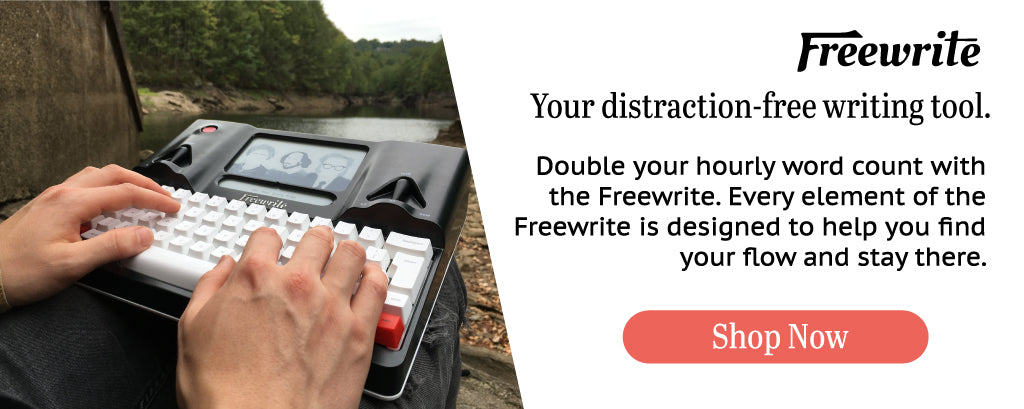
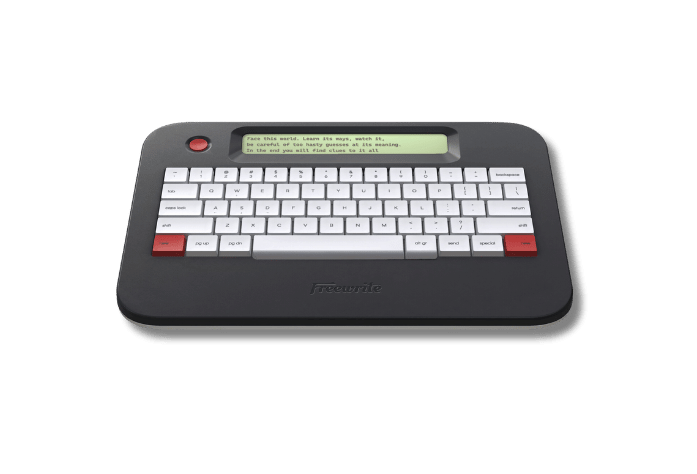
Freewrite - Votre outil d'écriture sans distraction

décembre 10, 2025 6 lire la lecture

Singer-songwriter Abner James finds his creativity in the quiet freedom of analog tools. Learn how his creative process transcends different media.

Abner James went to school for film directing. But the success of the band he and his brother formed together, Eighty Ninety, knocked him onto a different trajectory.

The band has accrued more than 40 million streams since the release of their debut EP “Elizabeth," and their work was even co-signed by Taylor Swift when the singer added Eighty Ninety to her playlist "Songs Taylor Loves.”

Now, Abner is returning to long-form writing in addition to songwriting, and with a change in media comes an examination of the creative process. We sat down to chat about what's the same — and what's different. 

ANNIE COSBY: Tell us about your songwriting process.

ABNER JAMES: The way I tend to write my songs is hunched over a guitar and just seeing what comes. Sounds become words become shapes. It's a very physical process that is really about turning my brain off.

And one of the things that occurred to me when I was traveling, actually, was that I would love to be able to do that but from a writing perspective. What would happen if I sat down and approached writing in the same way that I approached music? In a more intuitive and free-form kind of way? What would that dig up?

AC: That's basically the ethos of Freewrite.

AJ: Yes. We had just put out a record, and I was thinking about how to get into writing for the next one. It occurred to me that regardless of how I started, I always finished on a screen. And I wondered: what's the acoustic guitar version of writing?

Where there's not blue light hitting me in the face. Even if I'm using my Notes app, it's the same thing. It really gets me into a different mindset.

 "I wondered: what's the acoustic guitar version of writing?"

I grew up playing piano. That was my first instrument. And I found an old typewriter at a thrift store, and I love it. It actually reminded me a lot of playing piano, the kind of physical, the feeling of it. And it was really fun, but pretty impractical, especially because I travel a fair amount.

And so I wondered, is there such a thing as a digital typewriter? And I googled it, and I found Freewrite.

AC: What about Freewrite helps you write?

AJ:I think, pragmatically, just the E Ink screen is a huge deal, because it doesn't exhaust me in the same way. And the idea of having a tool specifically set aside for the process is appealing in an aesthetic way but also a mental-emotional way. When it comes out, it's kind of like ... It's like having an office you work out of. It's just for that.

"The way I tend to write my songs is hunched over a guitar and just seeing what comes. Sounds become words become shapes. It's a very physical process that is really about turning my brain off."

And all of the pragmatic limitations — like you're not getting texts on it, and you're not doing all that stuff on the internet — that's really helpful, too. But just having the mindset....

When I pick up a guitar, or I sit down at the piano, it very much puts me into that space. Having a tool just for words does the same thing. I find that to be really cool and inspiring.

"When I pick up a guitar, or I sit down at the piano, it very much puts me into that space. Having a tool just for words does the same thing."

AC: So mentally it gets you ready for writing.

AJ: Yeah, and also, when you write a Microsoft Word, it looks so finished that it's hard to keep going. If every time I strummed a chord, I was hearing it back, mixed and mastered and produced...?

It's hard to stay in that space when I'm seeing it fully written out and formatted in, like, Times New Roman, looking all seriously back at me.

AC: I get that. I have terrible instincts to edit stuff over and over again and never finish a story.

AJ:  Also, the way you just open it and it's ready to go. So you don't have the stages of the computer turning on, that kind of puts this pressure, this tension on.

It's working at the edges in all these different ways that on their own could feel a little bit like it's not really necessary. All these amorphous things where you could look at it and be like, well, I don't really need any of those. But they add up to a critical mass that actually is significant.

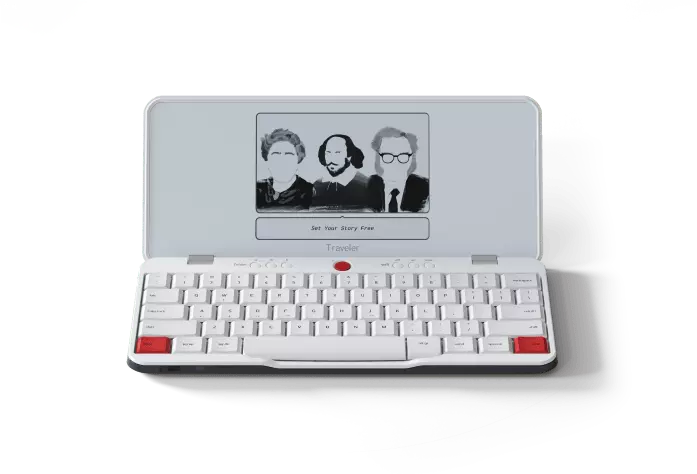
And sometimes, if I want to bring it on a plane, I've found it's replaced reading for me. Rather than pick up a book or bring a book on the plane, I bring Traveler and just kind of hang out in that space and see if anything comes up.

I've found that it's kind of like writing songs on a different instrument, you get different styles of music that you wouldn't have otherwise. I've found that writing from words towards music, I get different kinds of songs than I have in the past, which has been interesting.

In that way, like sitting at a piano, you just write differently than you do on a guitar, or even a bass, because of the things those instruments tend to encourage or that they can do.

It feels almost like a little synthesizer, a different kind of instrument that has unlocked a different kind of approach for me.

"I've found that it's kind of like writing songs on a different instrument, you get different styles of music that you wouldn't have otherwise... [Traveler] feels almost like a little synthesizer, a different kind of instrument that has unlocked a different kind of approach for me."

AC: As someone who doesn't know the first thing about writing music, that's fascinating. It's all magic to me.

AJ: Yeah.

AC: What else are you interested in writing?

AJ: I went to school for film directing. That was kind of what I thought I was going to do. And then my brother and I started the band and that kind of happened first and knocked me onto a different track for a little while after college.

Growing up, though, writing was my way into everything. In directing, I wanted to be in control of the thing that I wrote. And in music, it was the same — the songwriting really feels like it came from that same place. And then the idea of writing longer form, like fiction, almost feels just like the next step from song to EP to album to novel.

For whatever reason, that started feeling like a challenge that would be deeply related to the kinds of work that we do in the studio.

AC: Do you have any advice for aspiring songwriters?

AJ: This sounds like a cliche, but it's totally true: whatever success that I've had as a songwriter — judge that for yourself — but whatever success I have had, has been directly proportional to just writing the song that I wanted to hear.

What I mean by that is, even if you're being coldly, cynically, late-stage capitalist about it, it's by far the most success I've had. The good news is that you don't have to choose. And in fact, when you start making those little compromises, or even begin to inch in that direction, it just doesn't work. So you can forget about it.

Just make music you want to hear. And that will be the music that resonates with most people.

I think there's a temptation to have an imaginary focus group in your head of like 500 people. But the problem is all those people are fake. They're not real. None of those people are actually real people. You're a focus group of one, you're one real person. There are more real people in that focus group than in the imaginary one.

And I just don't think that we're that different, in the end. So that would be my advice.

AC: That seems like generally great creative advice. Because fiction writers talk about that too, right? Do you write to market or do you write the book you want to read. Same thing. And that imaginary focus group has been debilitating for me. I have to silence that focus group before I can write.

AJ: Absolutely.

"I think there's a temptation to have an imaginary focus group in your head of like 500 people. But the problem is all those people are fake... You're a focus group of one, you're one real person. There are more real people in that focus group than in the imaginary one."

--

Learn more about Abner James, his brother, and their band, Eighty Ninety, on Instagram.

novembre 29, 2025 4 lire la lecture

The Great Freewrite Séance: A Ghost'ly Charity Auction Full Terms & Conditions

These Terms and Conditions (“Terms”) govern participation in The Great Freewrite Séance: A Ghost'ly Charity Auction (“Auction”), organized by Freewrite (“Organizer,” “we,” “us,” or “our”). By registering for, bidding in, or otherwise participating in the Auction, you (“Participant,” “Bidder,” or “Winner”) agree to be bound by these Terms.

1. Auction Overview

1.1. The Auction offers for sale a limited number of Freewrite Traveler Ghost Edition units (“Items” or “Ghost Traveler units”), each personally signed and drawn on by a featured author.

1.2. All proceeds, net of explicitly disclosed administrative costs, will be donated to the charity or charitable initiative (“Charity”) identified on each auction item’s page, as chosen by the respective author.

2. Eligibility

2.1. Participants must be at least 18 years old or the age of majority in their jurisdiction, whichever is higher.

2.2. Employees of Freewrite, the participating authors, or any affiliates directly involved in the Auction are not eligible to bid.

2.3. By participating, you represent that you are legally permitted to take part in online auctions and to pay for any bids you win.

3. Auction Registration

3.1. Participants must create an account on the auction platform or otherwise register using accurate, current, and complete information.

3.2. Freewrite reserves the right to verify identity and to disqualify any Participant who provides false or misleading information.

4. Bidding Rules

4.1. All bids are binding, final, and non-retractable.

4.2. Bidders are responsible for monitoring their bids; Freewrite is not liable for missed notifications or technical issues on the auction platform or the Participant’s device.

4.3. Freewrite reserves the right to:

  • set minimum bids or bid increments;
  • reject bids deemed in bad faith or intended to disrupt the Auction;
  • extend, pause, or cancel the Auction in case of technical difficulties, fraud, or events beyond reasonable control.

5. Winning Bids and Payment

5.1. The highest valid bid at the close of the Auction is the Winning Bid, and the corresponding Participant becomes the Winner.

5.2. Winners will receive payment instructions and must complete payment within 48 hours of the auction’s close unless otherwise stated.

5.3. Failure to complete payment on time may result in forfeiture, and Freewrite may offer the Item to the next highest bidder.

5.4. Accepted payment methods will be listed on the Auction platform. All payments must be made in the currency specified.

6. Item Description and Condition

6.1. Each Ghost Traveler unit is authentic, and the signatures, doodles, and messages are original works created by the participating author. These are authors, not artists. By bidding on the Item, you acknowledge that you are receiving a one-of-a-kind unit marked with unique art and messages and you agree to these terms and conditions.

6.2. Because Items are customized and signed by hand, variations, imperfections, or unique marks are to be expected. These are considered part of the Item’s character and not defects.

6.3. Items are provided “as-is” and “as-available.” Freewrite makes no warranties of merchantability or fitness for a particular purpose.

7. Shipping & Delivery

7.1. Shipping costs, import duties, and taxes may apply unless explicitly stated otherwise.

7.2. Freewrite will make reasonable efforts to ship Items within the estimated timeline but cannot guarantee delivery dates.

7.3. Title and risk of loss transfer to the Winner upon delivery to the carrier.

7.4. Freewrite is not responsible for delays, damage, or loss caused by the courier or customs agencies.

8. Charity Donation

8.1. Net proceeds from the Auction will be donated to the Charity designated on each Item page.

8.2. Donation amounts and recipients may be disclosed publicly unless prohibited by law.

8.3. Winners acknowledge that they are purchasing Items, not making a tax-deductible donation to Freewrite; therefore, Winners will not receive charitable tax receipts unless Freewrite explicitly states otherwise in compliance with applicable laws.

9. Intellectual Property

9.1. All trademarks, brand names, product names, and creative materials associated with Freewrite and the Ghost Traveler remain the exclusive property of Freewrite or their respective rights holders.

9.2. Participants may not reproduce, distribute, or publicly display the authors’ doodles without permission where such rights are applicable, except as allowed by law (e.g., resale of the physical Item).

10. Privacy

10.1. By participating, you consent to Freewrite’s collection, use, and storage of your personal data in accordance with our Privacy Policy.

10.2. Freewrite may publicly announce auction results, including Winner’s first name, last initial, city, state/country, and winning bid amount unless prohibited by law or unless you formally request anonymity when possible.

11. Prohibited Conduct

Participants may not:

  • engage in bid manipulation, fraud, or collusive bidding;
  • use automated systems (bots, scripts, scrapers) to place or monitor bids;
  • interfere with the Auction, platform, or other participants

Freewrite may ban or disqualify any Participant violating these rules.

12. Limitation of Liability

To the fullest extent permitted by law:

12.1. Freewrite is not liable for indirect, incidental, special, or consequential damages arising from the Auction or purchase of Items.

12.2. Freewrite’s total liability in connection with these Terms shall not exceed the amount of the Winning Bid actually paid by the Participant.

12.3. Freewrite is not responsible for technical malfunctions, internet outages, system failures, or other issues beyond its control.

13. Cancellation and Force Majeure

Freewrite may cancel, postpone, or modify the Auction due to unforeseen circumstances, including but not limited to natural disasters, system failures, strikes, or events affecting participating authors or the Charity.

14. Governing Law & Dispute Resolution

14.1. These Terms are governed by the laws of Michigan, without regard to conflict-of-law rules.

14.2. Any disputes arising under these Terms will be resolved through binding arbitration or the courts of the specified jurisdiction, as applicable.

14.3. Participants waive any right to participate in class-action lawsuits relating to the Auction.

15. Amendments

Freewrite may update these Terms at any time. Continued participation in the Auction after updates constitutes acceptance of the revised Terms.

16. Contact Information

For questions or concerns regarding the Auction or these Terms, contact: hello@getfreewrite.com.

novembre 25, 2025 1 lire la lecture

This is a great gratitude writing exercise to be done alone or in a group, with people of any age.

How to Play

    1. Designate someone to read out each prompt below. (Feel free to add your own prompts.)
    2. After each prompt is read, set a timer for one minute. (With younger kids, this can be shortened. For older folks who want to freewrite meaningfully, more time can be added.)
    3. Each person freewrites by finishing the sentence and elaborating until the timer goes off. (For little kids, this can be done verbally with an adult recording their answers. Hilarity will ensue.)
    4. Remeber that freewriting — allowing yourself to write with abandon — enables you to let go, tapping into your subconscious to explore your thoughts more deeply.
    5. When everyone is done with all the prompts, take turns going through some your answers. Some people may be eager to share. Others may not want to. Respect their decision.

The Prompts

  • I'm grateful for... [After you've finished this prompt, repeat it five times. Challenge yourself and others not to repeat a singe word with each new answer.]
  • The silliest thing I'm grateful for is...
  • The littlest thing I'm grateful for is...
  • The biggest thing I'm grateful for is...
  • The grossest thing I'm grateful for is...
  • One thing I love about myself is...
  • My favorite thing that happened this year was...
  • My hope for next year is...

This writing exercise has resulted in some sweet answers — and many hilarious ones, too. If you try it out, do let us know.

Write on.