overlaylink

Dilemme littéraire : pourquoi Tolkien détestait-il Dune ?

Harrison Cook
juin 05, 2024 | 9 lire la lecture
Le Seigneur des Anneaux a été publié en 1954 et Dune en 1965, mais s'ils sont toujours sur votre liste de livres à lire , sachez que des spoilers pour les deux livres sont à venir.

Dans une autre vie, j’imagine John Ronald Reuel Tolkien et Frank Herbert assis dans un pub terre-à-terre, discutant de leurs obsessions actuelles : les religions, l’écologie et au-delà.

Ici, ils seraient à la retraite : Tolkien à 70 ans et Herbert à la fin de la cinquantaine. C'est une époque où l'on peut fumer à l'intérieur, alors Frank remplit sa pipe à tabac et cherche du feu, et Tolkien, un autre consommateur de tabac, gratte une allumette.

Peut-être sortiraient-ils leurs livres et compareraient-ils leurs couvertures, qui présentent des similitudes, avec des montagnes rétrécissant de vagues formes humanoïdes sur le chemin de l'aventure. Tolkien admirerait l'écriture majestueuse mais calligraphique de Dune , inscrite en haut, juxtaposée aux rochers rouille et vert caverne d'Arrakis. Herbert remarquerait les sentiers de montagne sinueux sfumato au loin, imitant une couverture brumeuse, tandis que les branches tortueuses des arbres encadrent la police mandarine du Seigneur des Anneaux.

Il est facile d’imaginer l’universitaire britannique et le journaliste américain discutant nonchalamment de la création de leurs œuvres qui formeraient le fondement du genre de science-fiction et de fantasy que les lecteurs modernes reconnaissent aujourd’hui.

Cependant, en réalité, cela ne pourrait pas être plus éloigné de la vérité.

En mars 1966, Tolkien avait reçu son deuxième exemplaire de Dune de Frank Herbert , de son ami John Bush, dans lequel il écrivait :

Il est impossible pour un auteur qui écrit encore d'être juste envers un autre auteur qui travaille dans le même domaine. Du moins, je le trouve ainsi. En fait, je déteste Dune avec une certaine intensité, et dans ce cas malheureux, il est de loin préférable et plus juste envers un autre auteur de garder le silence et de refuser tout commentaire.

Cette lettre inédite a été annotée plus tard comme faisant partie de la bibliothèque personnelle de Tolkien et comprenait une dernière ligne qui disait :

« Voulez-vous que je vous rende le livre, car j’en ai déjà un, ou que je le transmette ? »

Si l'on fait abstraction des décors – les vastes plaines de la Terre du Milieu et les confins du futur dans l'espace –, des riches cultures des Hobbits gourmands et des Fremen endurants, ainsi que des trajectoires de Frodon Sacquet et de Paul Atréides en héros, J.R.R. Tolkien et Frank Herbert présentent plus de similitudes que de différences dans la construction de leur monde. Cependant, ces différences fondamentales résident dans leurs philosophies et leurs croyances d'écrivains et éclipsent finalement toute comparaison entre les deux œuvres.

Une différence de moralité

L'une des principales différences entre les auteurs résidait dans leur présence sur des pans polarisés du spectre éthique. Tolkien adhérait à la déontologie , tandis qu'Herbert était un pur conséquentialiste . Qu'est-ce que cela signifie ?

En éthique, la déontologie revient à déterminer dans quelle mesure un acte est bon ou mauvais en fonction de sa nature et non de ses conséquences — si l’intention de l’action elle-même était intrinsèquement bonne ou mauvaise.

Sauron créa l'Anneau Unique pour les gouverner tous, dans le but d'asservir la Terre du Milieu à sa volonté. Sméagol était un Hobbit avant de tuer son ami pour s'emparer de l'anneau, ce qui le transforma plus tard en l'homme des cavernes grotesque que nous connaissons et aimons. Boromir, séduit par la puissance et la majesté de l'anneau, tenta de le ravir à Frodon pour aider son peuple du Gondor.

Le déontologisme est peut-être l'exemple le plus célèbre chez Gandalf, dans les Mines de la Moria, où Frodon affirme que Bilbon aurait dû tuer Gollum lorsqu'il en avait l'occasion, alors qu'il filait la Communauté dans l'obscurité. Le sage sorcier répond :

« Beaucoup de ceux qui vivent méritent la mort. Certains de ceux qui meurent méritent la vie. Peux-tu la leur donner, Frodon ? Ne sois pas trop pressé de leur infliger la mort en jugement. »

(Ian McKellen prononce ces répliques avec délice, je dois l'ajouter, dans les films de Peter Jackson.)

Tolkien aborde ensuite les principes de déontologie dans la scène finale, où Frodon, après des années de voyage jusqu'au Mordor, se retrouve saisi par le pouvoir de l'Anneau Unique, la lave du Mont Doom se reflétant dans son éclat doré. Incapable de le jeter au feu, il l'arrache de sa chaîne et le place à son doigt, qui est ensuite mordu par Gollum, qui tombe dans le gouffre ardent, emportant l'anneau avec lui.

Ici, Frodon, déterminé à conserver l'anneau, renonce à sa quête de destruction, ce qui lui fait perdre non seulement son pouvoir, mais aussi une part de lui-même. Gollum vole l'anneau sans intention de s'en débarrasser, mais, ce faisant, captivé par la beauté de son Précieux, tombe de la falaise, se détruisant ainsi que l'Anneau Régnant. Cette ironie oppose les actions des deux personnages au bien et au mal et complexifie leur dynamique. Le héros commet une mauvaise action, et le méchant en commet une autre, qui aboutit à un résultat positif. Cependant, Tolkien, en déontologiste, néglige les conséquences.

D'un autre côté, le conséquentialisme postule que les intentions des actes importent peu, car la moralité de leurs conséquences prime sur le choix. Dans Dune , Paul Atréides (magnifiquement interprété par Timothée Chalamet et Kyle MacLachlan ) est souvent confronté à des visions prophétiques, inspirées par le Mélange, le voyant suivre la voie de Lisan Al Gaib (Voix de l'Outre-Monde) et devenir le Kiwsatz Haderach (Raccourcissement de la Voie), ce qui mène à la famine, à la ruine et au génocide. Mais, en devenant le « Messie », Paul unit les différentes factions des Fremen et apporte un « paradis vert » à la planète désertique, la rendant ainsi plus habitable pour sa population. Pour Herbert, le sacrifice en vaut la peine, et la moralité est plus complexe que dans la version de Tolkien, car les héros commettent des actes non héroïques pour influencer leurs conséquences.

Cette moralité est encore plus remise en question dans le paysage amoral dans lequel se déroule la série Dune , qui est parfaitement résumé par l'un des principaux méchants de la série, le baron Vladimir Harkonnen, qui dit :

« Observez les plans dans les plans dans les plans. »

Cela suggère l'existence d'un réseau de motivations cachées. La confrérie intergalactique connue sous le nom de Bene Gesserit influence depuis des siècles les lignées de certains membres de la royauté en préparation du Kiwsatz Haderach. Disséminées à travers la galaxie, elles propagent des prophéties concernant l'Élu sur de nombreux mondes. Lady Jessica, la mère de Paul, est une Révérende Mère Bene Gesserit à la fin du livre, attisant la flamme des extrémistes religieux quant à la venue de Lisan Al Gaib, dont la prophétie prévoit la libération.

Alors que la population Fremen est prête à accueillir son « Messie », Paul n'a plus qu'à accomplir la prophétie et à survivre aux épreuves pour vaincre les forces Fremen et venger la mort de son père, le duc Leto, et de la Maison des Atréides. Mais Paul s'abstient constamment d'accomplir la prophétie, percevant les lueurs d'un avenir incertain et dangereux.

Une question de religion

Si l’éthique est un domaine sur lequel les auteurs étaient en désaccord, les opinions religieuses de Tolkien et d’Herbert en étaient un autre.

Herbert voulait que ses lecteurs soient sceptiques à l’égard de ses héros et considérait souvent la religion comme un moyen de contrôler les masses et de susciter de fausses attentes, lui-même n’étant pas religieux.

Dans Dune, Paul lui-même peine à accepter que le Messie prophétisé auquel les Fremen s'accrochent ait été en partie créé par le Bene Gesserit, et, tel un pion, il doit agir avec prudence. Pourtant, des miracles se produisent lors de ses rencontres avec Shai-Hulud, les vers des sables géants de Dune , alors qu'il traverse les déserts en exil.

De son côté, Tolkien, fervent catholique, s'accrochait à la religiosité comme moyen de transmettre les vérités éternelles de la bonté et de la rédemption. Même dans les systèmes magiques du Seigneur des Anneaux, Tolkien dépeint les sorts et ceux qui les lancent comme reliés à une puissance supérieure ou à un ordre cosmique. Sorciers et spectres brandissent leurs bâtons et leurs épées pour fracasser des éclairs ou émettre des flammes, tels des spectacles de l'Ancien Testament.

La religion de Tolkien n'était pas un outil pour contrôler les gens, mais plutôt un système de significations et de croyances, tandis qu'Herbert a élaboré un avertissement sur ce que ces croyances pouvaient faire lorsqu'elles étaient poussées à l'extrême dans un univers duplice.

Là où s'arrêtent les différences

Récemment, j'ai lu mes passages préférés de La Communauté de l'Anneau — où la Communauté voyage à travers les Mines de Moira — et le premier chapitre de Dune — lorsque Paul est testé par la Révérende Mère pour mettre sa main dans la boîte — à la recherche de différences dans la façon dont les deux écrivains construisent des phrases.

Au lieu de cela, j’ai trouvé des similitudes.

Tolkien et Herbert écrivent tous deux pour la caméra, offrant au lecteur un point de vue à la troisième personne tout en augmentant la tension avec des apartés captivants de nos narrateurs.

Pensez aux « tambours sous-marins » qui résonnent dans la Moria, et aux personnages de Dune qui scandent : « Je ne dois pas avoir peur. La peur tue l'esprit. La peur est la petite mort qui entraîne l'anéantissement total. »

En examinant les parcours des auteurs, j'ai découvert encore plus de similitudes. Enfants, Tolkien s'intéressait aux paysages, tandis qu'Herbert photographiait les forêts de son jardin. Tolkien adorait la calligraphie de sa mère, qui nourrissait son hobby : la cartographie. Herbert, lui, feuilletait des livres sur la faune sauvage de tous les hémisphères, à la recherche de connaissances spécifiques.

Les deux auteurs ont créé leurs propres cartes pour leurs romans, peuplé ces terres sauvages de créatures mythiques et allant jusqu'à créer des alphabets et des langues phonétiques spécifiques, qui ont donné naissance à de riches cultures. Ces deux contextes sont essentiels à la représentation de la folie ou de la prospérité de l'homme par chaque auteur.

Deux pierres de touche culturelles

Bien qu'il existe une trace écrite du dégoût de Tolkien pour Dune dans la bibliothèque de Tolkien, il existe peu de traces écrites des pensées d'Herbert sur Le Seigneur des Anneaux .

Les trois tomes du Seigneur des Anneaux ont été publiés entre 1954 et 1955, laissant à Herbert trente et un ans pour potentiellement reprendre la série. Un film d'animation reprenant les principaux points de l'intrigue des deux premiers tomes est sorti en 1978, huit ans avant le décès d'Herbert en 1986, offrant une nouvelle opportunité à l'époque où le Seigneur des Anneaux entrait dans l'air du temps.

Dans les années 1980, trois tentatives d'adaptation cinématographique de Dune ont eu lieu, la dernière aboutissant au classique culte de David Lynch de 1984. Et lorsque vous aurez terminé de regarder l'adaptation moderne de Dune ou les films du Seigneur des Anneaux du début des années 2000 , HBO Max vous suggérera les autres séries à ajouter à votre liste d'attente. Il semble que ces deux pôles culturels aient toujours été en orbite l'un vers l'autre.

Je me mets à la place d'un lecteur assidu en 1954, puis à nouveau dix ans plus tard, en 1965. En un peu plus d'une décennie, deux chefs-d'œuvre littéraires ont été publiés, ouvrant un tout nouveau monde de pensée, peuplé de personnages que nous aimons détester et de ceux que nous soutenons, et rendu d'autant plus impressionnant par le soin que les deux écrivains ont apporté à leurs mots.

Spéculation

Dans une autre vie, j'ai trouvé ma réponse définitive à la question de savoir pourquoi Tolkien détestait Dune « avec une certaine intensité » – une réponse dégagée de toute théorie littéraire, de concepts éthiques et de réflexions brûlantes sur la religiosité. Je comprends que Tolkien ne soit pas d'accord avec le Messie d'Herbert et sa conception de la religion utilisée comme outil de génocide, en plus de ne pas apprécier sincèrement la moralité de ses personnages.

Mais ce ne sont là que des spéculations éclairées.

Dans une autre vie, je suis assis dans ce pub terrestre à côté d'eux, écoutant deux maîtres écrivains échanger leurs époques.

Je renoncerai au tabac, mais je laisserai Tolkien et Herbert m'offrir une limonade. Je resterai les bras croisés pendant qu'ils parleront de vers des sables et de Balrogs.

Mais malheureusement, je suis ici, dans cette vie, où tout ce que nous avons, c'est l'évasion.

[RETOUR À « CE QUE LES ÉCRIVAIN PEUVENT APPRENDRE DE JRR TOLKIEN. »]

--

Références

Cilli, Oronzo : La bibliothèque de Tolkien : une liste de contrôle annotée. États-Unis : Luna Press Publishing, 2019.

Fraser, Greig et Josh Brolin. Dune : Exposures. États-Unis : Insight Editions, 2024.

Herbert, Brian. Le Rêveur de Dune : Biographie de Frank Herbert. États-Unis : Tor, 2003.

Herbert, Frank. Dune. États-Unis : Berkley Publishing, 1997.

Max, tout le monde. Un chef-d'œuvre en désordre. Dune de David Lynch, une histoire orale. États-Unis : Éditions 1984, 2023.

Tolkien, JRR La Communauté de l'Anneau. États-Unis : Ballantine Books, 1973.

Zaleski, Philip et Carol Zaleski. La Communauté : La vie littéraire des Inklings. États-Unis : Farrar, Straus et Giroux, 2015.
décembre 10, 2025 6 lire la lecture

Singer-songwriter Abner James finds his creativity in the quiet freedom of analog tools. Learn how his creative process transcends different media.

Abner James went to school for film directing. But the success of the band he and his brother formed together, Eighty Ninety, knocked him onto a different trajectory.

The band has accrued more than 40 million streams since the release of their debut EP “Elizabeth," and their work was even co-signed by Taylor Swift when the singer added Eighty Ninety to her playlist "Songs Taylor Loves.”

Now, Abner is returning to long-form writing in addition to songwriting, and with a change in media comes an examination of the creative process. We sat down to chat about what's the same — and what's different. 

ANNIE COSBY: Tell us about your songwriting process.

ABNER JAMES: The way I tend to write my songs is hunched over a guitar and just seeing what comes. Sounds become words become shapes. It's a very physical process that is really about turning my brain off.

And one of the things that occurred to me when I was traveling, actually, was that I would love to be able to do that but from a writing perspective. What would happen if I sat down and approached writing in the same way that I approached music? In a more intuitive and free-form kind of way? What would that dig up?

AC: That's basically the ethos of Freewrite.

AJ: Yes. We had just put out a record, and I was thinking about how to get into writing for the next one. It occurred to me that regardless of how I started, I always finished on a screen. And I wondered: what's the acoustic guitar version of writing?

Where there's not blue light hitting me in the face. Even if I'm using my Notes app, it's the same thing. It really gets me into a different mindset.

 "I wondered: what's the acoustic guitar version of writing?"

I grew up playing piano. That was my first instrument. And I found an old typewriter at a thrift store, and I love it. It actually reminded me a lot of playing piano, the kind of physical, the feeling of it. And it was really fun, but pretty impractical, especially because I travel a fair amount.

And so I wondered, is there such a thing as a digital typewriter? And I googled it, and I found Freewrite.

AC: What about Freewrite helps you write?

AJ:I think, pragmatically, just the E Ink screen is a huge deal, because it doesn't exhaust me in the same way. And the idea of having a tool specifically set aside for the process is appealing in an aesthetic way but also a mental-emotional way. When it comes out, it's kind of like ... It's like having an office you work out of. It's just for that.

"The way I tend to write my songs is hunched over a guitar and just seeing what comes. Sounds become words become shapes. It's a very physical process that is really about turning my brain off."

And all of the pragmatic limitations — like you're not getting texts on it, and you're not doing all that stuff on the internet — that's really helpful, too. But just having the mindset....

When I pick up a guitar, or I sit down at the piano, it very much puts me into that space. Having a tool just for words does the same thing. I find that to be really cool and inspiring.

"When I pick up a guitar, or I sit down at the piano, it very much puts me into that space. Having a tool just for words does the same thing."

AC: So mentally it gets you ready for writing.

AJ: Yeah, and also, when you write a Microsoft Word, it looks so finished that it's hard to keep going. If every time I strummed a chord, I was hearing it back, mixed and mastered and produced...?

It's hard to stay in that space when I'm seeing it fully written out and formatted in, like, Times New Roman, looking all seriously back at me.

AC: I get that. I have terrible instincts to edit stuff over and over again and never finish a story.

AJ:  Also, the way you just open it and it's ready to go. So you don't have the stages of the computer turning on, that kind of puts this pressure, this tension on.

It's working at the edges in all these different ways that on their own could feel a little bit like it's not really necessary. All these amorphous things where you could look at it and be like, well, I don't really need any of those. But they add up to a critical mass that actually is significant.

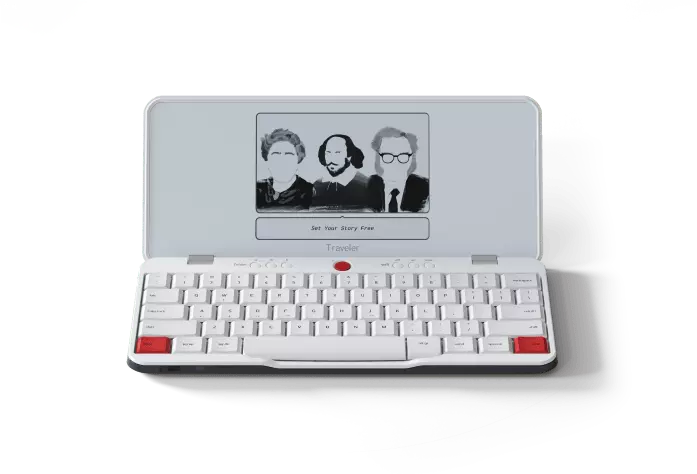
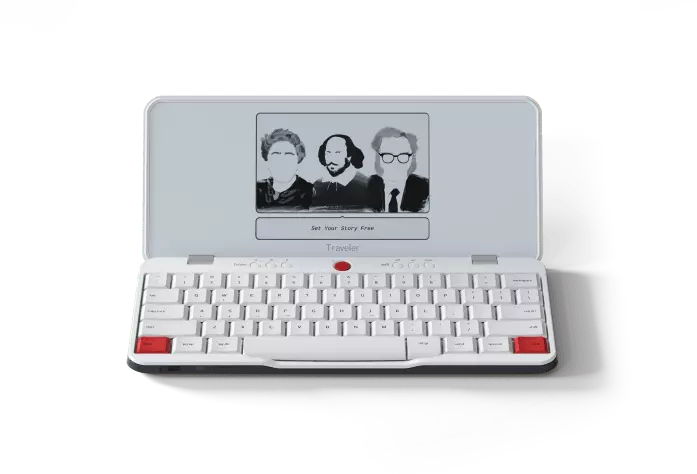
And sometimes, if I want to bring it on a plane, I've found it's replaced reading for me. Rather than pick up a book or bring a book on the plane, I bring Traveler and just kind of hang out in that space and see if anything comes up.

I've found that it's kind of like writing songs on a different instrument, you get different styles of music that you wouldn't have otherwise. I've found that writing from words towards music, I get different kinds of songs than I have in the past, which has been interesting.

In that way, like sitting at a piano, you just write differently than you do on a guitar, or even a bass, because of the things those instruments tend to encourage or that they can do.

It feels almost like a little synthesizer, a different kind of instrument that has unlocked a different kind of approach for me.

"I've found that it's kind of like writing songs on a different instrument, you get different styles of music that you wouldn't have otherwise... [Traveler] feels almost like a little synthesizer, a different kind of instrument that has unlocked a different kind of approach for me."

AC: As someone who doesn't know the first thing about writing music, that's fascinating. It's all magic to me.

AJ: Yeah.

AC: What else are you interested in writing?

AJ: I went to school for film directing. That was kind of what I thought I was going to do. And then my brother and I started the band and that kind of happened first and knocked me onto a different track for a little while after college.

Growing up, though, writing was my way into everything. In directing, I wanted to be in control of the thing that I wrote. And in music, it was the same — the songwriting really feels like it came from that same place. And then the idea of writing longer form, like fiction, almost feels just like the next step from song to EP to album to novel.

For whatever reason, that started feeling like a challenge that would be deeply related to the kinds of work that we do in the studio.

AC: Do you have any advice for aspiring songwriters?

AJ: This sounds like a cliche, but it's totally true: whatever success that I've had as a songwriter — judge that for yourself — but whatever success I have had, has been directly proportional to just writing the song that I wanted to hear.

What I mean by that is, even if you're being coldly, cynically, late-stage capitalist about it, it's by far the most success I've had. The good news is that you don't have to choose. And in fact, when you start making those little compromises, or even begin to inch in that direction, it just doesn't work. So you can forget about it.

Just make music you want to hear. And that will be the music that resonates with most people.

I think there's a temptation to have an imaginary focus group in your head of like 500 people. But the problem is all those people are fake. They're not real. None of those people are actually real people. You're a focus group of one, you're one real person. There are more real people in that focus group than in the imaginary one.

And I just don't think that we're that different, in the end. So that would be my advice.

AC: That seems like generally great creative advice. Because fiction writers talk about that too, right? Do you write to market or do you write the book you want to read. Same thing. And that imaginary focus group has been debilitating for me. I have to silence that focus group before I can write.

AJ: Absolutely.

"I think there's a temptation to have an imaginary focus group in your head of like 500 people. But the problem is all those people are fake... You're a focus group of one, you're one real person. There are more real people in that focus group than in the imaginary one."

--

Learn more about Abner James, his brother, and their band, Eighty Ninety, on Instagram.

novembre 29, 2025 4 lire la lecture

The Great Freewrite Séance: A Ghost'ly Charity Auction Full Terms & Conditions

These Terms and Conditions (“Terms”) govern participation in The Great Freewrite Séance: A Ghost'ly Charity Auction (“Auction”), organized by Freewrite (“Organizer,” “we,” “us,” or “our”). By registering for, bidding in, or otherwise participating in the Auction, you (“Participant,” “Bidder,” or “Winner”) agree to be bound by these Terms.

1. Auction Overview

1.1. The Auction offers for sale a limited number of Freewrite Traveler Ghost Edition units (“Items” or “Ghost Traveler units”), each personally signed and drawn on by a featured author.

1.2. All proceeds, net of explicitly disclosed administrative costs, will be donated to the charity or charitable initiative (“Charity”) identified on each auction item’s page, as chosen by the respective author.

2. Eligibility

2.1. Participants must be at least 18 years old or the age of majority in their jurisdiction, whichever is higher.

2.2. Employees of Freewrite, the participating authors, or any affiliates directly involved in the Auction are not eligible to bid.

2.3. By participating, you represent that you are legally permitted to take part in online auctions and to pay for any bids you win.

3. Auction Registration

3.1. Participants must create an account on the auction platform or otherwise register using accurate, current, and complete information.

3.2. Freewrite reserves the right to verify identity and to disqualify any Participant who provides false or misleading information.

4. Bidding Rules

4.1. All bids are binding, final, and non-retractable.

4.2. Bidders are responsible for monitoring their bids; Freewrite is not liable for missed notifications or technical issues on the auction platform or the Participant’s device.

4.3. Freewrite reserves the right to:

  • set minimum bids or bid increments;
  • reject bids deemed in bad faith or intended to disrupt the Auction;
  • extend, pause, or cancel the Auction in case of technical difficulties, fraud, or events beyond reasonable control.

5. Winning Bids and Payment

5.1. The highest valid bid at the close of the Auction is the Winning Bid, and the corresponding Participant becomes the Winner.

5.2. Winners will receive payment instructions and must complete payment within 48 hours of the auction’s close unless otherwise stated.

5.3. Failure to complete payment on time may result in forfeiture, and Freewrite may offer the Item to the next highest bidder.

5.4. Accepted payment methods will be listed on the Auction platform. All payments must be made in the currency specified.

6. Item Description and Condition

6.1. Each Ghost Traveler unit is authentic, and the signatures, doodles, and messages are original works created by the participating author. These are authors, not artists. By bidding on the Item, you acknowledge that you are receiving a one-of-a-kind unit marked with unique art and messages and you agree to these terms and conditions.

6.2. Because Items are customized and signed by hand, variations, imperfections, or unique marks are to be expected. These are considered part of the Item’s character and not defects.

6.3. Items are provided “as-is” and “as-available.” Freewrite makes no warranties of merchantability or fitness for a particular purpose.

7. Shipping & Delivery

7.1. Shipping costs, import duties, and taxes may apply unless explicitly stated otherwise.

7.2. Freewrite will make reasonable efforts to ship Items within the estimated timeline but cannot guarantee delivery dates.

7.3. Title and risk of loss transfer to the Winner upon delivery to the carrier.

7.4. Freewrite is not responsible for delays, damage, or loss caused by the courier or customs agencies.

8. Charity Donation

8.1. Net proceeds from the Auction will be donated to the Charity designated on each Item page.

8.2. Donation amounts and recipients may be disclosed publicly unless prohibited by law.

8.3. Winners acknowledge that they are purchasing Items, not making a tax-deductible donation to Freewrite; therefore, Winners will not receive charitable tax receipts unless Freewrite explicitly states otherwise in compliance with applicable laws.

9. Intellectual Property

9.1. All trademarks, brand names, product names, and creative materials associated with Freewrite and the Ghost Traveler remain the exclusive property of Freewrite or their respective rights holders.

9.2. Participants may not reproduce, distribute, or publicly display the authors’ doodles without permission where such rights are applicable, except as allowed by law (e.g., resale of the physical Item).

10. Privacy

10.1. By participating, you consent to Freewrite’s collection, use, and storage of your personal data in accordance with our Privacy Policy.

10.2. Freewrite may publicly announce auction results, including Winner’s first name, last initial, city, state/country, and winning bid amount unless prohibited by law or unless you formally request anonymity when possible.

11. Prohibited Conduct

Participants may not:

  • engage in bid manipulation, fraud, or collusive bidding;
  • use automated systems (bots, scripts, scrapers) to place or monitor bids;
  • interfere with the Auction, platform, or other participants

Freewrite may ban or disqualify any Participant violating these rules.

12. Limitation of Liability

To the fullest extent permitted by law:

12.1. Freewrite is not liable for indirect, incidental, special, or consequential damages arising from the Auction or purchase of Items.

12.2. Freewrite’s total liability in connection with these Terms shall not exceed the amount of the Winning Bid actually paid by the Participant.

12.3. Freewrite is not responsible for technical malfunctions, internet outages, system failures, or other issues beyond its control.

13. Cancellation and Force Majeure

Freewrite may cancel, postpone, or modify the Auction due to unforeseen circumstances, including but not limited to natural disasters, system failures, strikes, or events affecting participating authors or the Charity.

14. Governing Law & Dispute Resolution

14.1. These Terms are governed by the laws of Michigan, without regard to conflict-of-law rules.

14.2. Any disputes arising under these Terms will be resolved through binding arbitration or the courts of the specified jurisdiction, as applicable.

14.3. Participants waive any right to participate in class-action lawsuits relating to the Auction.

15. Amendments

Freewrite may update these Terms at any time. Continued participation in the Auction after updates constitutes acceptance of the revised Terms.

16. Contact Information

For questions or concerns regarding the Auction or these Terms, contact: hello@getfreewrite.com.

novembre 25, 2025 1 lire la lecture

This is a great gratitude writing exercise to be done alone or in a group, with people of any age.

How to Play

    1. Designate someone to read out each prompt below. (Feel free to add your own prompts.)
    2. After each prompt is read, set a timer for one minute. (With younger kids, this can be shortened. For older folks who want to freewrite meaningfully, more time can be added.)
    3. Each person freewrites by finishing the sentence and elaborating until the timer goes off. (For little kids, this can be done verbally with an adult recording their answers. Hilarity will ensue.)
    4. Remeber that freewriting — allowing yourself to write with abandon — enables you to let go, tapping into your subconscious to explore your thoughts more deeply.
    5. When everyone is done with all the prompts, take turns going through some your answers. Some people may be eager to share. Others may not want to. Respect their decision.

The Prompts

  • I'm grateful for... [After you've finished this prompt, repeat it five times. Challenge yourself and others not to repeat a singe word with each new answer.]
  • The silliest thing I'm grateful for is...
  • The littlest thing I'm grateful for is...
  • The biggest thing I'm grateful for is...
  • The grossest thing I'm grateful for is...
  • One thing I love about myself is...
  • My favorite thing that happened this year was...
  • My hope for next year is...

This writing exercise has resulted in some sweet answers — and many hilarious ones, too. If you try it out, do let us know.

Write on.