overlaylink

Comment écrire comme JRR Tolkien

Harrison Cook
octobre 03, 2024 | 5 lire la lecture

On imagine facilement J.R.R. Tolkien en train d'écrire chef-d'œuvre de fantasy après chef-d'œuvre. Après tout, c'est ainsi que nous lisons et vivons ses histoires aujourd'hui.

Mais en réalité, il a fallu à l’écrivain 14 ans et un processus d’écriture très intensif pour achever les écrits de la Terre du Milieu que nous connaissons et aimons aujourd’hui.

Tandis qu'il écrivait Le Hobbit , Tolkien travaillait simultanément sur les écrits qui allaient devenir Le Silmarillion . Ce recueil deviendrait plus tard le « livre d'histoire » de la Terre du Milieu, détaillant les races, les langues, les régions, la géographie et l'histoire de ce monde fantastique.

Ce niveau de détail n'étonnera aucun fan de Tolkien, car ses livres incluent généralement des dessins à la main des monuments, des plans, des ruines et des alphabets. Mais ce qui pourrait surprendre même les plus fervents fans de Tolkien, c'est qu'il a d'abord imaginé le monde – en commençant par la carte – puis qu'il a créé une histoire qui lui corresponde. Cela illustre ce que Tolkien appelait son sens de la « découverte ».

Examinons quatre concepts sur lesquels Tolkien s’est appuyé pour créer son monde qui a défini le genre.

1. Tolkien a utilisé l'écriture libre

Tolkien, alors professeur, a écrit la première phrase du Hobbit – « Dans un trou creusé dans la terre vivait un hobbit » – sur une feuille vierge d'un devoir d'étudiant. L'inspiration et la découverte peuvent surgir à tout moment, même lorsqu'on corrige une montagne de travaux de licence ou qu'on effectue d'autres tâches monotones.

Cherchant à intégrer son immense monde dans un récit, Tolkien se perdait souvent dans l'histoire avant de comprendre qu'il avait une histoire. Par exemple, il créa l'histoire des objets magiques destinés aux sorciers (les cinq bâtons) avant de les caractériser. Gandalf, étrangement absent des premières ébauches de La Communauté , devint pourtant de plus en plus actif au fil du voyage. Mais Saroumane, dès le début, commanda toujours la tour d'Isengard.

Tolkien, alors professeur, a écrit la première phrase du Hobbit — « Dans un trou dans le sol vivait un hobbit » — sur une feuille de papier vierge provenant d'un devoir d'un étudiant.

Tolkien avait cette tendance, souvent décrite dans ses lettres à ses proches, à écrire quelque chose, à construire un personnage autour, puis à le décrire comme un peintre peignant un tableau. Une étape en entraîne une autre, et cela se produisait si naturellement que Tolkien oubliait souvent qu'il l'avait fait.

Par exemple, il n'avait aucun souvenir d'avoir écrit des Ents dans le monde, même si Les Deux Tours ne seraient pas les mêmes sans Barbe-d'Arbre.

Dans l'une de ses lettres, Tolkien raconte avoir écrit le premier chapitre du Hobbit , l'avoir oublié, puis être passé à un autre chapitre.

« Je vois encore les trous. Il y en a un très grand après qu'ils aient atteint le nid des Aigles. Après ça, je ne savais vraiment pas comment continuer. J'ai simplement inventé des histoires à partir d'éléments dans ma tête. Je ne me souviens pas avoir organisé le tout. »

Tolkien était également un réviseur en série ; la majeure partie de son travail d'écriture consistait donc à coucher ses écrits sur le papier, un peu comme l'écriture libre ou la façon dont un peintre applique des couches de peinture. Finalement, tout cela forme une image cohérente.

La majeure partie de sa pratique d'écriture consistait simplement à coucher ses œuvres sur le papier, un peu comme l'écriture libre ou la façon dont un peintre applique des couches de peinture. Finalement, tout cela forme une image cohérente.

2. Tolkien a été largement révisé

Tolkien est allé jusqu'à créer plusieurs langues fictives pour son monde ; il n'est donc pas surprenant qu'il ait passé par plusieurs concepts et ébauches tout au long de son processus de révision. Il a célébré le changement dans presque tous les aspects de sa pratique d'écriture, depuis les changements de noms de lieux et de personnages entre chaque ébauche jusqu'aux itinéraires empruntés par les personnages sur sa carte dessinée à la main.

Il est noté dans L'Histoire de la Terre du Milieu qu'un assistant d'édition devait récupérer les pages fraîches de Tolkien avant qu'il ait le temps de les réviser, car il avait du mal à s'arrêter. Le perfectionnisme est vraiment pénible.

L'assistant d'édition suivait également les modifications de Tolkien (principalement les noms et les lieux) pour voir si elles changeaient au cours du processus de révision. Il n'y a probablement pas de changement plus important que celui concernant le roi lui-même, Aragorn.

À l'origine, Tolkien avait imaginé Aragorn comme un personnage hobbit appelé « Trotter ». Cependant, il se demandait comment intégrer Trotter à l'histoire existante. En amont, il semblait que Frodon avait suffisamment d'aide pour le mener à Fondcombe. Ainsi, Trotter, de hobbit, se métamorphosa en rôdeur elfique, puis en rôdeur humain, et enfin en rôdeur humain aux prétentions royales que l'on retrouve dans la série.

…Un assistant d'édition aurait dû récupérer les nouvelles pages de Tolkien avant qu'il ait eu le temps de les réviser, car il avait du mal à s'arrêter. Le perfectionnisme est vraiment pénible.

3. Tolkien a fait des pauses créatives

Cherchez n'importe quelle photographie de JRR Tolkien et vous trouverez au moins deux points communs : il est généralement représenté entouré d'une bibliothèque de livres et généralement avec sa pipe.

Tolkien — et ses personnages du Seigneur des Anneaux — fumaient pour se détendre et profiter du confort simple de la vie, une pratique courante à l'époque. Professeur à Oxford et spécialiste de littérature, il lisait aussi beaucoup. Mais surtout, il laissait libre cours à sa créativité.

Lorsqu'il se lassait d'écrire, Tolkien se consacrait à un autre projet, comme pratiquer la calligraphie de l'alphabet elfique ou faire des croquis détaillés de monuments mystiques qu'il voulait que le lecteur se représente précisément au cours de son voyage avec le livre.

Dans les premières phases de la Terre du Milieu, Tolkien commençait souvent par une carte et complétait sa typographie. Les caractéristiques physiques de la carte se traduiraient plus tard par des obstacles physiques que ses personnages devraient surmonter.

En fait, Tolkien utilisait fréquemment une machine à écrire pour écrire, car il souffrait de crampes à la main à force de travailler à la plume. Dans ses lettres à ses amis, qui constituent une autre bonne pause dans son écriture créative, il s'excusait que cette correspondance ne soit pas manuscrite.

Peut-être plus important encore, [Tolkien] a laissé sa créativité s’exprimer d’autres manières.

4. Tolkien savait qu'écrire était un marathon

Il a fallu quatorze ans à Tolkien pour achever Le Seigneur des Anneaux , y compris quelques livres supplémentaires sur la Terre du Milieu. Dans des interviews, il affirme avoir créé Sauron et Morgoth alors qu'il était étudiant, des années avant d'écrire la première phrase du Hobbit .

Cela prouve simplement que le vieil adage est vrai : écrire est un marathon, pas un sprint.

En prenant son temps, Tolkien a pu créer à la main des cartes riches en géographie, en histoire et en détails incroyables. Ce faisant, il nous a offert l'une des séries de fantasy les plus riches et les plus appréciées de tous les temps.

Tolkien a su créer des cartes à la main, riches en géographie, en histoire et en détails incroyables. Ce faisant, il nous a offert l'une des séries de fantasy les plus riches et les plus appréciées de tous les temps.

[RETOUR À « CE QUE LES ÉCRIVAIN PEUVENT APPRENDRE DE JRR TOLKIEN. »]

Ressources

La Zone Histoire. « Https://Www.Youtube.Com/Watch?v=mV9A50Bkf1A ». YouTube, 1962, www.youtube.com/watch?v=mV9A50Bkf1A.

Les lettres de JRR Tolkien , éditées par Christopher Tolkien et Humphrey Carpenter, HarperCollins, 1981.

Tolkien, JRR et Christopher Tolkien. Histoire de la Terre du Milieu . Houghton Mifflin Harcourt, 2020.

Wayne G. Hammond et Christina Scull, L'Art du Seigneur des Anneaux de J.R.R. Tolkien . Londres : HarperCollins, 2015.

Zaleski, Philip et Carol Zaleski. La Communauté : La vie littéraire des Inklings . États-Unis : Farrar, Straus et Giroux, 2015.
décembre 10, 2025 6 lire la lecture

Singer-songwriter Abner James finds his creativity in the quiet freedom of analog tools. Learn how his creative process transcends different media.

Abner James went to school for film directing. But the success of the band he and his brother formed together, Eighty Ninety, knocked him onto a different trajectory.

The band has accrued more than 40 million streams since the release of their debut EP “Elizabeth," and their work was even co-signed by Taylor Swift when the singer added Eighty Ninety to her playlist "Songs Taylor Loves.”

Now, Abner is returning to long-form writing in addition to songwriting, and with a change in media comes an examination of the creative process. We sat down to chat about what's the same — and what's different. 

ANNIE COSBY: Tell us about your songwriting process.

ABNER JAMES: The way I tend to write my songs is hunched over a guitar and just seeing what comes. Sounds become words become shapes. It's a very physical process that is really about turning my brain off.

And one of the things that occurred to me when I was traveling, actually, was that I would love to be able to do that but from a writing perspective. What would happen if I sat down and approached writing in the same way that I approached music? In a more intuitive and free-form kind of way? What would that dig up?

AC: That's basically the ethos of Freewrite.

AJ: Yes. We had just put out a record, and I was thinking about how to get into writing for the next one. It occurred to me that regardless of how I started, I always finished on a screen. And I wondered: what's the acoustic guitar version of writing?

Where there's not blue light hitting me in the face. Even if I'm using my Notes app, it's the same thing. It really gets me into a different mindset.

 "I wondered: what's the acoustic guitar version of writing?"

I grew up playing piano. That was my first instrument. And I found an old typewriter at a thrift store, and I love it. It actually reminded me a lot of playing piano, the kind of physical, the feeling of it. And it was really fun, but pretty impractical, especially because I travel a fair amount.

And so I wondered, is there such a thing as a digital typewriter? And I googled it, and I found Freewrite.

AC: What about Freewrite helps you write?

AJ:I think, pragmatically, just the E Ink screen is a huge deal, because it doesn't exhaust me in the same way. And the idea of having a tool specifically set aside for the process is appealing in an aesthetic way but also a mental-emotional way. When it comes out, it's kind of like ... It's like having an office you work out of. It's just for that.

"The way I tend to write my songs is hunched over a guitar and just seeing what comes. Sounds become words become shapes. It's a very physical process that is really about turning my brain off."

And all of the pragmatic limitations — like you're not getting texts on it, and you're not doing all that stuff on the internet — that's really helpful, too. But just having the mindset....

When I pick up a guitar, or I sit down at the piano, it very much puts me into that space. Having a tool just for words does the same thing. I find that to be really cool and inspiring.

"When I pick up a guitar, or I sit down at the piano, it very much puts me into that space. Having a tool just for words does the same thing."

AC: So mentally it gets you ready for writing.

AJ: Yeah, and also, when you write a Microsoft Word, it looks so finished that it's hard to keep going. If every time I strummed a chord, I was hearing it back, mixed and mastered and produced...?

It's hard to stay in that space when I'm seeing it fully written out and formatted in, like, Times New Roman, looking all seriously back at me.

AC: I get that. I have terrible instincts to edit stuff over and over again and never finish a story.

AJ:  Also, the way you just open it and it's ready to go. So you don't have the stages of the computer turning on, that kind of puts this pressure, this tension on.

It's working at the edges in all these different ways that on their own could feel a little bit like it's not really necessary. All these amorphous things where you could look at it and be like, well, I don't really need any of those. But they add up to a critical mass that actually is significant.

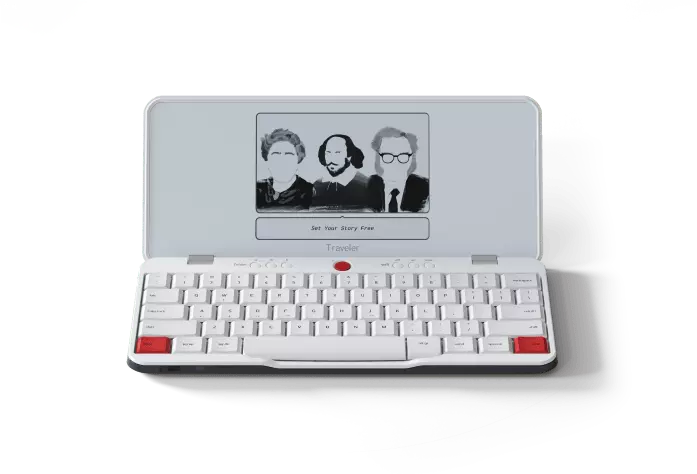
And sometimes, if I want to bring it on a plane, I've found it's replaced reading for me. Rather than pick up a book or bring a book on the plane, I bring Traveler and just kind of hang out in that space and see if anything comes up.

I've found that it's kind of like writing songs on a different instrument, you get different styles of music that you wouldn't have otherwise. I've found that writing from words towards music, I get different kinds of songs than I have in the past, which has been interesting.

In that way, like sitting at a piano, you just write differently than you do on a guitar, or even a bass, because of the things those instruments tend to encourage or that they can do.

It feels almost like a little synthesizer, a different kind of instrument that has unlocked a different kind of approach for me.

"I've found that it's kind of like writing songs on a different instrument, you get different styles of music that you wouldn't have otherwise... [Traveler] feels almost like a little synthesizer, a different kind of instrument that has unlocked a different kind of approach for me."

AC: As someone who doesn't know the first thing about writing music, that's fascinating. It's all magic to me.

AJ: Yeah.

AC: What else are you interested in writing?

AJ: I went to school for film directing. That was kind of what I thought I was going to do. And then my brother and I started the band and that kind of happened first and knocked me onto a different track for a little while after college.

Growing up, though, writing was my way into everything. In directing, I wanted to be in control of the thing that I wrote. And in music, it was the same — the songwriting really feels like it came from that same place. And then the idea of writing longer form, like fiction, almost feels just like the next step from song to EP to album to novel.

For whatever reason, that started feeling like a challenge that would be deeply related to the kinds of work that we do in the studio.

AC: Do you have any advice for aspiring songwriters?

AJ: This sounds like a cliche, but it's totally true: whatever success that I've had as a songwriter — judge that for yourself — but whatever success I have had, has been directly proportional to just writing the song that I wanted to hear.

What I mean by that is, even if you're being coldly, cynically, late-stage capitalist about it, it's by far the most success I've had. The good news is that you don't have to choose. And in fact, when you start making those little compromises, or even begin to inch in that direction, it just doesn't work. So you can forget about it.

Just make music you want to hear. And that will be the music that resonates with most people.

I think there's a temptation to have an imaginary focus group in your head of like 500 people. But the problem is all those people are fake. They're not real. None of those people are actually real people. You're a focus group of one, you're one real person. There are more real people in that focus group than in the imaginary one.

And I just don't think that we're that different, in the end. So that would be my advice.

AC: That seems like generally great creative advice. Because fiction writers talk about that too, right? Do you write to market or do you write the book you want to read. Same thing. And that imaginary focus group has been debilitating for me. I have to silence that focus group before I can write.

AJ: Absolutely.

"I think there's a temptation to have an imaginary focus group in your head of like 500 people. But the problem is all those people are fake... You're a focus group of one, you're one real person. There are more real people in that focus group than in the imaginary one."

--

Learn more about Abner James, his brother, and their band, Eighty Ninety, on Instagram.

novembre 29, 2025 4 lire la lecture

The Great Freewrite Séance: A Ghost'ly Charity Auction Full Terms & Conditions

These Terms and Conditions (“Terms”) govern participation in The Great Freewrite Séance: A Ghost'ly Charity Auction (“Auction”), organized by Freewrite (“Organizer,” “we,” “us,” or “our”). By registering for, bidding in, or otherwise participating in the Auction, you (“Participant,” “Bidder,” or “Winner”) agree to be bound by these Terms.

1. Auction Overview

1.1. The Auction offers for sale a limited number of Freewrite Traveler Ghost Edition units (“Items” or “Ghost Traveler units”), each personally signed and drawn on by a featured author.

1.2. All proceeds, net of explicitly disclosed administrative costs, will be donated to the charity or charitable initiative (“Charity”) identified on each auction item’s page, as chosen by the respective author.

2. Eligibility

2.1. Participants must be at least 18 years old or the age of majority in their jurisdiction, whichever is higher.

2.2. Employees of Freewrite, the participating authors, or any affiliates directly involved in the Auction are not eligible to bid.

2.3. By participating, you represent that you are legally permitted to take part in online auctions and to pay for any bids you win.

3. Auction Registration

3.1. Participants must create an account on the auction platform or otherwise register using accurate, current, and complete information.

3.2. Freewrite reserves the right to verify identity and to disqualify any Participant who provides false or misleading information.

4. Bidding Rules

4.1. All bids are binding, final, and non-retractable.

4.2. Bidders are responsible for monitoring their bids; Freewrite is not liable for missed notifications or technical issues on the auction platform or the Participant’s device.

4.3. Freewrite reserves the right to:

  • set minimum bids or bid increments;
  • reject bids deemed in bad faith or intended to disrupt the Auction;
  • extend, pause, or cancel the Auction in case of technical difficulties, fraud, or events beyond reasonable control.

5. Winning Bids and Payment

5.1. The highest valid bid at the close of the Auction is the Winning Bid, and the corresponding Participant becomes the Winner.

5.2. Winners will receive payment instructions and must complete payment within 48 hours of the auction’s close unless otherwise stated.

5.3. Failure to complete payment on time may result in forfeiture, and Freewrite may offer the Item to the next highest bidder.

5.4. Accepted payment methods will be listed on the Auction platform. All payments must be made in the currency specified.

6. Item Description and Condition

6.1. Each Ghost Traveler unit is authentic, and the signatures, doodles, and messages are original works created by the participating author. These are authors, not artists. By bidding on the Item, you acknowledge that you are receiving a one-of-a-kind unit marked with unique art and messages and you agree to these terms and conditions.

6.2. Because Items are customized and signed by hand, variations, imperfections, or unique marks are to be expected. These are considered part of the Item’s character and not defects.

6.3. Items are provided “as-is” and “as-available.” Freewrite makes no warranties of merchantability or fitness for a particular purpose.

7. Shipping & Delivery

7.1. Shipping costs, import duties, and taxes may apply unless explicitly stated otherwise.

7.2. Freewrite will make reasonable efforts to ship Items within the estimated timeline but cannot guarantee delivery dates.

7.3. Title and risk of loss transfer to the Winner upon delivery to the carrier.

7.4. Freewrite is not responsible for delays, damage, or loss caused by the courier or customs agencies.

8. Charity Donation

8.1. Net proceeds from the Auction will be donated to the Charity designated on each Item page.

8.2. Donation amounts and recipients may be disclosed publicly unless prohibited by law.

8.3. Winners acknowledge that they are purchasing Items, not making a tax-deductible donation to Freewrite; therefore, Winners will not receive charitable tax receipts unless Freewrite explicitly states otherwise in compliance with applicable laws.

9. Intellectual Property

9.1. All trademarks, brand names, product names, and creative materials associated with Freewrite and the Ghost Traveler remain the exclusive property of Freewrite or their respective rights holders.

9.2. Participants may not reproduce, distribute, or publicly display the authors’ doodles without permission where such rights are applicable, except as allowed by law (e.g., resale of the physical Item).

10. Privacy

10.1. By participating, you consent to Freewrite’s collection, use, and storage of your personal data in accordance with our Privacy Policy.

10.2. Freewrite may publicly announce auction results, including Winner’s first name, last initial, city, state/country, and winning bid amount unless prohibited by law or unless you formally request anonymity when possible.

11. Prohibited Conduct

Participants may not:

  • engage in bid manipulation, fraud, or collusive bidding;
  • use automated systems (bots, scripts, scrapers) to place or monitor bids;
  • interfere with the Auction, platform, or other participants

Freewrite may ban or disqualify any Participant violating these rules.

12. Limitation of Liability

To the fullest extent permitted by law:

12.1. Freewrite is not liable for indirect, incidental, special, or consequential damages arising from the Auction or purchase of Items.

12.2. Freewrite’s total liability in connection with these Terms shall not exceed the amount of the Winning Bid actually paid by the Participant.

12.3. Freewrite is not responsible for technical malfunctions, internet outages, system failures, or other issues beyond its control.

13. Cancellation and Force Majeure

Freewrite may cancel, postpone, or modify the Auction due to unforeseen circumstances, including but not limited to natural disasters, system failures, strikes, or events affecting participating authors or the Charity.

14. Governing Law & Dispute Resolution

14.1. These Terms are governed by the laws of Michigan, without regard to conflict-of-law rules.

14.2. Any disputes arising under these Terms will be resolved through binding arbitration or the courts of the specified jurisdiction, as applicable.

14.3. Participants waive any right to participate in class-action lawsuits relating to the Auction.

15. Amendments

Freewrite may update these Terms at any time. Continued participation in the Auction after updates constitutes acceptance of the revised Terms.

16. Contact Information

For questions or concerns regarding the Auction or these Terms, contact: hello@getfreewrite.com.

novembre 25, 2025 1 lire la lecture

This is a great gratitude writing exercise to be done alone or in a group, with people of any age.

How to Play

    1. Designate someone to read out each prompt below. (Feel free to add your own prompts.)
    2. After each prompt is read, set a timer for one minute. (With younger kids, this can be shortened. For older folks who want to freewrite meaningfully, more time can be added.)
    3. Each person freewrites by finishing the sentence and elaborating until the timer goes off. (For little kids, this can be done verbally with an adult recording their answers. Hilarity will ensue.)
    4. Remeber that freewriting — allowing yourself to write with abandon — enables you to let go, tapping into your subconscious to explore your thoughts more deeply.
    5. When everyone is done with all the prompts, take turns going through some your answers. Some people may be eager to share. Others may not want to. Respect their decision.

The Prompts

  • I'm grateful for... [After you've finished this prompt, repeat it five times. Challenge yourself and others not to repeat a singe word with each new answer.]
  • The silliest thing I'm grateful for is...
  • The littlest thing I'm grateful for is...
  • The biggest thing I'm grateful for is...
  • The grossest thing I'm grateful for is...
  • One thing I love about myself is...
  • My favorite thing that happened this year was...
  • My hope for next year is...

This writing exercise has resulted in some sweet answers — and many hilarious ones, too. If you try it out, do let us know.

Write on.