overlaylink

¿Qué pierde el mundo cuando muere una lengua?

Emily Pogue
diciembre 08, 2024 | 5 lectura mínima

Cada 40 días muere otro, extinguiéndose para siempre.

Para el año 2100, se habrán perdido 3.500.

No hablamos de una especie animal ni de una variedad vegetal. Hablamos de idiomas, la base de la comunicación humana tal como la conocemos.

A lo largo de los siglos, ciertas lenguas se han popularizado, mientras que otras han desaparecido debido a factores como el comercio, la migración y la opresión. Hoy en día, de las 7000 lenguas que aún se hablan, la mitad de la población mundial habla solo 23 .

Esto significa que hay miles de lenguas con sólo unos pocos cientos, o incluso una docena, de hablantes, lo que supone el precursor de la muerte de una lengua.

Cómo se ve la muerte de un idioma

Si bien un idioma puede ser rápidamente eliminado de la Tierra, como en el caso de un genocidio o de una censura gubernamental, suele ser un proceso más lento.

Las comunidades que hablan una lengua única pueden reducirse, hasta el punto de que solo queden unos pocos hablantes con fluidez. El punto final del léxico llega cuando los jóvenes dejan de aprender su lengua materna. Entonces, la lengua desaparece con el último aliento del último hablante.

Los factores externos que afectan la pérdida del lenguaje

Desafortunadamente, algunos de los lugares con mayor riqueza lingüística del mundo son también los más amenazados por el cambio climático. Aproximadamente el 20% de todas las lenguas se concentran en la región del Pacífico , que también es la zona con más residentes desplazados debido al clima severo y al aumento del nivel del mar.

Otro factor que contribuye a la pérdida del lenguaje es la tecnología, en particular la IA. Los modelos de IA generativa más populares, como ChatGPT , utilizan casi exclusivamente el inglés para generar sus respuestas. Esto significa que, a medida que nos volvemos más dependientes de la IA, los idiomas más pequeños que no están incorporados a la tecnología pueden volverse más difíciles de usar y hablar.

Entonces, ¿por qué deberíamos esforzarnos en salvar estos idiomas pequeños, cuando puede ser más eficiente para la gente adoptar los idiomas más populares?

Porque nuestros pensamientos, creencias y salud mental pueden verse afectados por el idioma que hablamos.

¿El lenguaje moldea el pensamiento?

El lenguaje nos permite nombrar un objeto, por supuesto, pero también definir nuestros pensamientos y sentimientos. Incluso podemos tener una mayor conciencia de un concepto porque tenemos una palabra para él.

Por ejemplo, la palabra danesa «hygge» ha ganado popularidad recientemente en línea. Muchos angloparlantes la han traducido como «acogedor», pero en realidad tiene un significado más profundo. Puede definir un momento especial entre seres queridos o la práctica de amor propio. Dado que esta palabra forma parte común de su repertorio verbal, los daneses podrían ser más conscientes de dedicar tiempo al hygge que los angloparlantes.

Para profundizar en este punto, podemos observar directamente los efectos de no tener una palabra en el vocabulario de la tribu Himba de Namibia. En el idioma Himba, no existe una palabra para el color azul.

Aunque no tengan una palabra para el azul, se podría suponer que pueden ver el color. Sin embargo, un experimento demostró que a los miembros de la tribu les costaba más diferenciar el azul de otros colores. Esto sugiere que nuestro vocabulario puede influir en cómo observamos nuestro entorno.

Estos ejemplos siguen la teoría del “Whorfianismo”: que el lenguaje moldea la realidad que vemos y los pensamientos que experimentamos.

Aunque algunos científicos sostienen que esto es cierto, otros creen que el lenguaje tiene un papel menos importante en nuestro pensamiento crítico, ya que a menudo podemos experimentar cosas para las que no tenemos palabras.

Cómo la gramática puede afectar nuestras creencias

El lenguaje no se trata solo de vocabulario. Cada lengua materna también tiene estructuras gramaticales únicas. En muchos idiomas, por ejemplo, los sustantivos tienen un "género gramatical".

Incluso esta simple categorización tiene un impacto duradero en nuestra percepción de una palabra. Por ejemplo, «muerte» es una palabra masculina en alemán, pero femenina en ruso. Si comparamos las pinturas de ambos países, veremos que los artistas alemanes tienden a representar la muerte como un hombre , mientras que los rusos la pintan con mayor frecuencia como una mujer.

¿Influye la percepción de la muerte como masculina o femenina en nuestra forma de pensar sobre la idea de morir? ¿Podría esta asociación afectar nuestra percepción de los hombres o las mujeres a nivel fundamental?

Si bien esto es difícil de probar, el punto muestra cuán profundamente la estructura del lenguaje puede penetrar nuestra psique.

Los beneficios para la salud mental de hablar la lengua materna

Preservar las lenguas menos populares no solo es importante para una cultura, sino que también puede tener implicaciones directas para una persona. Por ejemplo, un estudio reveló que un adolescente de una comunidad indígena que no dominaba bien su lengua materna tenía seis veces más probabilidades de tener ideas suicidas.

Al mismo tiempo, los adolescentes que hablaban con fluidez su lengua materna tenían menos probabilidades de abusar de las drogas y el alcohol.

Las investigaciones han demostrado que, para personas de todas las edades, hablar la lengua materna puede tener un impacto positivo en la visión que una persona tiene de su herencia, cultura e identidad .

¿Qué podemos hacer entonces para salvar estos importantes léxicos?

Modelado de una reimplementación exitosa del lenguaje

Una lengua moribunda puede resucitar: basta con mirar el Estado Aloha para inspirarse.

El idioma hawaiano nativo se había reducido a tan solo 2.000 hablantes en la década de 1980, cuando los lugareños exigieron medidas. Se abrieron escuelas de inmersión lingüística para niños de tan solo tres años, y hoy en día, 18.000 personas en Hawái hablan el idioma con fluidez .

Otras lenguas pequeñas pueden tomar Hawái como modelo a seguir. Y a todos nos interesa ayudar.

La popular aplicación de idiomas, Duolingo, tiene un curso en hawaiano y también tiene planes de agregar otros idiomas en peligro de extinción.

El presidente de Irlanda agradeció públicamente a los voluntarios que trabajaron en el curso de irlandés en la aplicación después de que aumentó la exposición al idioma irlandés a una asombrosa cantidad de 3 millones de usuarios, en marcado contraste con sus aproximadamente 30.000 hablantes nativos .

Ya sea que sea un hablante nativo de una lengua en peligro de extinción o simplemente esté interesado en el papel de la lengua en la sociedad, todos podemos ayudar a generar conciencia sobre este desafío.

Con suficiente apoyo y entusiasmo, quizá se puedan salvar unas cuantas víctimas más del cementerio lingüístico.
diciembre 18, 2025 5 lectura mínima

¿Qué pueden enseñar las cartas personales de Jane Austen a los escritores?

diciembre 10, 2025 6 lectura mínima

Singer-songwriter Abner James finds his creativity in the quiet freedom of analog tools. Learn how his creative process transcends different media.

Abner James went to school for film directing. But the success of the band he and his brother formed together, Eighty Ninety, knocked him onto a different trajectory.

The band has accrued more than 40 million streams since the release of their debut EP “Elizabeth," and their work was even co-signed by Taylor Swift when the singer added Eighty Ninety to her playlist "Songs Taylor Loves.”

Now, Abner is returning to long-form writing in addition to songwriting, and with a change in media comes an examination of the creative process. We sat down to chat about what's the same — and what's different. 

ANNIE COSBY: Tell us about your songwriting process.

ABNER JAMES: The way I tend to write my songs is hunched over a guitar and just seeing what comes. Sounds become words become shapes. It's a very physical process that is really about turning my brain off.

And one of the things that occurred to me when I was traveling, actually, was that I would love to be able to do that but from a writing perspective. What would happen if I sat down and approached writing in the same way that I approached music? In a more intuitive and free-form kind of way? What would that dig up?

AC: That's basically the ethos of Freewrite.

AJ: Yes. We had just put out a record, and I was thinking about how to get into writing for the next one. It occurred to me that regardless of how I started, I always finished on a screen. And I wondered: what's the acoustic guitar version of writing?

Where there's not blue light hitting me in the face. Even if I'm using my Notes app, it's the same thing. It really gets me into a different mindset.

 "I wondered: what's the acoustic guitar version of writing?"

I grew up playing piano. That was my first instrument. And I found an old typewriter at a thrift store, and I love it. It actually reminded me a lot of playing piano, the kind of physical, the feeling of it. And it was really fun, but pretty impractical, especially because I travel a fair amount.

And so I wondered, is there such a thing as a digital typewriter? And I googled it, and I found Freewrite.

AC: What about Freewrite helps you write?

AJ:I think, pragmatically, just the E Ink screen is a huge deal, because it doesn't exhaust me in the same way. And the idea of having a tool specifically set aside for the process is appealing in an aesthetic way but also a mental-emotional way. When it comes out, it's kind of like ... It's like having an office you work out of. It's just for that.

"The way I tend to write my songs is hunched over a guitar and just seeing what comes. Sounds become words become shapes. It's a very physical process that is really about turning my brain off."

And all of the pragmatic limitations — like you're not getting texts on it, and you're not doing all that stuff on the internet — that's really helpful, too. But just having the mindset....

When I pick up a guitar, or I sit down at the piano, it very much puts me into that space. Having a tool just for words does the same thing. I find that to be really cool and inspiring.

"When I pick up a guitar, or I sit down at the piano, it very much puts me into that space. Having a tool just for words does the same thing."

AC: So mentally it gets you ready for writing.

AJ: Yeah, and also, when you write a Microsoft Word, it looks so finished that it's hard to keep going. If every time I strummed a chord, I was hearing it back, mixed and mastered and produced...?

It's hard to stay in that space when I'm seeing it fully written out and formatted in, like, Times New Roman, looking all seriously back at me.

AC: I get that. I have terrible instincts to edit stuff over and over again and never finish a story.

AJ:  Also, the way you just open it and it's ready to go. So you don't have the stages of the computer turning on, that kind of puts this pressure, this tension on.

It's working at the edges in all these different ways that on their own could feel a little bit like it's not really necessary. All these amorphous things where you could look at it and be like, well, I don't really need any of those. But they add up to a critical mass that actually is significant.

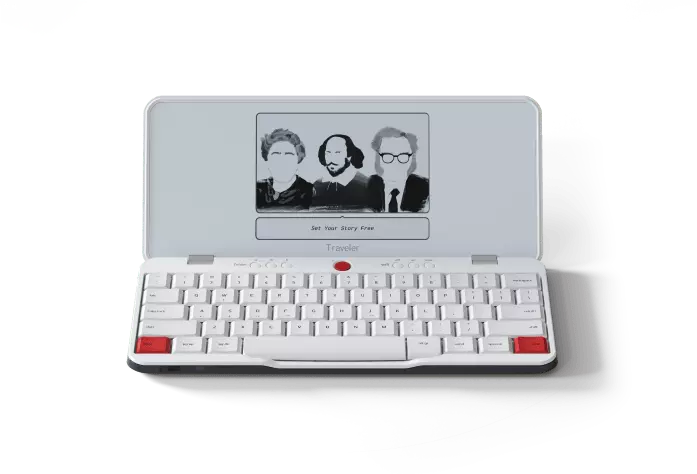
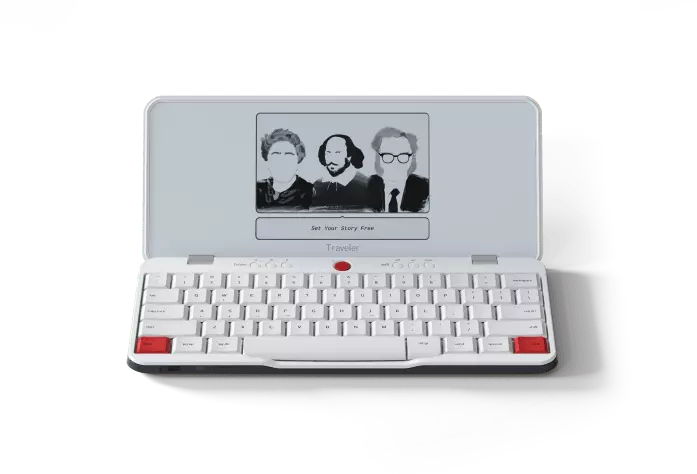
And sometimes, if I want to bring it on a plane, I've found it's replaced reading for me. Rather than pick up a book or bring a book on the plane, I bring Traveler and just kind of hang out in that space and see if anything comes up.

I've found that it's kind of like writing songs on a different instrument, you get different styles of music that you wouldn't have otherwise. I've found that writing from words towards music, I get different kinds of songs than I have in the past, which has been interesting.

In that way, like sitting at a piano, you just write differently than you do on a guitar, or even a bass, because of the things those instruments tend to encourage or that they can do.

It feels almost like a little synthesizer, a different kind of instrument that has unlocked a different kind of approach for me.

"I've found that it's kind of like writing songs on a different instrument, you get different styles of music that you wouldn't have otherwise... [Traveler] feels almost like a little synthesizer, a different kind of instrument that has unlocked a different kind of approach for me."

AC: As someone who doesn't know the first thing about writing music, that's fascinating. It's all magic to me.

AJ: Yeah.

AC: What else are you interested in writing?

AJ: I went to school for film directing. That was kind of what I thought I was going to do. And then my brother and I started the band and that kind of happened first and knocked me onto a different track for a little while after college.

Growing up, though, writing was my way into everything. In directing, I wanted to be in control of the thing that I wrote. And in music, it was the same — the songwriting really feels like it came from that same place. And then the idea of writing longer form, like fiction, almost feels just like the next step from song to EP to album to novel.

For whatever reason, that started feeling like a challenge that would be deeply related to the kinds of work that we do in the studio.

AC: Do you have any advice for aspiring songwriters?

AJ: This sounds like a cliche, but it's totally true: whatever success that I've had as a songwriter — judge that for yourself — but whatever success I have had, has been directly proportional to just writing the song that I wanted to hear.

What I mean by that is, even if you're being coldly, cynically, late-stage capitalist about it, it's by far the most success I've had. The good news is that you don't have to choose. And in fact, when you start making those little compromises, or even begin to inch in that direction, it just doesn't work. So you can forget about it.

Just make music you want to hear. And that will be the music that resonates with most people.

I think there's a temptation to have an imaginary focus group in your head of like 500 people. But the problem is all those people are fake. They're not real. None of those people are actually real people. You're a focus group of one, you're one real person. There are more real people in that focus group than in the imaginary one.

And I just don't think that we're that different, in the end. So that would be my advice.

AC: That seems like generally great creative advice. Because fiction writers talk about that too, right? Do you write to market or do you write the book you want to read. Same thing. And that imaginary focus group has been debilitating for me. I have to silence that focus group before I can write.

AJ: Absolutely.

"I think there's a temptation to have an imaginary focus group in your head of like 500 people. But the problem is all those people are fake... You're a focus group of one, you're one real person. There are more real people in that focus group than in the imaginary one."

--

Learn more about Abner James, his brother, and their band, Eighty Ninety, on Instagram.

noviembre 29, 2025 4 lectura mínima

The Great Freewrite Séance: A Ghost'ly Charity Auction Full Terms & Conditions

These Terms and Conditions (“Terms”) govern participation in The Great Freewrite Séance: A Ghost'ly Charity Auction (“Auction”), organized by Freewrite (“Organizer,” “we,” “us,” or “our”). By registering for, bidding in, or otherwise participating in the Auction, you (“Participant,” “Bidder,” or “Winner”) agree to be bound by these Terms.

1. Auction Overview

1.1. The Auction offers for sale a limited number of Freewrite Traveler Ghost Edition units (“Items” or “Ghost Traveler units”), each personally signed and drawn on by a featured author.

1.2. All proceeds, net of explicitly disclosed administrative costs, will be donated to the charity or charitable initiative (“Charity”) identified on each auction item’s page, as chosen by the respective author.

2. Eligibility

2.1. Participants must be at least 18 years old or the age of majority in their jurisdiction, whichever is higher.

2.2. Employees of Freewrite, the participating authors, or any affiliates directly involved in the Auction are not eligible to bid.

2.3. By participating, you represent that you are legally permitted to take part in online auctions and to pay for any bids you win.

3. Auction Registration

3.1. Participants must create an account on the auction platform or otherwise register using accurate, current, and complete information.

3.2. Freewrite reserves the right to verify identity and to disqualify any Participant who provides false or misleading information.

4. Bidding Rules

4.1. All bids are binding, final, and non-retractable.

4.2. Bidders are responsible for monitoring their bids; Freewrite is not liable for missed notifications or technical issues on the auction platform or the Participant’s device.

4.3. Freewrite reserves the right to:

  • set minimum bids or bid increments;
  • reject bids deemed in bad faith or intended to disrupt the Auction;
  • extend, pause, or cancel the Auction in case of technical difficulties, fraud, or events beyond reasonable control.

5. Winning Bids and Payment

5.1. The highest valid bid at the close of the Auction is the Winning Bid, and the corresponding Participant becomes the Winner.

5.2. Winners will receive payment instructions and must complete payment within 48 hours of the auction’s close unless otherwise stated.

5.3. Failure to complete payment on time may result in forfeiture, and Freewrite may offer the Item to the next highest bidder.

5.4. Accepted payment methods will be listed on the Auction platform. All payments must be made in the currency specified.

6. Item Description and Condition

6.1. Each Ghost Traveler unit is authentic, and the signatures, doodles, and messages are original works created by the participating author. These are authors, not artists. By bidding on the Item, you acknowledge that you are receiving a one-of-a-kind unit marked with unique art and messages and you agree to these terms and conditions.

6.2. Because Items are customized and signed by hand, variations, imperfections, or unique marks are to be expected. These are considered part of the Item’s character and not defects.

6.3. Items are provided “as-is” and “as-available.” Freewrite makes no warranties of merchantability or fitness for a particular purpose.

7. Shipping & Delivery

7.1. Shipping costs, import duties, and taxes may apply unless explicitly stated otherwise.

7.2. Freewrite will make reasonable efforts to ship Items within the estimated timeline but cannot guarantee delivery dates.

7.3. Title and risk of loss transfer to the Winner upon delivery to the carrier.

7.4. Freewrite is not responsible for delays, damage, or loss caused by the courier or customs agencies.

8. Charity Donation

8.1. Net proceeds from the Auction will be donated to the Charity designated on each Item page.

8.2. Donation amounts and recipients may be disclosed publicly unless prohibited by law.

8.3. Winners acknowledge that they are purchasing Items, not making a tax-deductible donation to Freewrite; therefore, Winners will not receive charitable tax receipts unless Freewrite explicitly states otherwise in compliance with applicable laws.

9. Intellectual Property

9.1. All trademarks, brand names, product names, and creative materials associated with Freewrite and the Ghost Traveler remain the exclusive property of Freewrite or their respective rights holders.

9.2. Participants may not reproduce, distribute, or publicly display the authors’ doodles without permission where such rights are applicable, except as allowed by law (e.g., resale of the physical Item).

10. Privacy

10.1. By participating, you consent to Freewrite’s collection, use, and storage of your personal data in accordance with our Privacy Policy.

10.2. Freewrite may publicly announce auction results, including Winner’s first name, last initial, city, state/country, and winning bid amount unless prohibited by law or unless you formally request anonymity when possible.

11. Prohibited Conduct

Participants may not:

  • engage in bid manipulation, fraud, or collusive bidding;
  • use automated systems (bots, scripts, scrapers) to place or monitor bids;
  • interfere with the Auction, platform, or other participants

Freewrite may ban or disqualify any Participant violating these rules.

12. Limitation of Liability

To the fullest extent permitted by law:

12.1. Freewrite is not liable for indirect, incidental, special, or consequential damages arising from the Auction or purchase of Items.

12.2. Freewrite’s total liability in connection with these Terms shall not exceed the amount of the Winning Bid actually paid by the Participant.

12.3. Freewrite is not responsible for technical malfunctions, internet outages, system failures, or other issues beyond its control.

13. Cancellation and Force Majeure

Freewrite may cancel, postpone, or modify the Auction due to unforeseen circumstances, including but not limited to natural disasters, system failures, strikes, or events affecting participating authors or the Charity.

14. Governing Law & Dispute Resolution

14.1. These Terms are governed by the laws of Michigan, without regard to conflict-of-law rules.

14.2. Any disputes arising under these Terms will be resolved through binding arbitration or the courts of the specified jurisdiction, as applicable.

14.3. Participants waive any right to participate in class-action lawsuits relating to the Auction.

15. Amendments

Freewrite may update these Terms at any time. Continued participation in the Auction after updates constitutes acceptance of the revised Terms.

16. Contact Information

For questions or concerns regarding the Auction or these Terms, contact: hello@getfreewrite.com.