overlaylink

Explorando recursos literarios inusuales para una prosa poderosa

septiembre 10, 2019 | 7 lectura mínima

En la entrada anterior de esta serie, analizamos algunos recursos literarios populares que pueden hacer que tu escritura destaque. Esta semana, profundizaremos en algunos recursos literarios de los que probablemente nunca hayas oído hablar, pero que pueden aportar un poder increíble a tu escritura.

Cuando empecé a estudiar mi licenciatura en Lengua Inglesa y Escritura Creativa, no tenía ni idea de que existían tantos recursos literarios. Claro, conocía las metáforas y los símiles, la aliteración y la asonancia, pero cuando me encontré con términos como Epizeuxis, Polisíndeton y Litotes , me sentí completamente perdido. En serio, esas palabras parecen como si alguien hubiera metido la mano en una bolsa de fichas de Scrabble, sacado letras al azar y las hubiera unido.

Fichas de Scrabble

Aunque estos recursos literarios son mucho menos conocidos, probablemente porque la mayoría de la gente no sabe escribirlos, descubrí que son realmente geniales. Hicieron que mi escritura fuera más sólida, más impactante y me permitieron desarrollar mi propio estilo único. Los uso en mi ficción, por supuesto, pero también los uso en mi trabajo diario como redactora.

En este artículo, exploraré mis cinco recursos literarios más inusuales y cómo puedes usarlos para que tu prosa sea más impactante. ¿Listos? ¡Comencemos!

1. Metonimia

Me resultan muy útiles los recursos literarios de figuras retóricas como la metonimia al escribir, sobre todo cuando trabajo con un límite de palabras ajustado. La metonimia es un recurso que probablemente ya uses, ¡pero que no sabes que lo estás usando!

La metonimia es un recurso que proviene del griego metōnymía , que literalmente significa «cambio de nombre». Consiste, en esencia, en llamar a un objeto o concepto por el nombre de algo con lo que está asociado o del que es un atributo.

Seguramente conoces la frase « la pluma es más poderosa que la espada ». Pues bien, esto es metonimia en acción. «Pluma» se usa para representar la palabra escrita, y «espada» representa el poder militar. Al usar la metonimia, se acorta la frase «la palabra escrita es más poderosa que el poder militar» a algo que se lee mejor y fluye con mayor facilidad.

Veamos algunos otros ejemplos de metonimia:

  • “Hollywood” — se utiliza en lugar de “la industria cinematográfica de Estados Unidos”
  • “Bollywood” — usado en lugar de “la industria cinematográfica en la India”
  • “La Corona” — se usa en lugar de “rey/reina”
  • “Capitol Hill” — usado en lugar de “el Gobierno de los Estados Unidos”
  • “Downing Street” — se utiliza en lugar de “el gobierno del Reino Unido”
  • “Préstame tus oídos” (de Julio César de William Shakespeare) — solía significar “escúchame”
  • “Sudor y sangre”: solía significar “trabajo duro”

Usar la metonimia en tus escritos puede tener varias ventajas. En muchos casos, acorta las oraciones. También puedes usarla para evitar repetir la misma frase con frecuencia. Además, hace que tu escritura sea más interesante, especialmente si eres capaz de crear tus propias metonimias (asegurándote de que tu audiencia comprenda el significado).

2. Polisíndeton

Me encanta descubrir la etimología de las palabras. «Polisíndeton» proviene de la raíz «syndetic» , que significa «conectado». «Syndetic» proviene del griego « syndein», que significa «unir». «Poli» , por supuesto, es un prefijo que significa «muchos», así que, en esencia, «polisíndeton» significa «múltiples conexiones». Si has seguido esta breve lección de etimología, probablemente puedas adivinar el significado de «polisíndeton» como recurso literario.

El polisíndeton se produce cuando se usan muchas conjunciones (conexiones) en una frase o un párrafo, en lugar, por ejemplo, de comas. Esto crea un ritmo en la escritura que hace que los pasajes sean más memorables e interesantes. El uso poco convencional de conjunciones (como " y" ) destaca y capta la atención del lector.

Veamos algunos ejemplos:

  • “Si hay cuerdas, o cuchillos, o veneno, o fuego, o arroyos sofocantes, no lo soportaré” — Shakespeare, Otelo
  • “Dije: ‘¿Quién lo mató?’ y él dijo: ‘No sé quién lo mató, pero está muerto’. Estaba oscuro y había agua estancada en la calle, sin luces ni ventanas rotas, y había barcos por todo el pueblo, árboles derribados y todo volado. Conseguí un esquife, salí y encontré mi bote, lo tenía dentro de Mango Key, y estaba bien, solo que estaba lleno de agua”. — Ernest Hemingway, Después de la tormenta.
  • “Y fue destruido todo ser viviente que había sobre la faz de la tierra, desde el hombre hasta la bestia, y los reptiles, y las aves del cielo; y fueron raídos de la tierra; y solamente quedó con vida Noé, y los que con él estaban en el arca.” — Génesis 7:3

Existe la versión inversa del polisíndeton, el asíndeton, que consiste en prescindir de las conjunciones y, en su lugar, usar comas. Como era de esperar, asíndeton proviene del griego y significa "sin conexión". Tanto el polisíndeton como el asíndeton pueden usarse para variar el efecto estilístico de la escritura.

3. Litotes

Litotes es otra figura retórica. Se ha usado (al menos) desde la época de las tragedias griegas y proviene de una palabra que significa "simple" en griego. Estoy bastante seguro de que ya estarás usando este recurso literario, pero puede ser útil conocer los nombres de los recursos que estás usando y todas las maneras en que puedes usarlos.

En 2015, el periódico The Guardian declaró que los litotes eran “el recurso retórico más común del que nunca has oído hablar” y, por lo tanto, no es sorprendente descubrir que a los políticos les encanta utilizarlos en sus discursos.

¿Alguna vez has respondido a la pregunta "¿cómo estás?" con un "oh, no está mal"? Si es así, eres un usuario oficial de litotes (¡como la mayoría de la población!). El diccionario Merriam-Webster define litotes como: una subestimación en la que una afirmación se expresa con la negación de lo contrario (como en "no canta mal" o "no está descontento").

En otras palabras, si usas dobles negaciones (por ejemplo, "no está mal" en lugar de "bueno"), estás usando litotes. Estás afirmando algo como positivo sin decir directamente algo positivo. Sin embargo, las litotes son más que dobles negaciones. Veamos algunos ejemplos:

  • “Ella ya no es tan joven como antes” o “ ya no es un jovencito ” —en lugar de decir que alguien es viejo.
  • Vigila a tu madre, porque ambos sabemos que no tiene los dos remos en el agua .” (Jim Harrison, El camino a casa) —lo que significa que la madre no está del todo compuesta.
  • El problema es que, bajo el liderazgo de David Cameron, tenemos un gobierno que, lejos de cambiar las cosas, las está empeorando mucho. No por casualidad. Sino porque se guía por creencias totalmente erróneas sobre cómo un país puede tener éxito en el siglo XXI. (Ed Miliband, exlíder del Partido Laborista en el Reino Unido) —este es un ejemplo más complejo donde «no por casualidad» se usa para significar «a propósito» sin decirlo directamente como acusación.
  • No está mal expresar preocupación por la cantidad de personas que llegan al país” ( David Cameron, ex primer ministro del Reino Unido) — aquí, en lugar de admitir que “es correcto expresar preocupación”, se utiliza la frase “no está mal” para hacer que su declaración sea menos controvertida.

4. Sinécdoque

Al igual que la metonimia, la sinécdoque es un recurso literario figurativo que puede hacer que tu escritura sea más interesante. El diccionario Merriam-Webster la define como:

“una figura retórica mediante la cual se pone una parte por el todo, el todo por una parte, la especie por el género, el género por la especie o el nombre del material por la cosa hecha”.

Bueno, esa definición no explica muy bien qué sucede al usar la sinécdoque, ¿verdad? Para que te sea más fácil entenderlo, veamos algunos ejemplos:

  • “Rusia ganó la Copa”: se usa en lugar de decir “La selección rusa de fútbol ganó el Mundial”.
  • “Ruedas” — en lugar de “coche” (que en la definición anterior es una parte que se pone en lugar del todo)
  • “Él va a tomar su mano en matrimonio” — en lugar de “Él se va a casar con ella” (¡no es sólo su mano con la que se va a casar!)
  • “Moneda” — en lugar de “dinero” (el dinero, en su conjunto, comprende más que monedas)
  • “Las tablas” —en lugar de “el escenario” (como en “pisar las tablas”)
  • “Trajes” —en lugar de “ejecutivos de negocios”
  • “Shakespeare” — en lugar de “las obras de Shakespeare”

La sinécdoque suele confundirse con la metonimia, ya que son muy similares. Sin embargo, con la metonimia, se pueden usar términos relacionados con algo; no necesariamente forman parte de él.

5. Epizeuxis

Considerando que esta palabra es tan difícil de escribir y pronunciar, uno esperaría que fuera un recurso literario muy técnico, ¿verdad? En realidad, no lo es, pero epizeuxis sigue siendo una herramienta excelente para el escritor.

Entonces, ¿qué es la epizeuxis? En esencia, consiste en repetir una palabra para enfatizar o transmitir una emoción. Es excelente para captar la atención del lector y comunicar la importancia de lo que se dice. La epizeuxis se usa mucho en discursos políticos (¿quizás por eso la palabra es tan compleja cuando el recurso en sí no lo es?). Por ejemplo:

Nunca cedas, nunca, nunca, nunca, en nada grande ni pequeño, grande o insignificante, nunca cedas excepto por convicciones de honor y buen juicio. Nunca cedas ante la fuerza; nunca cedas ante el poder aparentemente abrumador del enemigo.

  • Winston Churchill

La palabra epizeuxis existe desde hace mucho tiempo, y los escritores la utilizan en el Antiguo Testamento de la Biblia:

“Santo, santo, santo es el Señor de los ejércitos; toda la tierra está llena de su gloria”

  • Isaías 6:3

Sin embargo, se puede usar epizeuxis en cualquier tipo de texto para añadir énfasis y emoción. Veamos algunos ejemplos más cotidianos:

  • " No lo soporto", suspiró Hillary. "No hace más que quejarse, quejarse, quejarse. Estoy desesperada con él".
  • William observó el jardín y se tapó la cabeza con las manos. ¿Por dónde había empezado? Todo el jardín estaba destrozado por la maleza, la maleza y más maleza por todas partes.
  • El mejor consejo que recibí al empezar fue de alguien mucho mayor y más sabio que yo. Me dijo: «La única manera de tener éxito como escritor es escribiendo. Escribe cuando no tengas ganas. Escribe cuando no le veas el sentido. Escribe cuando lleguen las cartas de rechazo. Simplemente escribe, escribe, escribe, y no pares».

Como todos los recursos literarios, la epizeuxis puede abusarse y perder parte de su impacto. Intenta encontrar el equilibrio adecuado al usar este tipo de recurso literario en tus escritos.

Recursos literarios inusuales en abundancia

Solo les he dado una muestra de los recursos literarios disponibles, listos para que los aprovechen como poderosas herramientas de escritura. Si bien estos son mis cinco favoritos, hay muchos más, como la hipófora, la anástrofe, el quiasmo, el isocolon, el póliptoton, la anadiplosis, la anáfora y la epístrofe.

Si quieres darle más estilo a tu escritura y mantener a tus lectores enganchados, deberías usar recursos literarios, y usarlos correctamente. Claro que también es importante no abusar de ellos, pero cuantas más herramientas tengas en tu caja de herramientas de escritor, menos probable será que dependas demasiado de una en particular.
Referencias

https://www.theguardian.com/media/mind-your-language/2015/mar/26/litotes-the-most-common-rhetorical-device-youve-never-heard-of

diciembre 30, 2025 3 lectura mínima

It’s Freewrite’s favorite time of year. When dictionaries around the world examine language use of the previous year and select a “Word of the Year.”

Of course, there are many different dictionaries in use in the English language, and they all have different ideas about what word was the most influential or saw the most growth in the previous year. They individually review new slang and culturally relevant vocabulary, examine spikes or dips in usage, and pour over internet trend data.

Let’s see what some of the biggest dictionaries decided for 2025. And read to the end for a chance to submit your own Word of the Year — and win a Freewrite gift card.

[SUBMIT YOUR WORD OF THE YEAR]


Merriam-Webster: "slop"

Merriam-Webster chose "slop" as its Word of the Year for 2025 to describe "all that stuff dumped on our screens, captured in just four letters."

The dictionary lists "absurd videos, off-kilter advertising images, cheesy propaganda, fake news that looks pretty real, junky AI-written books, 'workslop' reports that waste coworkers’ time … and lots of talking cats" as examples of slop.

The original sense of the word "slop" from the 1700s was “soft mud” and eventually evolved to mean "food waste" and "rubbish." 2025 linked the term to AI, and the rest is history.

Honorable mentions: conclave, gerrymander, touch grass, performative, tariff, 67.

Dictionary.com: "67"

The team at Dictionary.com likes to pick a word that serves as “a linguistic time capsule, reflecting social trends and global events that defined the year.”

For 2025, they decided that “word” was actually a number. Or two numbers, to be exact.

If you’re an old, like me, and don’t know many school-age children, you may not have heard “67” in use. (Note that this is not “sixty-seven,” but “six, seven.”)

Dictionary.com claims the origin of “67” is a song called “Doot Doot (6 7)” by Skrilla, quickly made infamous by viral TikTok videos, most notably featuring a child who will for the rest of his life be known as the “6-7 Kid.” But according to my nine-year-old cousin, the origins of something so mystical can’t ever truly be known.

(My third grade expert also demonstrated the accompanying signature hand gesture, where you place both hands palms up and alternately move up and down.)

And if you happen to find yourself in a fourth-grade classroom, watch your mouth, because there’s a good chance this term has been banned for the teacher’s sanity.

Annoyed yet? Don’t be. As Dictionary.com points out, 6-7 is a rather delightful example at how fast language can develop as a new generation joins the conversation.

Dictionary.com honorable mentions: agentic, aura farming, broligarchy, clanker, Gen Z stare, kiss cam, overtourism, tariff, tradwife.

Oxford Dictionary: "rage bait"

With input from more than 30,000 users and expert analysis, Oxford Dictionary chose "rage bait" for their word of the year.

Specifically, the dictionary pointed to 2025’s news cycle, online manipulation tactics, and growing awareness of where we spend our time and attention online.

While closely paralleling its etymological cousin "clickbait," rage bait more specifically denotes content that evokes anger, discord, or polarization.

Oxford's experts report that use of the term has tripled in the last 12 months.

Oxford Dictionary's honorable mentions:aura farming, biohack.

Cambridge Dictionary: "parasocial"

The Cambridge Dictionary examined a sustained trend of increased searches to choose "parasocial" as its Word of the Year.

Believe it or not, this term was coined by sociologists in 1956, combining “social” with the Greek-derived prefix para-, which in this case means “similar to or parallel to, but separate from.”

But interest in and use of the term exploded this year, finally moving from a mainly academic context to the mainstream.

Cambridge Dictionary's honorable mentions: slop, delulu, skibidi, tradwife

Freewrite: TBD

This year, the Freewrite Fam is picking our own Word of the Year.

Click below to submit what you think the Word of 2025 should be, and we'll pick one submission to receive a Freewrite gift card.

[SUBMIT HERE] 

--

Sources

diciembre 18, 2025 5 lectura mínima

¿Qué pueden enseñar las cartas personales de Jane Austen a los escritores?

diciembre 10, 2025 6 lectura mínima

Singer-songwriter Abner James finds his creativity in the quiet freedom of analog tools. Learn how his creative process transcends different media.

Abner James went to school for film directing. But the success of the band he and his brother formed together, Eighty Ninety, knocked him onto a different trajectory.

The band has accrued more than 40 million streams since the release of their debut EP “Elizabeth," and their work was even co-signed by Taylor Swift when the singer added Eighty Ninety to her playlist "Songs Taylor Loves.”

Now, Abner is returning to long-form writing in addition to songwriting, and with a change in media comes an examination of the creative process. We sat down to chat about what's the same — and what's different. 

ANNIE COSBY: Tell us about your songwriting process.

ABNER JAMES: The way I tend to write my songs is hunched over a guitar and just seeing what comes. Sounds become words become shapes. It's a very physical process that is really about turning my brain off.

And one of the things that occurred to me when I was traveling, actually, was that I would love to be able to do that but from a writing perspective. What would happen if I sat down and approached writing in the same way that I approached music? In a more intuitive and free-form kind of way? What would that dig up?

AC: That's basically the ethos of Freewrite.

AJ: Yes. We had just put out a record, and I was thinking about how to get into writing for the next one. It occurred to me that regardless of how I started, I always finished on a screen. And I wondered: what's the acoustic guitar version of writing?

Where there's not blue light hitting me in the face. Even if I'm using my Notes app, it's the same thing. It really gets me into a different mindset.

 "I wondered: what's the acoustic guitar version of writing?"

I grew up playing piano. That was my first instrument. And I found an old typewriter at a thrift store, and I love it. It actually reminded me a lot of playing piano, the kind of physical, the feeling of it. And it was really fun, but pretty impractical, especially because I travel a fair amount.

And so I wondered, is there such a thing as a digital typewriter? And I googled it, and I found Freewrite.

AC: What about Freewrite helps you write?

AJ:I think, pragmatically, just the E Ink screen is a huge deal, because it doesn't exhaust me in the same way. And the idea of having a tool specifically set aside for the process is appealing in an aesthetic way but also a mental-emotional way. When it comes out, it's kind of like ... It's like having an office you work out of. It's just for that.

"The way I tend to write my songs is hunched over a guitar and just seeing what comes. Sounds become words become shapes. It's a very physical process that is really about turning my brain off."

And all of the pragmatic limitations — like you're not getting texts on it, and you're not doing all that stuff on the internet — that's really helpful, too. But just having the mindset....

When I pick up a guitar, or I sit down at the piano, it very much puts me into that space. Having a tool just for words does the same thing. I find that to be really cool and inspiring.

"When I pick up a guitar, or I sit down at the piano, it very much puts me into that space. Having a tool just for words does the same thing."

AC: So mentally it gets you ready for writing.

AJ: Yeah, and also, when you write a Microsoft Word, it looks so finished that it's hard to keep going. If every time I strummed a chord, I was hearing it back, mixed and mastered and produced...?

It's hard to stay in that space when I'm seeing it fully written out and formatted in, like, Times New Roman, looking all seriously back at me.

AC: I get that. I have terrible instincts to edit stuff over and over again and never finish a story.

AJ:  Also, the way you just open it and it's ready to go. So you don't have the stages of the computer turning on, that kind of puts this pressure, this tension on.

It's working at the edges in all these different ways that on their own could feel a little bit like it's not really necessary. All these amorphous things where you could look at it and be like, well, I don't really need any of those. But they add up to a critical mass that actually is significant.

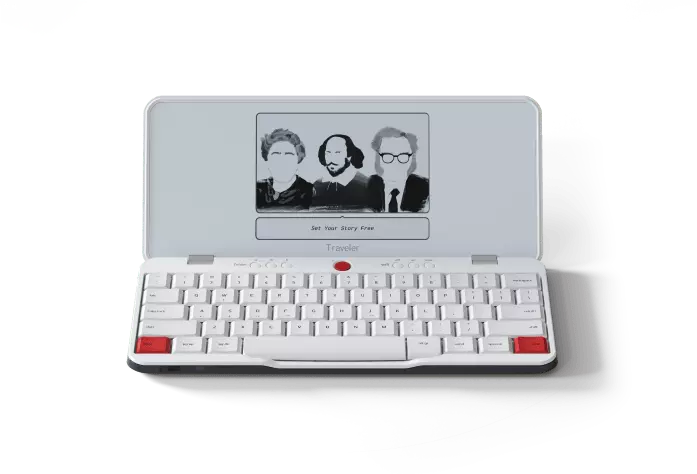
And sometimes, if I want to bring it on a plane, I've found it's replaced reading for me. Rather than pick up a book or bring a book on the plane, I bring Traveler and just kind of hang out in that space and see if anything comes up.

I've found that it's kind of like writing songs on a different instrument, you get different styles of music that you wouldn't have otherwise. I've found that writing from words towards music, I get different kinds of songs than I have in the past, which has been interesting.

In that way, like sitting at a piano, you just write differently than you do on a guitar, or even a bass, because of the things those instruments tend to encourage or that they can do.

It feels almost like a little synthesizer, a different kind of instrument that has unlocked a different kind of approach for me.

"I've found that it's kind of like writing songs on a different instrument, you get different styles of music that you wouldn't have otherwise... [Traveler] feels almost like a little synthesizer, a different kind of instrument that has unlocked a different kind of approach for me."

AC: As someone who doesn't know the first thing about writing music, that's fascinating. It's all magic to me.

AJ: Yeah.

AC: What else are you interested in writing?

AJ: I went to school for film directing. That was kind of what I thought I was going to do. And then my brother and I started the band and that kind of happened first and knocked me onto a different track for a little while after college.

Growing up, though, writing was my way into everything. In directing, I wanted to be in control of the thing that I wrote. And in music, it was the same — the songwriting really feels like it came from that same place. And then the idea of writing longer form, like fiction, almost feels just like the next step from song to EP to album to novel.

For whatever reason, that started feeling like a challenge that would be deeply related to the kinds of work that we do in the studio.

AC: Do you have any advice for aspiring songwriters?

AJ: This sounds like a cliche, but it's totally true: whatever success that I've had as a songwriter — judge that for yourself — but whatever success I have had, has been directly proportional to just writing the song that I wanted to hear.

What I mean by that is, even if you're being coldly, cynically, late-stage capitalist about it, it's by far the most success I've had. The good news is that you don't have to choose. And in fact, when you start making those little compromises, or even begin to inch in that direction, it just doesn't work. So you can forget about it.

Just make music you want to hear. And that will be the music that resonates with most people.

I think there's a temptation to have an imaginary focus group in your head of like 500 people. But the problem is all those people are fake. They're not real. None of those people are actually real people. You're a focus group of one, you're one real person. There are more real people in that focus group than in the imaginary one.

And I just don't think that we're that different, in the end. So that would be my advice.

AC: That seems like generally great creative advice. Because fiction writers talk about that too, right? Do you write to market or do you write the book you want to read. Same thing. And that imaginary focus group has been debilitating for me. I have to silence that focus group before I can write.

AJ: Absolutely.

"I think there's a temptation to have an imaginary focus group in your head of like 500 people. But the problem is all those people are fake... You're a focus group of one, you're one real person. There are more real people in that focus group than in the imaginary one."

--

Learn more about Abner James, his brother, and their band, Eighty Ninety, on Instagram.