overlaylink

Secretos esenciales de creación de mundos para escritores de fantasía

noviembre 12, 2019 | 6 lectura mínima

¿Creciste fascinado por las historias de los niños Pevensie en Narnia o de Frodo y Bilbo Bolsón en la Tierra Media? Si soñabas con crear algún día tu propio mundo de fantasía para basar tus novelas, este artículo es para ti. Exploraremos algunos consejos clave para crear mundos de fantasía, basándonos en los consejos de algunos de los héroes de la literatura fantástica, como George R. R. Martin , quien escribe:

Leemos fantasía para reencontrar los colores, creo. Para saborear especias fuertes y escuchar las canciones de las sirenas. Hay algo antiguo y verdadero en la fantasía que nos habla a algo profundo, al niño que soñó que un día cazaría en los bosques de la noche, se deleitaría bajo las colinas cóncavas y encontraría un amor eterno en algún lugar al sur de Oz y al norte de Shangri-La. Que se queden con su paraíso. Cuando muera, preferiría ir a la Tierra Media.

Acercándose a la construcción del mundo

Construcción de mundos de fantasía

Los grandes maestros de la escritura fantástica tienen sus propias peculiaridades en cuanto a su enfoque de la construcción de mundos. Sin embargo, existen básicamente dos enfoques generales que se pueden adoptar. El primero se conoce como construcción de mundos de afuera hacia adentro o de arriba hacia abajo, y el segundo se denomina construcción de mundos de adentro hacia afuera o de abajo hacia arriba.

Construcción de mundos de afuera hacia adentro

Con el enfoque de afuera hacia adentro para la construcción del mundo, te concentras al 100% en construirlo. Esto ocurre incluso antes de empezar a pensar en la trama de tu historia. Cada detalle del mundo debe describirse y mapearse con minuciosidad.

La construcción de un mundo desde afuera hacia adentro incluye la creación de historias, mitologías y etimologías detalladas para tu mundo, y estos detalles forman el telón de fondo de tu historia.

El peligro de construir un mundo desde afuera hacia adentro es que te involucras tanto en su construcción que nunca llegas a escribir la historia. O que descuidas el desarrollo de tus personajes y la trama con el mismo detalle. Aunque el enfoque desde afuera hacia adentro puede ser muy divertido, ¡recuerda que empezaste a construir tu mundo para contar una historia!

Construcción de mundos de adentro hacia afuera

A diferencia de la construcción de mundos desde afuera hacia adentro, el enfoque desde adentro hacia afuera comienza con uno o más personajes y una idea argumental. Luego, el mundo se crea alrededor de los personajes para que sus detalles siempre contribuyan a la trama y a los personajes de la historia. Este fue el enfoque que adoptó J. R. R. Tolkien al escribir El Hobbit.

Con El Hobbit , Tolkien comenzó con el personaje de Bilbo Bolsón y creó la Tierra Media a su alrededor. Todo en la Tierra Media contribuye al viaje que emprende Bolsón. Por ejemplo, los logros que debe alcanzar y cómo crece como personaje. El paisaje y los habitantes de la Tierra Media se desarrollaron posteriormente, pero Bilbo fue el punto de partida.

Mapeando tu mundo

Mapea tu mundo

No necesitas crear un mapa de tu mundo, pero hacerlo es realmente divertido. Recuerdo pasar horas mapeando el mundo fantástico de Alaryon cuando era adolescente. Usaba mapas de mis novelas de fantasía favoritas como guía. Tener un mapa de tu mundo fantástico le da más sustancia, de alguna manera, y te da algo a lo que recurrir cuando escribes.

Hay mucho que considerar al mapear tu mundo. No se trata solo de decidir el tipo de terreno, la ubicación de las comunidades o la ubicación de las defensas clave. Debes considerar los beneficios y desafíos de todo desde la perspectiva de tus personajes.

Si una gran parte de tu mundo está cubierta de bosques, tus personajes podrían ser hábiles en la carpintería. Incluso podrían tener una comunidad con casas en los árboles. Si tu mundo está rodeado de mar, es más probable que tus personajes sean hábiles en la navegación y la pesca.

¿Cómo se desplazarán tus personajes por tu mundo? Si dificultas el recorrido del paisaje, tener personajes que viajan con frecuencia puede resultar menos creíble. Todos estos aspectos deben tenerse en cuenta al mapear tu mundo.

La cultura de tu mundo

Cultura de tu mundo

En realidad, es muy difícil crear un mundo de fantasía de la nada. Lo que quiero decir con esto es que la mayoría de los mundos de fantasía tienen algún tipo de base sobre la que se construyen.

Por ejemplo, para George Martin, el mundo de fantasía en el que se ambienta Juego de Tronos comenzó con un concepto particular. Se trataba de un mundo con la forma de las Islas Británicas, pero de un tamaño similar al de Sudamérica. Este mundo, por lo tanto, tenía una cultura similar a la de la Gran Bretaña medieval. Esto, por supuesto, fue solo el punto de partida para la creación del mundo de Martin. Pero como pueden ver, tener una base sobre la que construir su mundo de fantasía es más fácil que empezar con un lienzo en blanco.

Al empezar con una cultura o civilización existente, construyes tu mundo pensando en cómo es diferente tu mundo de fantasía. ¡Es un excelente trampolín para tu creatividad!

Para obtener ideas sobre el punto de partida para tu mundo fantástico, las historias o mitologías existentes pueden ser un excelente recurso. Los escritores de fantasía suelen utilizar la mitología artúrica, aborigen y nórdica como punto de partida. También puedes elegir un período histórico específico (la Edad Oscura, por ejemplo). Las mitologías, las historias y las culturas ofrecen un valioso punto de partida.

Lenguaje y construcción de mundos

Lenguaje y construcción del mundo

J. R. R. Tolkien creó el idioma ficticio quenya para sus novelas ambientadas en la Tierra Media antes de comenzar a construir el paisaje de su mundo fantástico. Claro que Tolkien era lingüista, así que crear el idioma élfico le resultó algo agradable y natural. La mayoría de los escritores de fantasía no llegan a este extremo al crear mundos.

Sin embargo, incluso si no planeas crear un lenguaje completamente nuevo para tu mundo de fantasía, debes considerar el lenguaje. Que tus personajes hablen de una manera particular es una técnica que todos los escritores usan para añadir profundidad. Esto también aporta realismo a tus historias.

Hay algunas preguntas que debes plantearte al considerar el idioma que se habla y se utiliza en tu mundo de fantasía:

  • ¿Tu mundo de fantasía se ambienta en una época comparable a la Edad Oscura o en una época más reciente? Para que sea más realista, elige construcciones lingüísticas apropiadas para la etapa del desarrollo humano.
  • ¿Tu mundo de fantasía abarca una zona extensa, con diferentes tribus o grupos de personas en distintos lugares? Es poco probable que las personas separadas por la distancia hablen todas de la misma manera. Por lo tanto, deberías considerar darle a cada tribu formas de hablar diferentes.

Creando sociedades en tu mundo de fantasía

Creando sociedades para tu mundo

La construcción de un mundo se centra tanto en las personas que lo habitan como en el paisaje del mismo. Independientemente del tipo de mundo, las personas siempre viven en sociedades, y todas ellas deben tener algún tipo de orden o reglas.

Consideremos el mundo mágico de las novelas de Harry Potter. La sociedad mágica se rige por reglas, por ejemplo:

  • Las maldiciones se pueden contrarrestar con contramaldiciones.
  • Diferentes criaturas pueden tener poderes secretos (por ejemplo, los elfos domésticos).
  • Hay órganos de gobierno que impiden que los muggles descubran la magia que está ocurriendo.

Las preguntas que debes responder sobre las sociedades de tu mundo incluyen:

  • ¿Qué reglas y restricciones existen en vuestras sociedades?
  • ¿Quién está en el poder y/o gobierna sus sociedades?
  • ¿Existen sociedades opuestas en guerra entre sí?
  • ¿Están las diferentes sociedades en alianza entre sí?
  • ¿Existen religiones o cultos en vuestras sociedades?
  • Si hay religiones ¿son monoteístas o politeístas?
  • ¿Existen sociedades que temen a otras sociedades? (por ejemplo, una sociedad que usa magia puede ser temida por una sociedad que no usa magia)

Algunos consejos finales para los creadores de mundos

La creación de mundos es como un campo de juego para la imaginación, y es fácil dejarse llevar. Los detalles de tu mundo son vitales para que tus lectores puedan visualizar el mundo de tu novela. Pero demasiados detalles pueden ser perjudiciales. Es fundamental no sobrecargar tu historia con información. Abrumar a tus lectores con información es, como mínimo, desagradable.

Debes encontrar el equilibrio adecuado al revelar información esencial a tus lectores. Hazlo despacio y con control, como hacen los maestros de la fantasía. Aprende de expertos como Tolkien y J.K. Rowling. Puede ser útil releer los clásicos de la literatura fantástica para familiarizarte con la forma en que se revela la información. Toma notas mientras lees y aplica lo aprendido en tu propia escritura.

Pero, sobre todo, ¡nunca veas la creación de mundos como una tarea ardua! Si crear mundos te parece un trabajo, quizás deberías buscar otro género para escribir.
diciembre 10, 2025 6 lectura mínima

Singer-songwriter Abner James finds his creativity in the quiet freedom of analog tools. Learn how his creative process transcends different media.

Abner James went to school for film directing. But the success of the band he and his brother formed together, Eighty Ninety, knocked him onto a different trajectory.

The band has accrued more than 40 million streams since the release of their debut EP “Elizabeth," and their work was even co-signed by Taylor Swift when the singer added Eighty Ninety to her playlist "Songs Taylor Loves.”

Now, Abner is returning to long-form writing in addition to songwriting, and with a change in media comes an examination of the creative process. We sat down to chat about what's the same — and what's different. 

ANNIE COSBY: Tell us about your songwriting process.

ABNER JAMES: The way I tend to write my songs is hunched over a guitar and just seeing what comes. Sounds become words become shapes. It's a very physical process that is really about turning my brain off.

And one of the things that occurred to me when I was traveling, actually, was that I would love to be able to do that but from a writing perspective. What would happen if I sat down and approached writing in the same way that I approached music? In a more intuitive and free-form kind of way? What would that dig up?

AC: That's basically the ethos of Freewrite.

AJ: Yes. We had just put out a record, and I was thinking about how to get into writing for the next one. It occurred to me that regardless of how I started, I always finished on a screen. And I wondered: what's the acoustic guitar version of writing?

Where there's not blue light hitting me in the face. Even if I'm using my Notes app, it's the same thing. It really gets me into a different mindset.

 "I wondered: what's the acoustic guitar version of writing?"

I grew up playing piano. That was my first instrument. And I found an old typewriter at a thrift store, and I love it. It actually reminded me a lot of playing piano, the kind of physical, the feeling of it. And it was really fun, but pretty impractical, especially because I travel a fair amount.

And so I wondered, is there such a thing as a digital typewriter? And I googled it, and I found Freewrite.

AC: What about Freewrite helps you write?

AJ:I think, pragmatically, just the E Ink screen is a huge deal, because it doesn't exhaust me in the same way. And the idea of having a tool specifically set aside for the process is appealing in an aesthetic way but also a mental-emotional way. When it comes out, it's kind of like ... It's like having an office you work out of. It's just for that.

"The way I tend to write my songs is hunched over a guitar and just seeing what comes. Sounds become words become shapes. It's a very physical process that is really about turning my brain off."

And all of the pragmatic limitations — like you're not getting texts on it, and you're not doing all that stuff on the internet — that's really helpful, too. But just having the mindset....

When I pick up a guitar, or I sit down at the piano, it very much puts me into that space. Having a tool just for words does the same thing. I find that to be really cool and inspiring.

"When I pick up a guitar, or I sit down at the piano, it very much puts me into that space. Having a tool just for words does the same thing."

AC: So mentally it gets you ready for writing.

AJ: Yeah, and also, when you write a Microsoft Word, it looks so finished that it's hard to keep going. If every time I strummed a chord, I was hearing it back, mixed and mastered and produced...?

It's hard to stay in that space when I'm seeing it fully written out and formatted in, like, Times New Roman, looking all seriously back at me.

AC: I get that. I have terrible instincts to edit stuff over and over again and never finish a story.

AJ:  Also, the way you just open it and it's ready to go. So you don't have the stages of the computer turning on, that kind of puts this pressure, this tension on.

It's working at the edges in all these different ways that on their own could feel a little bit like it's not really necessary. All these amorphous things where you could look at it and be like, well, I don't really need any of those. But they add up to a critical mass that actually is significant.

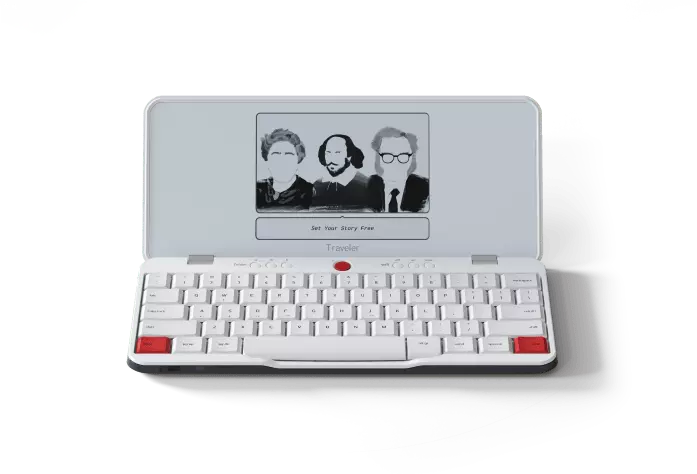
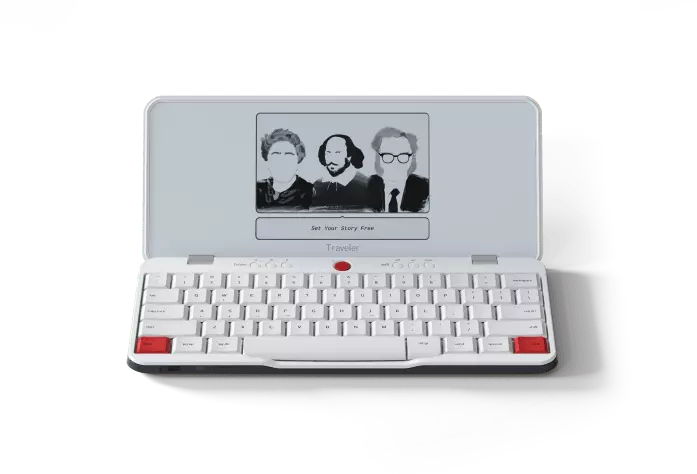
And sometimes, if I want to bring it on a plane, I've found it's replaced reading for me. Rather than pick up a book or bring a book on the plane, I bring Traveler and just kind of hang out in that space and see if anything comes up.

I've found that it's kind of like writing songs on a different instrument, you get different styles of music that you wouldn't have otherwise. I've found that writing from words towards music, I get different kinds of songs than I have in the past, which has been interesting.

In that way, like sitting at a piano, you just write differently than you do on a guitar, or even a bass, because of the things those instruments tend to encourage or that they can do.

It feels almost like a little synthesizer, a different kind of instrument that has unlocked a different kind of approach for me.

"I've found that it's kind of like writing songs on a different instrument, you get different styles of music that you wouldn't have otherwise... [Traveler] feels almost like a little synthesizer, a different kind of instrument that has unlocked a different kind of approach for me."

AC: As someone who doesn't know the first thing about writing music, that's fascinating. It's all magic to me.

AJ: Yeah.

AC: What else are you interested in writing?

AJ: I went to school for film directing. That was kind of what I thought I was going to do. And then my brother and I started the band and that kind of happened first and knocked me onto a different track for a little while after college.

Growing up, though, writing was my way into everything. In directing, I wanted to be in control of the thing that I wrote. And in music, it was the same — the songwriting really feels like it came from that same place. And then the idea of writing longer form, like fiction, almost feels just like the next step from song to EP to album to novel.

For whatever reason, that started feeling like a challenge that would be deeply related to the kinds of work that we do in the studio.

AC: Do you have any advice for aspiring songwriters?

AJ: This sounds like a cliche, but it's totally true: whatever success that I've had as a songwriter — judge that for yourself — but whatever success I have had, has been directly proportional to just writing the song that I wanted to hear.

What I mean by that is, even if you're being coldly, cynically, late-stage capitalist about it, it's by far the most success I've had. The good news is that you don't have to choose. And in fact, when you start making those little compromises, or even begin to inch in that direction, it just doesn't work. So you can forget about it.

Just make music you want to hear. And that will be the music that resonates with most people.

I think there's a temptation to have an imaginary focus group in your head of like 500 people. But the problem is all those people are fake. They're not real. None of those people are actually real people. You're a focus group of one, you're one real person. There are more real people in that focus group than in the imaginary one.

And I just don't think that we're that different, in the end. So that would be my advice.

AC: That seems like generally great creative advice. Because fiction writers talk about that too, right? Do you write to market or do you write the book you want to read. Same thing. And that imaginary focus group has been debilitating for me. I have to silence that focus group before I can write.

AJ: Absolutely.

"I think there's a temptation to have an imaginary focus group in your head of like 500 people. But the problem is all those people are fake... You're a focus group of one, you're one real person. There are more real people in that focus group than in the imaginary one."

--

Learn more about Abner James, his brother, and their band, Eighty Ninety, on Instagram.

noviembre 29, 2025 4 lectura mínima

The Great Freewrite Séance: A Ghost'ly Charity Auction Full Terms & Conditions

These Terms and Conditions (“Terms”) govern participation in The Great Freewrite Séance: A Ghost'ly Charity Auction (“Auction”), organized by Freewrite (“Organizer,” “we,” “us,” or “our”). By registering for, bidding in, or otherwise participating in the Auction, you (“Participant,” “Bidder,” or “Winner”) agree to be bound by these Terms.

1. Auction Overview

1.1. The Auction offers for sale a limited number of Freewrite Traveler Ghost Edition units (“Items” or “Ghost Traveler units”), each personally signed and drawn on by a featured author.

1.2. All proceeds, net of explicitly disclosed administrative costs, will be donated to the charity or charitable initiative (“Charity”) identified on each auction item’s page, as chosen by the respective author.

2. Eligibility

2.1. Participants must be at least 18 years old or the age of majority in their jurisdiction, whichever is higher.

2.2. Employees of Freewrite, the participating authors, or any affiliates directly involved in the Auction are not eligible to bid.

2.3. By participating, you represent that you are legally permitted to take part in online auctions and to pay for any bids you win.

3. Auction Registration

3.1. Participants must create an account on the auction platform or otherwise register using accurate, current, and complete information.

3.2. Freewrite reserves the right to verify identity and to disqualify any Participant who provides false or misleading information.

4. Bidding Rules

4.1. All bids are binding, final, and non-retractable.

4.2. Bidders are responsible for monitoring their bids; Freewrite is not liable for missed notifications or technical issues on the auction platform or the Participant’s device.

4.3. Freewrite reserves the right to:

  • set minimum bids or bid increments;
  • reject bids deemed in bad faith or intended to disrupt the Auction;
  • extend, pause, or cancel the Auction in case of technical difficulties, fraud, or events beyond reasonable control.

5. Winning Bids and Payment

5.1. The highest valid bid at the close of the Auction is the Winning Bid, and the corresponding Participant becomes the Winner.

5.2. Winners will receive payment instructions and must complete payment within 48 hours of the auction’s close unless otherwise stated.

5.3. Failure to complete payment on time may result in forfeiture, and Freewrite may offer the Item to the next highest bidder.

5.4. Accepted payment methods will be listed on the Auction platform. All payments must be made in the currency specified.

6. Item Description and Condition

6.1. Each Ghost Traveler unit is authentic, and the signatures, doodles, and messages are original works created by the participating author. These are authors, not artists. By bidding on the Item, you acknowledge that you are receiving a one-of-a-kind unit marked with unique art and messages and you agree to these terms and conditions.

6.2. Because Items are customized and signed by hand, variations, imperfections, or unique marks are to be expected. These are considered part of the Item’s character and not defects.

6.3. Items are provided “as-is” and “as-available.” Freewrite makes no warranties of merchantability or fitness for a particular purpose.

7. Shipping & Delivery

7.1. Shipping costs, import duties, and taxes may apply unless explicitly stated otherwise.

7.2. Freewrite will make reasonable efforts to ship Items within the estimated timeline but cannot guarantee delivery dates.

7.3. Title and risk of loss transfer to the Winner upon delivery to the carrier.

7.4. Freewrite is not responsible for delays, damage, or loss caused by the courier or customs agencies.

8. Charity Donation

8.1. Net proceeds from the Auction will be donated to the Charity designated on each Item page.

8.2. Donation amounts and recipients may be disclosed publicly unless prohibited by law.

8.3. Winners acknowledge that they are purchasing Items, not making a tax-deductible donation to Freewrite; therefore, Winners will not receive charitable tax receipts unless Freewrite explicitly states otherwise in compliance with applicable laws.

9. Intellectual Property

9.1. All trademarks, brand names, product names, and creative materials associated with Freewrite and the Ghost Traveler remain the exclusive property of Freewrite or their respective rights holders.

9.2. Participants may not reproduce, distribute, or publicly display the authors’ doodles without permission where such rights are applicable, except as allowed by law (e.g., resale of the physical Item).

10. Privacy

10.1. By participating, you consent to Freewrite’s collection, use, and storage of your personal data in accordance with our Privacy Policy.

10.2. Freewrite may publicly announce auction results, including Winner’s first name, last initial, city, state/country, and winning bid amount unless prohibited by law or unless you formally request anonymity when possible.

11. Prohibited Conduct

Participants may not:

  • engage in bid manipulation, fraud, or collusive bidding;
  • use automated systems (bots, scripts, scrapers) to place or monitor bids;
  • interfere with the Auction, platform, or other participants

Freewrite may ban or disqualify any Participant violating these rules.

12. Limitation of Liability

To the fullest extent permitted by law:

12.1. Freewrite is not liable for indirect, incidental, special, or consequential damages arising from the Auction or purchase of Items.

12.2. Freewrite’s total liability in connection with these Terms shall not exceed the amount of the Winning Bid actually paid by the Participant.

12.3. Freewrite is not responsible for technical malfunctions, internet outages, system failures, or other issues beyond its control.

13. Cancellation and Force Majeure

Freewrite may cancel, postpone, or modify the Auction due to unforeseen circumstances, including but not limited to natural disasters, system failures, strikes, or events affecting participating authors or the Charity.

14. Governing Law & Dispute Resolution

14.1. These Terms are governed by the laws of Michigan, without regard to conflict-of-law rules.

14.2. Any disputes arising under these Terms will be resolved through binding arbitration or the courts of the specified jurisdiction, as applicable.

14.3. Participants waive any right to participate in class-action lawsuits relating to the Auction.

15. Amendments

Freewrite may update these Terms at any time. Continued participation in the Auction after updates constitutes acceptance of the revised Terms.

16. Contact Information

For questions or concerns regarding the Auction or these Terms, contact: hello@getfreewrite.com.

noviembre 25, 2025 1 lectura mínima

This is a great gratitude writing exercise to be done alone or in a group, with people of any age.

How to Play

    1. Designate someone to read out each prompt below. (Feel free to add your own prompts.)
    2. After each prompt is read, set a timer for one minute. (With younger kids, this can be shortened. For older folks who want to freewrite meaningfully, more time can be added.)
    3. Each person freewrites by finishing the sentence and elaborating until the timer goes off. (For little kids, this can be done verbally with an adult recording their answers. Hilarity will ensue.)
    4. Remeber that freewriting — allowing yourself to write with abandon — enables you to let go, tapping into your subconscious to explore your thoughts more deeply.
    5. When everyone is done with all the prompts, take turns going through some your answers. Some people may be eager to share. Others may not want to. Respect their decision.

The Prompts

  • I'm grateful for... [After you've finished this prompt, repeat it five times. Challenge yourself and others not to repeat a singe word with each new answer.]
  • The silliest thing I'm grateful for is...
  • The littlest thing I'm grateful for is...
  • The biggest thing I'm grateful for is...
  • The grossest thing I'm grateful for is...
  • One thing I love about myself is...
  • My favorite thing that happened this year was...
  • My hope for next year is...

This writing exercise has resulted in some sweet answers — and many hilarious ones, too. If you try it out, do let us know.

Write on.