overlaylink

Un programme en douze étapes pour écrire plus et moins sur Internet

mai 04, 2017 | 7 lire la lecture

Modifié le 10/05/2017

Ils viennent vers vous, exercent une pression sur vos nerfs, votre santé mentale, le fondement même de votre existence.

Un gazouillis, un bing, un whap, une corne de brume, un « ahuga »… votre téléphone portable interprète comme au lycée le légendaire haricot sauteur mexicain. Ce haricot danse pratiquement la Macarena sur votre bureau.

« Seigneur », implorez-vous l'une de vos divinités païennes, « je vous en prie, pas aujourd'hui. Pas aujourd'hui ! J'ai du travail… Tout sauf ça… »

Mais, malgré tout, tel ce chien pavlovien proverbial, vous avancez en titubant. L'appel d'une notification vous soulève du sol par les poils de votre menton. Soulevé, les pieds effleurant le sol, l'air d'un idiot obscurcissant votre tête surchargée de TDAH. Vous vous adossez à votre fragile rempart, sans vouloir voir ; cette route est sombre et sans issue. Pourtant, vos yeux, ces traîtres coquins, travaillent d'eux-mêmes. Juste un coup d'œil, vous vous dites. Un tout petit clignement, presque insignifiant, et retour au travail. Quel mal cela peut-il faire ?

« Quoi ?! » Vos yeux se transforment en œufs au plat géants. Un bikini blanc fragile, un corps à tomber par terre et un bras, pas le vôtre, glissant sur un ventre plat. « Elle n'avait pas l'air comme ça avec moi ! Et c'est qui ? »

Votre journée est hantée par les visions de l'escapade de votre ex à Cancún. Demain, peut-être, une balade sur la chaîne YouTube de Gordon Ramsay. Le surlendemain, une mission d'enquête sur les divorces légendaires d'Hollywood. Vendredi, un troll vous interpelle. Et ainsi de suite. Le travail s'accumule, créant des bivouacs partout dans votre bureau.

Eh bien, il est temps de se ressaisir ! C'est aussi simple que ça. Il y a la décontraction, et il y a la DÉCONTRACTION. Si votre chat – qui, comme tous les félins, a l'air constamment défoncé – s'approche et vous crie : « Lève-toi, espèce de bon à rien ! Fais quelque chose ! » Alors, vous avez franchi la ligne. Il est temps d'exorciser ces démons numériques. Il est temps de vous transformer en Chuck Norris sur ce Pokémon Go en mêlée générale qui est soudain devenu le célèbre Pikachu sur votre dos. En route vers la nuit, Facebook, Twitter, Pinterest, Instagram, Snapchat et tous vos cousins. Tic-tac-tac, sur cette obsession dérangée pour Candy Crush qui se transforme en Linda Blair sur votre productivité ; du vomi vert partout, la tête qui tourne et qui danse, les accusations scandaleuses des exploits de votre mère à Hollywood Hill en Enfer. Il est temps, mon ami, de vous reprendre.

Les douze étapes

Première étape : Admettez que vous êtes impuissant ; votre Wi-Fi vous tient à la gorge et votre iPhone a un crochet du droit redoutable.

Il est temps d'admettre que, malheureusement, vous n'avez aucun contrôle sur vous-même. Comme 90 % de la population, vous avez été malmenés par l'ère numérique. Tout est là, un simple glissement, un pincement, et voilà. La procrastination s'inscrit lentement mais méthodiquement dans notre ADN. Nous sommes devenus des vaches : nourries de données, contrôlées, heureuses de brouter le champ tant qu'un tweet de Selena Gomez chasse l'ennui.

Deuxième étape : Un pouvoir plus grand que nous-mêmes : mangez d’abord la grenouille.

Au cours de vos pérégrinations dans ce monde chaotique, vous réaliserez qu'il existe une puissance supérieure à nous-mêmes. Non, ce n'est ni Dieu, ni Krishna, ni Zeus, ni Odin. Non, aucun de ces hommes. Je parle de Jobs, de Léonard de Vinci, d'Einstein, de Rockefeller, de Churchill, de Gates, de Patton, de Twain et de Wilde. Les fonceurs. La plupart ont joué gros, mais ont aussi fait grand. La seule chose sur laquelle ils étaient tous d'accord, c'est ceci : MANGEZ LA GRENOUILLE D'ABORD.

Dès que vous vous levez, faites cette chose qui vous gâche complètement le moral. Cette activité qui vous pèse comme une épée. Si vous ne le faites pas, vous perdrez souvent votre concentration tout au long de la journée. Vous passerez des heures à regarder des objets brillants juste pour tenir ce sale type à l'écart.

Troisième étape : c'est un sprint, pas un marathon.

Travaillez par à-coups. Dressez la liste des tâches à terminer ce jour-là, et n'essayez jamais de toutes les accomplir d'un coup. Si vous essayez de vous battre avec le groupe, vous vous retrouverez ensanglanté et écrasé ; battu à mort. Choisissez un loup solitaire sur votre liste et ne le lâchez pas avant de l'avoir apprivoisé. Cela peut prendre dix minutes ou une heure, mais travaillez comme un forcené sur ce projet unique. Après avoir enterré ce vilain petit con à deux mètres sous terre, prenez le même temps pour vous détendre. Rincez et recommencez.

Étape quatre : Éliminez les distractions.

Tant que tu ne seras pas transformé en ninja de la production, en gourou des tâches, en Svengali obsédé par le travail, tu auras la capacité d'attention d'une gerbille sous méthamphétamine. C'est comme ça, et tu devras apprendre à vivre avec. À cause de tous tes gadgets, tu es devenu ce gamin agaçant de ton école qui buvait du Coca toute la journée et vibrait dans et hors de cette dimension à la pause déjeuner. Alors, élimine toute distraction en travaillant. Tu es alcoolique, mais au lieu de José Cuervo, tu te fais plaisir avec ton iPad.

Limitez-vous à une seule fenêtre ou application sur votre navigateur.

Éteignez votre téléphone portable.

Détruisez, anéantissez vos anciennes tâches. Libérez de l'espace en distinguant ce que vous avez déjà accompli et ce qui n'est que du baratin.

Travaillez dans un endroit qui ressemble à ce trou où l'on jette les prisonniers qui font des bêtises. Vous avez été pris avec un couteau, et maintenant, place à l'isolement.

Étape cinq : Zen votre zone.

Un portefeuille, une maison et un bureau peuvent en dire long sur une personne. Si votre portefeuille a réorganisé votre colonne vertébrale, que votre maison semble avoir besoin d'une intervention d'un accumulateur compulsif et que votre bureau est devenu un microenvironnement biologique, il est temps d'aller au supermarché du coin. Prenez un paquet d'allumettes, un bidon d'essence et préparez un barbecue. Repartez frais et minimaliste. Une vie épurée est une vie paisible.

Étape 6 : Gérer les transitions.

Votre journée est remplie d'une série de tâches, qu'elles soient simples ou épuisantes. Vous sautez d'une pierre glissante à une autre. Vous vous réveillez au bout d'une berge boueuse, face à une rivière noire et déchaînée, et votre objectif est d'atteindre l'autre rive avant la nuit. Ou, si vous êtes fan de Frogger, vous êtes ce crapaud suicidaire. Avant de vous précipiter dans une nouvelle intersection ou de sauter sur l'autre rocher, prenez un moment pour respirer et vous remettre les idées en place. Vie de famille, vie professionnelle, loisirs, temps libre, temps libre, tout cela crée des ambiances différentes. Prenez dix à vingt minutes avant de vous lancer dans une nouvelle bataille ou un nouveau terrain de jeu ; mettez de l'ordre dans vos pensées et changez de vitesse.

Étape sept : Faites comme Bruce.

Si vous sentez que votre esprit s'agite et veut filer, alors n'hésitez pas à l'accompagner. Comme Springsteen, vous êtes né pour courir. Prenez la Thunderoad, mais pas votre téléphone portable. Sortez, au pays des jungles, peut-être dans ces ruelles, ou dans les rues de Philadelphie. Profitez, parce que vous le pouvez, d'un Freeze-Out sur la Dixième Avenue. Asseyez-vous sur un banc et méditez sur l'incident de la 57e Rue. Pensez à votre ville natale. Mais, surtout, n'oubliez pas de vous dégourdir les jambes, même si vous vous retrouvez au bord de la rivière, la pluie vous tombant sur la tête, attendant un jour ensoleillé.

Étape huit : transpirez comme un super-héros.

Trente minutes à une heure d'effort physique peuvent faire des merveilles contre le stress et l'anxiété, ces deux vilains maux de cheville qui perturbent votre concentration. Les exercices d'aérobic à fort impact les domptent. Vous découvrirez qu'en laissant votre graisse corporelle sur le trottoir, en plus de tous ces dépôts de fast-food, vous aurez aussi votre téléphone portable dans le rétroviseur.

Ou, si courir n'est pas votre truc, alors choisissez un passe-temps qui demande des muscles plutôt que de l'intelligence. C'est le moment idéal pour apprendre à jouer de la guitare.

Étape neuf : Stimulez-vous.

Sortez du caniveau ! Ce que je veux dire, c'est qu'il faut essayer de rendre les tâches ennuyeuses intéressantes. Des études montrent qu'un niveau de stimulation constant et optimal est essentiel pour l'attention. Une stimulation trop faible signifie qu'une tâche est ennuyeuse. Une stimulation trop forte est synonyme de stress ou d'anxiété.

Jouez de la musique rythmée et relaxante, j'oserais dire, de la « musique d'ascenseur ».

Achetez un sac de bonbons et récompensez-vous chaque fois que vous terminez une tâche.

Prenez une longue pause déjeuner.

Parlez à vos collègues une fois par heure.

La clé est de trouver sa « zone ». La stimulation est un concept complexe ; elle stimule votre attention, mais seulement jusqu'à un certain point. Une fois à son apogée, elle devient contre-productive. Vous commencez, par exemple, à jouer un solo de guitare aérienne dans votre box, en faisant fi de toutes ces erreurs que vous devez saisir dans Excel.

Étape dix : Dialogue intérieur.

Munissez-vous de ces pompons imaginaires et encouragez-vous jusqu'à la ligne d'arrivée. Des études ont montré – car c'est toujours le cas – que lorsque vous hésitez, lorsque vous pensez ne pas y arriver, la meilleure chose à faire est de faire comme un fou et de commencer à vous parler à vous-même. Soyez votre propre coach. Répétez après moi :

« Que dois-je faire maintenant ? »

« Restez avec ça ; restez avec ça ; restez avec ça. »

« Vous y êtes presque. »

« Espèce d'asticot ! Tu me dégoûtes ! Pose ce téléphone ! »

Étape onze : Parlez à tout le monde de votre soirée d’ouverture.

Voici une astuce : si tout le monde sait que vous avez décidé d'accomplir quelque chose, vous avez plus de chances de l'accomplir. Si vous avez créé une attente, vous avez de fortes chances de la satisfaire. Il n'y a rien de pire que de passer pour un perdant devant sa famille et ses amis. Alors, la prochaine fois que vous essayez de cocher un objectif de votre liste de choses à faire, parlez-en à un proche. Cela suscitera un sentiment de responsabilité.

Étape 12 : Gardez deux listes de choses à faire.

La première liste est un peu comme un journal de pensées : notez tout ce qui vous passe par la tête. Notez absolument chaque impulsion distrayante qui vous fait vibrer. « Voir Facebook » ; « Tweeter ceci et cela » ; « Envoyer un mail à un ami du lycée » ; « Aller chercher le linge. » Ce grand décompte vous aidera à garder l'esprit clair. Vous n'aurez plus besoin de tout faire à la hâte, de peur d'oublier. Notez vos pensées et revenez-y après le travail.

La deuxième liste est la plus importante. Ce catalogue primordial devrait contenir trois éléments maximum. Ces éléments essentiels pour obtenir un sentiment d'accomplissement à la fin de la journée. Fixez-vous trois grands objectifs pour la journée et félicitez-vous lorsque vous les atteignez.
décembre 30, 2025 3 lire la lecture

It’s Freewrite’s favorite time of year. When dictionaries around the world examine language use of the previous year and select a “Word of the Year.”

Of course, there are many different dictionaries in use in the English language, and they all have different ideas about what word was the most influential or saw the most growth in the previous year. They individually review new slang and culturally relevant vocabulary, examine spikes or dips in usage, and pour over internet trend data.

Let’s see what some of the biggest dictionaries decided for 2025. And read to the end for a chance to submit your own Word of the Year — and win a Freewrite gift card.

[SUBMIT YOUR WORD OF THE YEAR]


Merriam-Webster: "slop"

Merriam-Webster chose "slop" as its Word of the Year for 2025 to describe "all that stuff dumped on our screens, captured in just four letters."

The dictionary lists "absurd videos, off-kilter advertising images, cheesy propaganda, fake news that looks pretty real, junky AI-written books, 'workslop' reports that waste coworkers’ time … and lots of talking cats" as examples of slop.

The original sense of the word "slop" from the 1700s was “soft mud” and eventually evolved to mean "food waste" and "rubbish." 2025 linked the term to AI, and the rest is history.

Honorable mentions: conclave, gerrymander, touch grass, performative, tariff, 67.

Dictionary.com: "67"

The team at Dictionary.com likes to pick a word that serves as “a linguistic time capsule, reflecting social trends and global events that defined the year.”

For 2025, they decided that “word” was actually a number. Or two numbers, to be exact.

If you’re an old, like me, and don’t know many school-age children, you may not have heard “67” in use. (Note that this is not “sixty-seven,” but “six, seven.”)

Dictionary.com claims the origin of “67” is a song called “Doot Doot (6 7)” by Skrilla, quickly made infamous by viral TikTok videos, most notably featuring a child who will for the rest of his life be known as the “6-7 Kid.” But according to my nine-year-old cousin, the origins of something so mystical can’t ever truly be known.

(My third grade expert also demonstrated the accompanying signature hand gesture, where you place both hands palms up and alternately move up and down.)

And if you happen to find yourself in a fourth-grade classroom, watch your mouth, because there’s a good chance this term has been banned for the teacher’s sanity.

Annoyed yet? Don’t be. As Dictionary.com points out, 6-7 is a rather delightful example at how fast language can develop as a new generation joins the conversation.

Dictionary.com honorable mentions: agentic, aura farming, broligarchy, clanker, Gen Z stare, kiss cam, overtourism, tariff, tradwife.

Oxford Dictionary: "rage bait"

With input from more than 30,000 users and expert analysis, Oxford Dictionary chose "rage bait" for their word of the year.

Specifically, the dictionary pointed to 2025’s news cycle, online manipulation tactics, and growing awareness of where we spend our time and attention online.

While closely paralleling its etymological cousin "clickbait," rage bait more specifically denotes content that evokes anger, discord, or polarization.

Oxford's experts report that use of the term has tripled in the last 12 months.

Oxford Dictionary's honorable mentions:aura farming, biohack.

Cambridge Dictionary: "parasocial"

The Cambridge Dictionary examined a sustained trend of increased searches to choose "parasocial" as its Word of the Year.

Believe it or not, this term was coined by sociologists in 1956, combining “social” with the Greek-derived prefix para-, which in this case means “similar to or parallel to, but separate from.”

But interest in and use of the term exploded this year, finally moving from a mainly academic context to the mainstream.

Cambridge Dictionary's honorable mentions: slop, delulu, skibidi, tradwife

Freewrite: TBD

This year, the Freewrite Fam is picking our own Word of the Year.

Click below to submit what you think the Word of 2025 should be, and we'll pick one submission to receive a Freewrite gift card.

[SUBMIT HERE] 

--

Sources

décembre 18, 2025 6 lire la lecture

Que peuvent apprendre les lettres personnelles de Jane Austen aux écrivains ?

décembre 10, 2025 6 lire la lecture

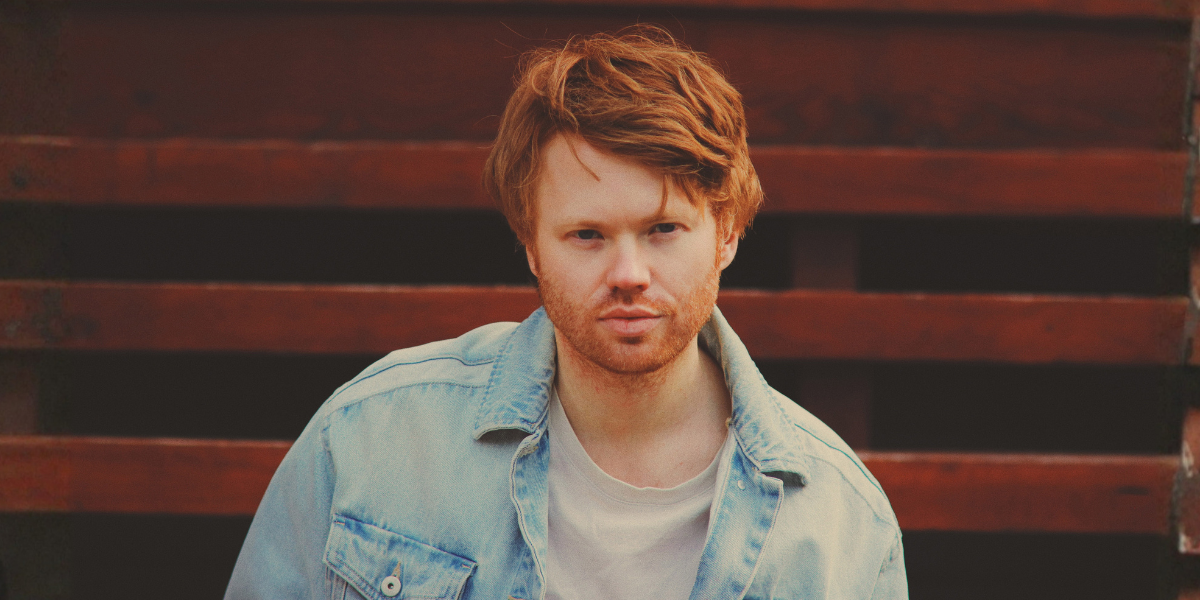
Singer-songwriter Abner James finds his creativity in the quiet freedom of analog tools. Learn how his creative process transcends different media.

Abner James went to school for film directing. But the success of the band he and his brother formed together, Eighty Ninety, knocked him onto a different trajectory.

The band has accrued more than 40 million streams since the release of their debut EP “Elizabeth," and their work was even co-signed by Taylor Swift when the singer added Eighty Ninety to her playlist "Songs Taylor Loves.”

Now, Abner is returning to long-form writing in addition to songwriting, and with a change in media comes an examination of the creative process. We sat down to chat about what's the same — and what's different. 

ANNIE COSBY: Tell us about your songwriting process.

ABNER JAMES: The way I tend to write my songs is hunched over a guitar and just seeing what comes. Sounds become words become shapes. It's a very physical process that is really about turning my brain off.

And one of the things that occurred to me when I was traveling, actually, was that I would love to be able to do that but from a writing perspective. What would happen if I sat down and approached writing in the same way that I approached music? In a more intuitive and free-form kind of way? What would that dig up?

AC: That's basically the ethos of Freewrite.

AJ: Yes. We had just put out a record, and I was thinking about how to get into writing for the next one. It occurred to me that regardless of how I started, I always finished on a screen. And I wondered: what's the acoustic guitar version of writing?

Where there's not blue light hitting me in the face. Even if I'm using my Notes app, it's the same thing. It really gets me into a different mindset.

 "I wondered: what's the acoustic guitar version of writing?"

I grew up playing piano. That was my first instrument. And I found an old typewriter at a thrift store, and I love it. It actually reminded me a lot of playing piano, the kind of physical, the feeling of it. And it was really fun, but pretty impractical, especially because I travel a fair amount.

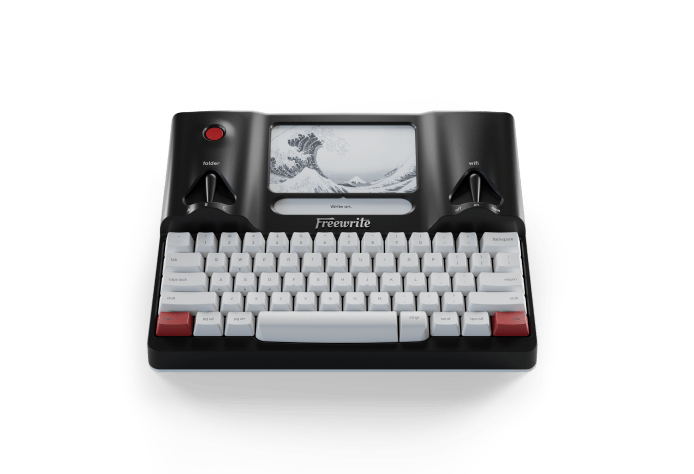
And so I wondered, is there such a thing as a digital typewriter? And I googled it, and I found Freewrite.

AC: What about Freewrite helps you write?

AJ:I think, pragmatically, just the E Ink screen is a huge deal, because it doesn't exhaust me in the same way. And the idea of having a tool specifically set aside for the process is appealing in an aesthetic way but also a mental-emotional way. When it comes out, it's kind of like ... It's like having an office you work out of. It's just for that.

"The way I tend to write my songs is hunched over a guitar and just seeing what comes. Sounds become words become shapes. It's a very physical process that is really about turning my brain off."

And all of the pragmatic limitations — like you're not getting texts on it, and you're not doing all that stuff on the internet — that's really helpful, too. But just having the mindset....

When I pick up a guitar, or I sit down at the piano, it very much puts me into that space. Having a tool just for words does the same thing. I find that to be really cool and inspiring.

"When I pick up a guitar, or I sit down at the piano, it very much puts me into that space. Having a tool just for words does the same thing."

AC: So mentally it gets you ready for writing.

AJ: Yeah, and also, when you write a Microsoft Word, it looks so finished that it's hard to keep going. If every time I strummed a chord, I was hearing it back, mixed and mastered and produced...?

It's hard to stay in that space when I'm seeing it fully written out and formatted in, like, Times New Roman, looking all seriously back at me.

AC: I get that. I have terrible instincts to edit stuff over and over again and never finish a story.

AJ:  Also, the way you just open it and it's ready to go. So you don't have the stages of the computer turning on, that kind of puts this pressure, this tension on.

It's working at the edges in all these different ways that on their own could feel a little bit like it's not really necessary. All these amorphous things where you could look at it and be like, well, I don't really need any of those. But they add up to a critical mass that actually is significant.

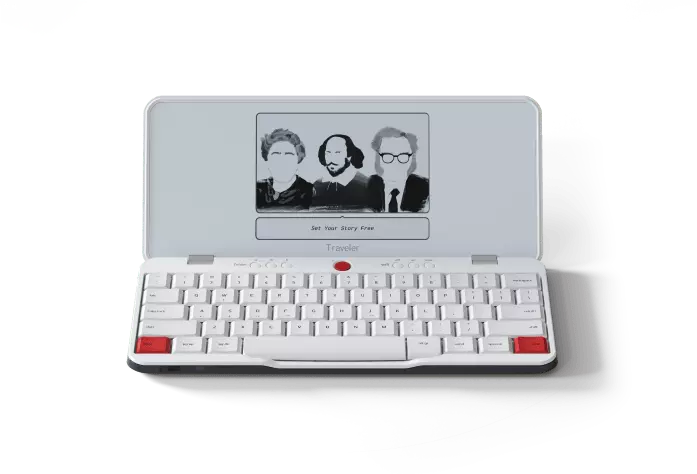
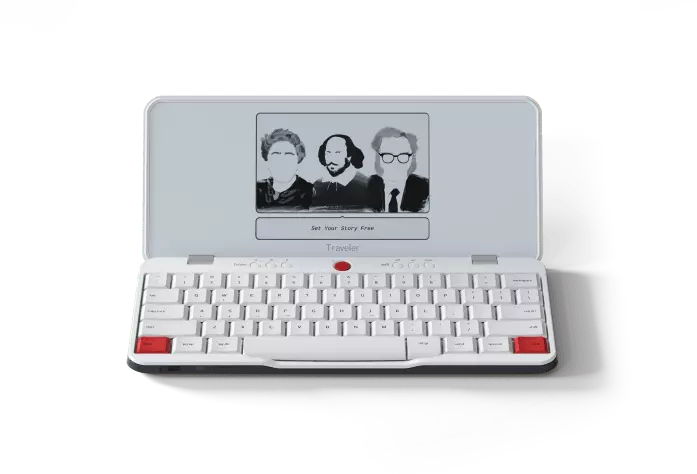
And sometimes, if I want to bring it on a plane, I've found it's replaced reading for me. Rather than pick up a book or bring a book on the plane, I bring Traveler and just kind of hang out in that space and see if anything comes up.

I've found that it's kind of like writing songs on a different instrument, you get different styles of music that you wouldn't have otherwise. I've found that writing from words towards music, I get different kinds of songs than I have in the past, which has been interesting.

In that way, like sitting at a piano, you just write differently than you do on a guitar, or even a bass, because of the things those instruments tend to encourage or that they can do.

It feels almost like a little synthesizer, a different kind of instrument that has unlocked a different kind of approach for me.

"I've found that it's kind of like writing songs on a different instrument, you get different styles of music that you wouldn't have otherwise... [Traveler] feels almost like a little synthesizer, a different kind of instrument that has unlocked a different kind of approach for me."

AC: As someone who doesn't know the first thing about writing music, that's fascinating. It's all magic to me.

AJ: Yeah.

AC: What else are you interested in writing?

AJ: I went to school for film directing. That was kind of what I thought I was going to do. And then my brother and I started the band and that kind of happened first and knocked me onto a different track for a little while after college.

Growing up, though, writing was my way into everything. In directing, I wanted to be in control of the thing that I wrote. And in music, it was the same — the songwriting really feels like it came from that same place. And then the idea of writing longer form, like fiction, almost feels just like the next step from song to EP to album to novel.

For whatever reason, that started feeling like a challenge that would be deeply related to the kinds of work that we do in the studio.

AC: Do you have any advice for aspiring songwriters?

AJ: This sounds like a cliche, but it's totally true: whatever success that I've had as a songwriter — judge that for yourself — but whatever success I have had, has been directly proportional to just writing the song that I wanted to hear.

What I mean by that is, even if you're being coldly, cynically, late-stage capitalist about it, it's by far the most success I've had. The good news is that you don't have to choose. And in fact, when you start making those little compromises, or even begin to inch in that direction, it just doesn't work. So you can forget about it.

Just make music you want to hear. And that will be the music that resonates with most people.

I think there's a temptation to have an imaginary focus group in your head of like 500 people. But the problem is all those people are fake. They're not real. None of those people are actually real people. You're a focus group of one, you're one real person. There are more real people in that focus group than in the imaginary one.

And I just don't think that we're that different, in the end. So that would be my advice.

AC: That seems like generally great creative advice. Because fiction writers talk about that too, right? Do you write to market or do you write the book you want to read. Same thing. And that imaginary focus group has been debilitating for me. I have to silence that focus group before I can write.

AJ: Absolutely.

"I think there's a temptation to have an imaginary focus group in your head of like 500 people. But the problem is all those people are fake... You're a focus group of one, you're one real person. There are more real people in that focus group than in the imaginary one."

--

Learn more about Abner James, his brother, and their band, Eighty Ninety, on Instagram.