overlaylink

Trouver votre voix d'écrivain : conseils d'experts pour développer votre style

mai 01, 2019 | 7 lire la lecture

Que vous écriviez des blogs et des articles ou que vous vous consacriez à la fiction, vous devez trouver votre voix. Chaque écrivain a une voix ou un style unique, mais il faut parfois du temps pour trouver sa propre voix. Surtout lorsque vous débutez en tant qu'écrivain, vous pourriez avoir tendance à imiter la voix d'un autre écrivain, ce qui signifie que votre voix unique est cachée.

En fait, vous n'avez pas besoin que votre écriture ressemble à celle d'un autre écrivain. En fait, imiter le style d'autres auteurs ne vous aidera pas à vous faire remarquer. Vos lecteurs veulent quelque chose de différent, pas un autre clone d'un écrivain ou d'un auteur populaire. Ils veulent entendre votre voix – votre voix unique et authentique.

Qu’est-ce que la voix d’un écrivain et est-elle la même que votre style ?

Avant d'entrer dans le vif du sujet, je voudrais prendre un moment pour définir précisément ce que j'entends par « voix d'écrivain » et son lien avec votre style d'écriture global. Certains affirment que voix et style sont deux choses complètement différentes, mais leurs points communs sont si nombreux qu'il est impossible de les dissocier.

Votre voix d’écrivain comprend :

  • Votre personnalité
  • Votre ton
  • Votre choix de mots
  • Votre utilisation de la ponctuation
  • Votre attitude
  • Vos préférences personnelles ou votre style personnel
  • Votre approche de la structure des phrases
  • Votre attitude envers le respect strict des « règles » grammaticales
  • Votre utilisation d'un langage formel ou informel
  • Votre utilisation du langage lorsque vous parlez

Vous constaterez dans cette liste que votre véritable voix d'écrivain vous sera propre, car elle est influencée par votre personnalité et votre façon unique d'utiliser la langue. En matière de style, votre voix peut varier selon le public auquel vous vous adressez.

En fin de compte , que vous écriviez pour une publication universitaire, un magazine ou un blog, votre style doit transparaître dans votre adaptation d'un style particulier. Votre style implique également que vous privilégiez certains styles d'écriture ; il est donc impossible de séparer complètement les sujets de style et de style.

Mais pourquoi tant d'écrivains peinent-ils à exprimer leur propre voix ? Il y a en réalité une excellente explication.

Vaincre le syndrome de l'imposteur

Ces doutes que vous éprouvez chaque fois que vous vous mettez à écrire, et ce sentiment que votre écriture ne peut rivaliser avec celle de tous les « grands » écrivains, sont souvent appelés « syndrome de l'imposteur ». Bien que vous aimiez écrire, vous n'êtes jamais satisfait du résultat et vous attendez constamment que vos lecteurs découvrent que vous n'êtes « pas vraiment un écrivain ».

Le syndrome de l'imposteur est un obstacle majeur à l'expression de votre propre voix. Bien qu'il n'existe pas de solution miracle pour s'en débarrasser, en vous concentrant sur le développement de votre propre voix plutôt que de copier le style d'autrui, vous comprendrez progressivement l'intérêt d'utiliser votre propre style.

Techniques pour libérer la voix de votre écrivain

Alors, comment explorer sa propre voix d'écrivain quand on a tellement l'habitude d'imiter ses auteurs préférés ? J'ai consacré beaucoup de temps à mes recherches sur le sujet (car j'ai vraiment lutté contre le syndrome de l'imposteur à mes débuts) et j'ai rassemblé quelques-uns des meilleurs conseils et exercices pour vous aider à découvrir votre style d'écriture unique.

1. Libérez votre voix

Quand j'ai commencé à écrire de la fiction, des blogs et des articles, j'ai constaté que je me concentrais beaucoup trop sur le fait de « bien faire les choses ». Je pouvais passer des jours à écrire et réécrire une phrase d'introduction ou un paragraphe, de peur d'enfreindre les « règles ». J'accuse le système éducatif de m'avoir asservi à une longue liste de règles grammaticales à ne jamais transgresser.

J'étais aussi trop concentré sur la recherche de lignes directrices stylistiques à suivre scrupuleusement, même si je détestais ces règles que je m'imposais. Le plus absurde, c'est que je savais que beaucoup d'écrivains enfreignaient régulièrement les règles grammaticales et stylistiques, mais je n'arrivais pas à m'y résoudre dans mon écriture. J'étais pris au piège et je ne savais pas comment m'en libérer.

J'ai ensuite découvert l'écriture libre en suivant un cours d'écriture créative dans le cadre de mon cursus universitaire. On nous demandait de consacrer au moins 15 minutes par jour à l'écriture libre, et j'ai trouvé cela tellement libérateur. Alors, qu'est-ce que l'écriture libre exactement ?

L'écriture libre libère votre voix, car vous brisez délibérément les règles qui la freinent. Elle vous donne l'occasion d'explorer votre créativité, de vous exprimer sans restriction et de ne plus vous soucier du « quoi que les gens pensent ». Parce que vous écrivez librement pour vous-même, un processus psychologique se produit qui brise les chaînes qui ont empêché votre voix unique de véritablement émerger.

2. Écrivez même lorsque vous n'êtes pas obligé d'écrire

Si l'écriture est votre métier, il est facile de tomber dans le piège de n'écrire que lorsque vous avez un projet à réaliser (c'est-à-dire que vous n'écrivez que lorsque vous êtes payé pour écrire). Ce n'est pas bon pour votre voix d'écrivain, car vous perdez ce sentiment d'écrire pour le plaisir et votre écriture peut devenir plus conventionnelle.

Malcolm Gladwell, auteur de Outliers: The Story of Success, estime qu'il faut 10 000 heures pour perfectionner son art. Même si ce chiffre est peut-être exagéré (et a été contesté), il est important de le garder à l'esprit. Vous ne trouverez pas votre propre voix sans beaucoup de pratique, ce qui signifie qu'il faut écrire pour le plaisir autant que pour le profit.

Se fixer des objectifs d'écriture (réalisables) – par exemple, écrire (pour le plaisir) au moins 30 minutes par jour – peut vous donner l'espace nécessaire pour explorer votre voix d'écrivain. Avec une habitude d'écriture régulière, libre de contraintes imposées par d'autres, il est plus facile d'entrer dans le flux qui révélera votre propre voix.

À la fin de chaque semaine, prenez le temps de relire ce que vous avez écrit. Vous devriez pouvoir déceler des schémas dans votre langage et voir comment votre personnalité transparaît dans vos écrits. C'est votre voix d'écrivain, et plus vous vous entraînerez à l'utiliser, plus vous serez à l'aise pour la partager avec le monde.

3. Sortez de votre zone de confort

Si vous êtes le genre d'écrivain qui s'en tient à un seul type d'écriture (par exemple, vous écrivez uniquement des blogs, ou uniquement de la poésie, ou uniquement de la fiction fantastique), alors sortir de votre zone de confort d'écriture peut vraiment vous aider à découvrir davantage la voix de votre écrivain.

Lorsque vous écrivez dans un genre ou un format auquel vous n'êtes pas habitué ou que vous lisez peu, vous n'avez pas les mêmes idées préconçues sur ce que votre écriture « devrait » être. Cela signifie que lorsque vous commencez à écrire, votre style a plus de chances de s'exprimer plus facilement, car vous n'essayez pas de rendre votre écriture « conforme » d'une quelconque manière.

Voici quelques exemples de types d’écriture qui peuvent sortir de votre zone de confort d’écriture et qui peuvent vous aider à explorer la façon dont la voix de votre écrivain émerge lorsqu’elle est totalement libre :

  • Non-fiction créative
  • Écriture de style journalistique
  • Un genre de fiction complètement différent de ce que vous avez l'habitude de lire ou d'écrire. Parmi les genres, on trouve :
    • fiction historique
    • fiction romantique
    • Fiction pour enfants
    • Fiction pour jeunes adultes
    • la science-fiction
    • Fantaisie
    • Crime
    • Thriller
    • Fiction littéraire
  • Un texte persuasif
  • Un discours politique
  • Poésie
  • Un court scénario de pièce de théâtre/film
  • Écriture biographique

4. Faites un voyage de découverte de soi

Pour explorer votre voix d'écrivain, il est essentiel de se connaître soi-même et de comprendre comment vous percevez le monde qui vous entoure et comment vous vous y connectez. Si vous avez du mal à vous exprimer, peut-être avez-vous besoin de prendre le temps de vous découvrir.

Il est très facile de se laisser influencer par les opinions et les points de vue d'autrui, au point d'intérioriser facilement sa façon de penser et d'être. Ces points de vue et schémas de pensée pouvant être en contradiction avec nos façons de penser et d'être naturelles (uniques), des conflits internes peuvent surgir et affecter la voix de l'auteur.

Pour renouer avec votre façon de penser et d'être, vous devez entreprendre un travail approfondi pour comprendre vos propres opinions, votre vision du monde et vos passions. À la base de la découverte de soi, il faut prêter attention à ce qui vous rend heureux, ce qui vous inspire, ce qui illumine votre journée, ce qui vous met en colère et ce qui vous passionne.

Tous ces éléments influenceront votre style d'écriture unique. Plus vous les explorerez, plus vous pourrez libérer votre voix d'écrivain. Être à l'aise avec vous-même vous permettra de prendre davantage de risques dans votre écriture, et votre style d'écriture vous remerciera de l'investissement que vous aurez fait dans la découverte de vous-même.

Tenir un journal est un excellent moyen de se découvrir soi-même, et il est judicieux de prendre l'habitude de le faire régulièrement. Des journaux guidés sont disponibles sur des plateformes comme Amazon si vous avez besoin d'aide pour vous lancer. Vous pouvez également utiliser ces questions comme pistes pour vos séances de découverte personnelle :

  • Ma plus grande force est…
  • Je ne supporte pas que les autres…
  • Si j’avais une chanson thème, ce serait…
  • Quand je pense à l’avenir, ce que je crains le plus, c’est…
  • Face à un défi, je…
  • Si je rencontrais une route qui avait trois bifurcations et dont un chemin menait à une montagne, un autre à une forêt et le troisième à un océan, je choisirais… (expliquez pourquoi)
  • Les choses qui me passionnent le plus sont…
  • La cause caritative qui me passionne le plus est…
  • L’injustice dans le monde me rend…
  • Si j'avais un budget illimité, je...

Découvrez votre voix d'écrivain et libérez-vous

Découvrir et développer votre voix d'écrivain est une aventure qui peut avoir un impact considérable sur la puissance de votre écriture. Cependant, lorsque vous vous lancez dans cette aventure, n'oubliez pas que votre voix continue de se développer au fil de l'écriture. Avec la maturité, par exemple, vous remarquerez peut-être des changements subtils dans votre voix d'écrivain, voire dans les styles d'écriture que vous préférez.

L'objectif de découvrir et de développer votre voix d'écrivain est de sortir du piège de l'imitation et d'apprendre à aimer votre propre voix unique au lieu de ressentir le besoin de copier un autre écrivain que vous admirez. En investissant dans le développement de votre voix d'écrivain, vous gagnerez en confiance et votre écriture gagnera en impact.

Chaque écrivain a, à un moment ou à un autre, éprouvé des difficultés avec sa voix, même des auteurs à succès comme Stephen King. Persévérez dans votre quête de découverte et vous atteindrez le stade où Stephen King est parvenu : vos lecteurs pourront reconnaître votre voix sans même voir votre nom.
décembre 10, 2025 6 lire la lecture

Singer-songwriter Abner James finds his creativity in the quiet freedom of analog tools. Learn how his creative process transcends different media.

Abner James went to school for film directing. But the success of the band he and his brother formed together, Eighty Ninety, knocked him onto a different trajectory.

The band has accrued more than 40 million streams since the release of their debut EP “Elizabeth," and their work was even co-signed by Taylor Swift when the singer added Eighty Ninety to her playlist "Songs Taylor Loves.”

Now, Abner is returning to long-form writing in addition to songwriting, and with a change in media comes an examination of the creative process. We sat down to chat about what's the same — and what's different. 

ANNIE COSBY: Tell us about your songwriting process.

ABNER JAMES: The way I tend to write my songs is hunched over a guitar and just seeing what comes. Sounds become words become shapes. It's a very physical process that is really about turning my brain off.

And one of the things that occurred to me when I was traveling, actually, was that I would love to be able to do that but from a writing perspective. What would happen if I sat down and approached writing in the same way that I approached music? In a more intuitive and free-form kind of way? What would that dig up?

AC: That's basically the ethos of Freewrite.

AJ: Yes. We had just put out a record, and I was thinking about how to get into writing for the next one. It occurred to me that regardless of how I started, I always finished on a screen. And I wondered: what's the acoustic guitar version of writing?

Where there's not blue light hitting me in the face. Even if I'm using my Notes app, it's the same thing. It really gets me into a different mindset.

 "I wondered: what's the acoustic guitar version of writing?"

I grew up playing piano. That was my first instrument. And I found an old typewriter at a thrift store, and I love it. It actually reminded me a lot of playing piano, the kind of physical, the feeling of it. And it was really fun, but pretty impractical, especially because I travel a fair amount.

And so I wondered, is there such a thing as a digital typewriter? And I googled it, and I found Freewrite.

AC: What about Freewrite helps you write?

AJ:I think, pragmatically, just the E Ink screen is a huge deal, because it doesn't exhaust me in the same way. And the idea of having a tool specifically set aside for the process is appealing in an aesthetic way but also a mental-emotional way. When it comes out, it's kind of like ... It's like having an office you work out of. It's just for that.

"The way I tend to write my songs is hunched over a guitar and just seeing what comes. Sounds become words become shapes. It's a very physical process that is really about turning my brain off."

And all of the pragmatic limitations — like you're not getting texts on it, and you're not doing all that stuff on the internet — that's really helpful, too. But just having the mindset....

When I pick up a guitar, or I sit down at the piano, it very much puts me into that space. Having a tool just for words does the same thing. I find that to be really cool and inspiring.

"When I pick up a guitar, or I sit down at the piano, it very much puts me into that space. Having a tool just for words does the same thing."

AC: So mentally it gets you ready for writing.

AJ: Yeah, and also, when you write a Microsoft Word, it looks so finished that it's hard to keep going. If every time I strummed a chord, I was hearing it back, mixed and mastered and produced...?

It's hard to stay in that space when I'm seeing it fully written out and formatted in, like, Times New Roman, looking all seriously back at me.

AC: I get that. I have terrible instincts to edit stuff over and over again and never finish a story.

AJ:  Also, the way you just open it and it's ready to go. So you don't have the stages of the computer turning on, that kind of puts this pressure, this tension on.

It's working at the edges in all these different ways that on their own could feel a little bit like it's not really necessary. All these amorphous things where you could look at it and be like, well, I don't really need any of those. But they add up to a critical mass that actually is significant.

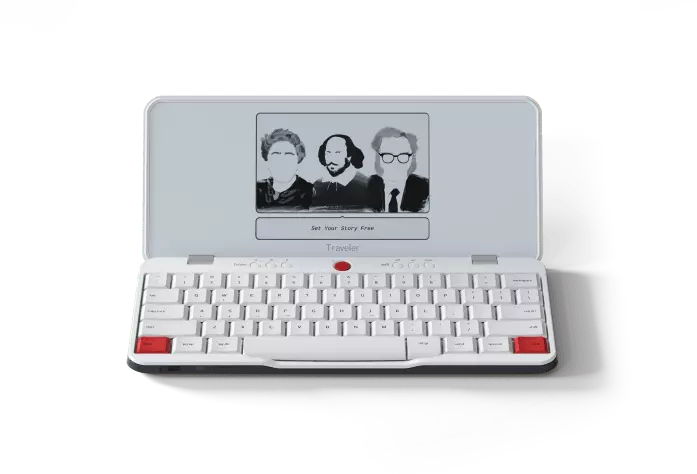
And sometimes, if I want to bring it on a plane, I've found it's replaced reading for me. Rather than pick up a book or bring a book on the plane, I bring Traveler and just kind of hang out in that space and see if anything comes up.

I've found that it's kind of like writing songs on a different instrument, you get different styles of music that you wouldn't have otherwise. I've found that writing from words towards music, I get different kinds of songs than I have in the past, which has been interesting.

In that way, like sitting at a piano, you just write differently than you do on a guitar, or even a bass, because of the things those instruments tend to encourage or that they can do.

It feels almost like a little synthesizer, a different kind of instrument that has unlocked a different kind of approach for me.

"I've found that it's kind of like writing songs on a different instrument, you get different styles of music that you wouldn't have otherwise... [Traveler] feels almost like a little synthesizer, a different kind of instrument that has unlocked a different kind of approach for me."

AC: As someone who doesn't know the first thing about writing music, that's fascinating. It's all magic to me.

AJ: Yeah.

AC: What else are you interested in writing?

AJ: I went to school for film directing. That was kind of what I thought I was going to do. And then my brother and I started the band and that kind of happened first and knocked me onto a different track for a little while after college.

Growing up, though, writing was my way into everything. In directing, I wanted to be in control of the thing that I wrote. And in music, it was the same — the songwriting really feels like it came from that same place. And then the idea of writing longer form, like fiction, almost feels just like the next step from song to EP to album to novel.

For whatever reason, that started feeling like a challenge that would be deeply related to the kinds of work that we do in the studio.

AC: Do you have any advice for aspiring songwriters?

AJ: This sounds like a cliche, but it's totally true: whatever success that I've had as a songwriter — judge that for yourself — but whatever success I have had, has been directly proportional to just writing the song that I wanted to hear.

What I mean by that is, even if you're being coldly, cynically, late-stage capitalist about it, it's by far the most success I've had. The good news is that you don't have to choose. And in fact, when you start making those little compromises, or even begin to inch in that direction, it just doesn't work. So you can forget about it.

Just make music you want to hear. And that will be the music that resonates with most people.

I think there's a temptation to have an imaginary focus group in your head of like 500 people. But the problem is all those people are fake. They're not real. None of those people are actually real people. You're a focus group of one, you're one real person. There are more real people in that focus group than in the imaginary one.

And I just don't think that we're that different, in the end. So that would be my advice.

AC: That seems like generally great creative advice. Because fiction writers talk about that too, right? Do you write to market or do you write the book you want to read. Same thing. And that imaginary focus group has been debilitating for me. I have to silence that focus group before I can write.

AJ: Absolutely.

"I think there's a temptation to have an imaginary focus group in your head of like 500 people. But the problem is all those people are fake... You're a focus group of one, you're one real person. There are more real people in that focus group than in the imaginary one."

--

Learn more about Abner James, his brother, and their band, Eighty Ninety, on Instagram.

novembre 29, 2025 4 lire la lecture

The Great Freewrite Séance: A Ghost'ly Charity Auction Full Terms & Conditions

These Terms and Conditions (“Terms”) govern participation in The Great Freewrite Séance: A Ghost'ly Charity Auction (“Auction”), organized by Freewrite (“Organizer,” “we,” “us,” or “our”). By registering for, bidding in, or otherwise participating in the Auction, you (“Participant,” “Bidder,” or “Winner”) agree to be bound by these Terms.

1. Auction Overview

1.1. The Auction offers for sale a limited number of Freewrite Traveler Ghost Edition units (“Items” or “Ghost Traveler units”), each personally signed and drawn on by a featured author.

1.2. All proceeds, net of explicitly disclosed administrative costs, will be donated to the charity or charitable initiative (“Charity”) identified on each auction item’s page, as chosen by the respective author.

2. Eligibility

2.1. Participants must be at least 18 years old or the age of majority in their jurisdiction, whichever is higher.

2.2. Employees of Freewrite, the participating authors, or any affiliates directly involved in the Auction are not eligible to bid.

2.3. By participating, you represent that you are legally permitted to take part in online auctions and to pay for any bids you win.

3. Auction Registration

3.1. Participants must create an account on the auction platform or otherwise register using accurate, current, and complete information.

3.2. Freewrite reserves the right to verify identity and to disqualify any Participant who provides false or misleading information.

4. Bidding Rules

4.1. All bids are binding, final, and non-retractable.

4.2. Bidders are responsible for monitoring their bids; Freewrite is not liable for missed notifications or technical issues on the auction platform or the Participant’s device.

4.3. Freewrite reserves the right to:

  • set minimum bids or bid increments;
  • reject bids deemed in bad faith or intended to disrupt the Auction;
  • extend, pause, or cancel the Auction in case of technical difficulties, fraud, or events beyond reasonable control.

5. Winning Bids and Payment

5.1. The highest valid bid at the close of the Auction is the Winning Bid, and the corresponding Participant becomes the Winner.

5.2. Winners will receive payment instructions and must complete payment within 48 hours of the auction’s close unless otherwise stated.

5.3. Failure to complete payment on time may result in forfeiture, and Freewrite may offer the Item to the next highest bidder.

5.4. Accepted payment methods will be listed on the Auction platform. All payments must be made in the currency specified.

6. Item Description and Condition

6.1. Each Ghost Traveler unit is authentic, and the signatures, doodles, and messages are original works created by the participating author. These are authors, not artists. By bidding on the Item, you acknowledge that you are receiving a one-of-a-kind unit marked with unique art and messages and you agree to these terms and conditions.

6.2. Because Items are customized and signed by hand, variations, imperfections, or unique marks are to be expected. These are considered part of the Item’s character and not defects.

6.3. Items are provided “as-is” and “as-available.” Freewrite makes no warranties of merchantability or fitness for a particular purpose.

7. Shipping & Delivery

7.1. Shipping costs, import duties, and taxes may apply unless explicitly stated otherwise.

7.2. Freewrite will make reasonable efforts to ship Items within the estimated timeline but cannot guarantee delivery dates.

7.3. Title and risk of loss transfer to the Winner upon delivery to the carrier.

7.4. Freewrite is not responsible for delays, damage, or loss caused by the courier or customs agencies.

8. Charity Donation

8.1. Net proceeds from the Auction will be donated to the Charity designated on each Item page.

8.2. Donation amounts and recipients may be disclosed publicly unless prohibited by law.

8.3. Winners acknowledge that they are purchasing Items, not making a tax-deductible donation to Freewrite; therefore, Winners will not receive charitable tax receipts unless Freewrite explicitly states otherwise in compliance with applicable laws.

9. Intellectual Property

9.1. All trademarks, brand names, product names, and creative materials associated with Freewrite and the Ghost Traveler remain the exclusive property of Freewrite or their respective rights holders.

9.2. Participants may not reproduce, distribute, or publicly display the authors’ doodles without permission where such rights are applicable, except as allowed by law (e.g., resale of the physical Item).

10. Privacy

10.1. By participating, you consent to Freewrite’s collection, use, and storage of your personal data in accordance with our Privacy Policy.

10.2. Freewrite may publicly announce auction results, including Winner’s first name, last initial, city, state/country, and winning bid amount unless prohibited by law or unless you formally request anonymity when possible.

11. Prohibited Conduct

Participants may not:

  • engage in bid manipulation, fraud, or collusive bidding;
  • use automated systems (bots, scripts, scrapers) to place or monitor bids;
  • interfere with the Auction, platform, or other participants

Freewrite may ban or disqualify any Participant violating these rules.

12. Limitation of Liability

To the fullest extent permitted by law:

12.1. Freewrite is not liable for indirect, incidental, special, or consequential damages arising from the Auction or purchase of Items.

12.2. Freewrite’s total liability in connection with these Terms shall not exceed the amount of the Winning Bid actually paid by the Participant.

12.3. Freewrite is not responsible for technical malfunctions, internet outages, system failures, or other issues beyond its control.

13. Cancellation and Force Majeure

Freewrite may cancel, postpone, or modify the Auction due to unforeseen circumstances, including but not limited to natural disasters, system failures, strikes, or events affecting participating authors or the Charity.

14. Governing Law & Dispute Resolution

14.1. These Terms are governed by the laws of Michigan, without regard to conflict-of-law rules.

14.2. Any disputes arising under these Terms will be resolved through binding arbitration or the courts of the specified jurisdiction, as applicable.

14.3. Participants waive any right to participate in class-action lawsuits relating to the Auction.

15. Amendments

Freewrite may update these Terms at any time. Continued participation in the Auction after updates constitutes acceptance of the revised Terms.

16. Contact Information

For questions or concerns regarding the Auction or these Terms, contact: hello@getfreewrite.com.

novembre 25, 2025 1 lire la lecture

This is a great gratitude writing exercise to be done alone or in a group, with people of any age.

How to Play

    1. Designate someone to read out each prompt below. (Feel free to add your own prompts.)
    2. After each prompt is read, set a timer for one minute. (With younger kids, this can be shortened. For older folks who want to freewrite meaningfully, more time can be added.)
    3. Each person freewrites by finishing the sentence and elaborating until the timer goes off. (For little kids, this can be done verbally with an adult recording their answers. Hilarity will ensue.)
    4. Remeber that freewriting — allowing yourself to write with abandon — enables you to let go, tapping into your subconscious to explore your thoughts more deeply.
    5. When everyone is done with all the prompts, take turns going through some your answers. Some people may be eager to share. Others may not want to. Respect their decision.

The Prompts

  • I'm grateful for... [After you've finished this prompt, repeat it five times. Challenge yourself and others not to repeat a singe word with each new answer.]
  • The silliest thing I'm grateful for is...
  • The littlest thing I'm grateful for is...
  • The biggest thing I'm grateful for is...
  • The grossest thing I'm grateful for is...
  • One thing I love about myself is...
  • My favorite thing that happened this year was...
  • My hope for next year is...

This writing exercise has resulted in some sweet answers — and many hilarious ones, too. If you try it out, do let us know.

Write on.