overlaylink

Écrire malgré la maladie et les blessures

septembre 11, 2023 | 2 lire la lecture

Parfois, lorsque nous traversons une période difficile, l'écriture et notre créativité peuvent être mises de côté. Et parfois, l'écriture est ce qui nous permet de nous en sortir.

L'écrivaine Danielle Christopher nous rejoint depuis son domicile sur la côte ouest du Canada pour parler de la façon dont l'écriture l'aide à traverser les périodes de maladie et de blessure.

À quoi ressemble votre vie d’écrivain ?

Après avoir été blessée dans un accident de voiture, je suis actuellement en congé médical de l'entreprise générale que je dirige avec mon mari.

Après avoir survécu à un cancer et à un accident de voiture, l’écriture a été cathartique pour moi pendant ma convalescence.

C'est beaucoup pour survivre. Sur quoi travaillez-vous en ce moment ?

Je viens de terminer la première ébauche d'un mémoire qui traite du deuil, de l'éducation d'un enfant neurotypique et d'un enfant neurodivergent, et de l'acceptation que l'histoire de ma mère n'est pas la mienne.

J'ai commencé le livre en octobre 2019, quelques mois seulement après avoir reçu un diagnostic de cancer du côlon de stade 2.

Puis, en février 2020, j'ai dû interrompre mon travail sur le livre à la suite d'un accident de voiture. Depuis, je souffre du syndrome post-commotionnel (SPC).

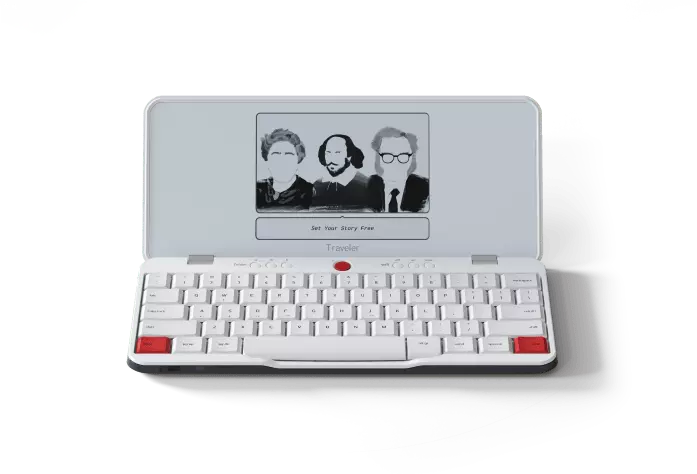
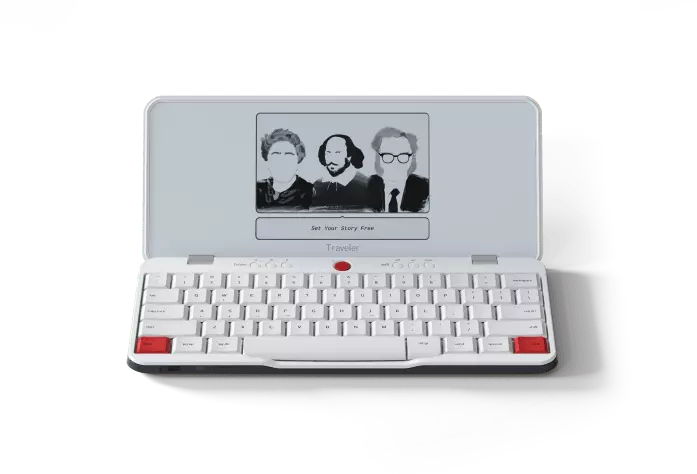
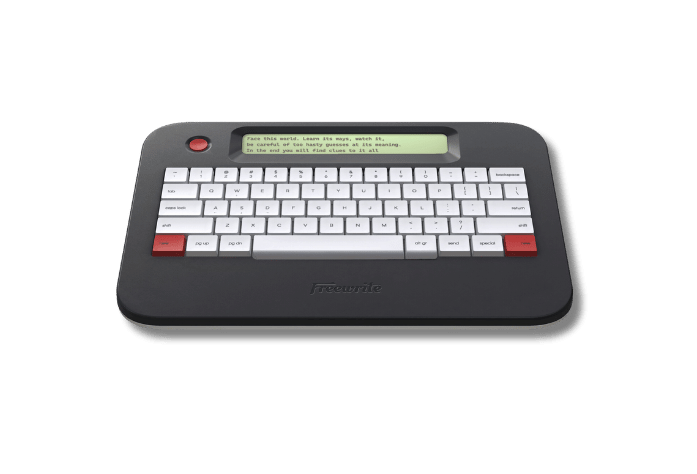
Sur la photo, on voit le Traveler de Danielle, orné d'un autocollant sur lequel est écrit : « Écrivez comme si vous manquiez de temps. »

Écrire tout en luttant contre le cancer et en se remettant d'une commotion cérébrale ne paraît pas facile. Comment écrire malgré de tels obstacles, tant sur le plan émotionnel que technique ?

Écrire est pour moi un moyen de prendre soin de moi. Et comme je l'ai dit, cela a été une véritable catharsis pendant ma convalescence. Une autre motivation pour écrire est le décès de ma mère quand j'avais dix ans. Et comme je n'ai pas ses histoires, cela me motive à écrire les miennes pour mes propres enfants.
L’écriture est un soin personnel pour moi.
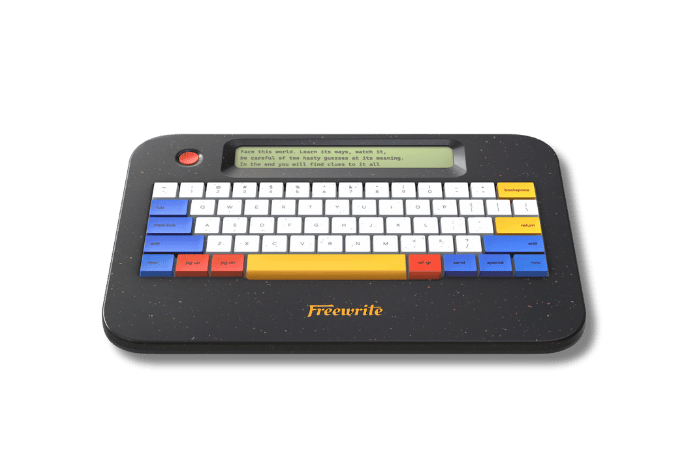
Techniquement parlant, ma journée d'écriture se déroule partout : à la maison, en voiture, dans les salles d'attente, au café. Parfois, j'utilise Siri pour dicter, parfois j'utilise un stylo et du papier, et bien sûr, j'utilise surtout Freewrite Traveler pour structurer mes pensées en chapitres.
Traveler est très doux pour mes yeux. Les lumières vives peuvent déclencher des migraines et des troubles de la vue dus à la commotion cérébrale ; l'ordinateur n'est donc pas la meilleure option. Mais avec Freewrite, je peux taper 100 à 800 mots par session.
J'aime aussi la facilité avec laquelle je peux m'envoyer des pièces par e-mail et les synchroniser avec mon Dropbox !

Quelle est la prochaine étape pour vous ?

Une fois mes mémoires terminées, je pense utiliser mon travail au cinéma et à la télévision des années 80 au début des années 2000 pour explorer la fiction. C'était une époque pré-réseaux sociaux, et j'ai beaucoup de matière !
--
Danielle Christopher vit et écrit à Langley, dans la vallée du Fraser, en Colombie-Britannique, au Canada. Elle a participé au Writer's Studio de la SFU en 2022 et 2023. Suivez son parcours d'écriture sur Instagram et Facebook .
janvier 09, 2026 2 lire la lecture

A new year means a whole new crop of work is entering the public domain. And that means endless opportunities for retellings, spoofs, adaptations, and fan fiction.

décembre 30, 2025 3 lire la lecture

It’s Freewrite’s favorite time of year. When dictionaries around the world examine language use of the previous year and select a “Word of the Year.”

Of course, there are many different dictionaries in use in the English language, and they all have different ideas about what word was the most influential or saw the most growth in the previous year. They individually review new slang and culturally relevant vocabulary, examine spikes or dips in usage, and pour over internet trend data.

Let’s see what some of the biggest dictionaries decided for 2025. And read to the end for a chance to submit your own Word of the Year — and win a Freewrite gift card.

[SUBMIT YOUR WORD OF THE YEAR]


Merriam-Webster: "slop"

Merriam-Webster chose "slop" as its Word of the Year for 2025 to describe "all that stuff dumped on our screens, captured in just four letters."

The dictionary lists "absurd videos, off-kilter advertising images, cheesy propaganda, fake news that looks pretty real, junky AI-written books, 'workslop' reports that waste coworkers’ time … and lots of talking cats" as examples of slop.

The original sense of the word "slop" from the 1700s was “soft mud” and eventually evolved to mean "food waste" and "rubbish." 2025 linked the term to AI, and the rest is history.

Honorable mentions: conclave, gerrymander, touch grass, performative, tariff, 67.

Dictionary.com: "67"

The team at Dictionary.com likes to pick a word that serves as “a linguistic time capsule, reflecting social trends and global events that defined the year.”

For 2025, they decided that “word” was actually a number. Or two numbers, to be exact.

If you’re an old, like me, and don’t know many school-age children, you may not have heard “67” in use. (Note that this is not “sixty-seven,” but “six, seven.”)

Dictionary.com claims the origin of “67” is a song called “Doot Doot (6 7)” by Skrilla, quickly made infamous by viral TikTok videos, most notably featuring a child who will for the rest of his life be known as the “6-7 Kid.” But according to my nine-year-old cousin, the origins of something so mystical can’t ever truly be known.

(My third grade expert also demonstrated the accompanying signature hand gesture, where you place both hands palms up and alternately move up and down.)

And if you happen to find yourself in a fourth-grade classroom, watch your mouth, because there’s a good chance this term has been banned for the teacher’s sanity.

Annoyed yet? Don’t be. As Dictionary.com points out, 6-7 is a rather delightful example at how fast language can develop as a new generation joins the conversation.

Dictionary.com honorable mentions: agentic, aura farming, broligarchy, clanker, Gen Z stare, kiss cam, overtourism, tariff, tradwife.

Oxford Dictionary: "rage bait"

With input from more than 30,000 users and expert analysis, Oxford Dictionary chose "rage bait" for their word of the year.

Specifically, the dictionary pointed to 2025’s news cycle, online manipulation tactics, and growing awareness of where we spend our time and attention online.

While closely paralleling its etymological cousin "clickbait," rage bait more specifically denotes content that evokes anger, discord, or polarization.

Oxford's experts report that use of the term has tripled in the last 12 months.

Oxford Dictionary's honorable mentions:aura farming, biohack.

Cambridge Dictionary: "parasocial"

The Cambridge Dictionary examined a sustained trend of increased searches to choose "parasocial" as its Word of the Year.

Believe it or not, this term was coined by sociologists in 1956, combining “social” with the Greek-derived prefix para-, which in this case means “similar to or parallel to, but separate from.”

But interest in and use of the term exploded this year, finally moving from a mainly academic context to the mainstream.

Cambridge Dictionary's honorable mentions: slop, delulu, skibidi, tradwife

Freewrite: TBD

This year, the Freewrite Fam is picking our own Word of the Year.

Click below to submit what you think the Word of 2025 should be, and we'll pick one submission to receive a Freewrite gift card.

[SUBMIT HERE] 

--

Sources

décembre 18, 2025 6 lire la lecture

Que peuvent apprendre les lettres personnelles de Jane Austen aux écrivains ?