overlaylink

Règles de grammaire que nous avons tous apprises et qui sont en fait fausses

Annie Cosby
janvier 05, 2025 | 4 lire la lecture

Si vous m'avez déjà parlé pendant plus de 5 minutes, vous m'avez probablement entendu dire ma leçon préférée de mon diplôme d'anglais : « La langue est fluide. »

Qu'est-ce que cela signifie exactement ? Cela signifie que tout le langage est inventé. Il change. constamment basé sur l'usage courant, les méthodes de communication populaires et le monde en général.

Oui, votre professeur d'anglais de CE2 vous a menti. Nous apprenons tous une multitude de règles de grammaire qui sont dépassées, de simples rumeurs, ou tout simplement fausses.

L’anglais — et toutes les langues actives — évoluent constamment, reflétant le monde en constante évolution qui nous entoure.

La fluidité du langage

Ce qui est considéré comme une grammaire correcte aujourd’hui peut être obsolète ou complètement rejeté demain, et les règles de grammaire évoluent pour s’adapter à la façon dont nous communiquons.

Ces changements sont influencés par de nombreux facteurs, de la technologie (pensez au langage SMS ! !) à la mondialisation (nous empruntons souvent des mots à d'autres langues). Les réseaux sociaux, par exemple, ont accéléré l'évolution linguistique : les abréviations, les émojis et le ton informel sont devenus largement acceptés, tant dans les contextes informels que professionnels. Le dictionnaire s'enrichit sans cesse !

La grammaire n'est pas non plus un ensemble de règles rigides, mais un cadre flexible qui s'adapte à la façon dont les gens parlent et écrivent. Ce qui était autrefois considéré comme « incorrect » peut devenir la norme avec le temps, à mesure que les modes d'usage se généralisent.

Cette fluidité rend la langue à la fois fascinante et stimulante, car elle reflète non seulement notre façon de nous exprimer, mais aussi la façon dont nous façonnons le monde qui nous entoure et dont nous sommes façonnés par lui. Cela implique également que les passionnés de grammaire doivent s'adapter à leur époque, sous peine de se tromper.

Règles de grammaire anglaise que vous ne maîtrisez pas correctement

Voici quelques-unes de mes « règles » de grammaire anglaise préférées… qui sont en fait fausses.

1. Terminer une phrase par une préposition

Si, comme moi, vous avez déjà été corrigé par un professeur d'anglais lorsque vous terminiez une phrase par une préposition, vous avez probablement perdu beaucoup de temps à essayer de réécrire la phrase et vous vous êtes retrouvé avec quelque chose d'alambiqué :

La grammaire n’a rien à craindre.
La grammaire n’est pas quelque chose dont il faut avoir peur.

Dans ce cas, vous pourriez être ennuyé d’apprendre que vous pouvez absolument terminer une phrase par une préposition en anglais.

En fait, il s'agit d'une règle latine que les grammairiens du XVIIe siècle ont arbitrairement appliquée à l'anglais pour des raisons oubliées dans l'histoire. Ils ont commencé à écrire à ce sujet, et les gens les ont crus.

Sérieusement.

Apprenez-en davantage dans cet article de Merriam-Webster , l'un des dictionnaires anglais les plus influents et les plus connus.

2. « Mon frère et moi »

« Le même professeur de quatrième année a enseigné à mon frère et à moi. »

« Tu veux dire « mon frère et moi ». »

Non, je ne le pense pas. (C'est une vraie conversation que j'ai eue récemment.)

Cette surcorrection est si courante qu'on la retrouve même fréquemment dans les ouvrages publiés. Pourquoi ? C'est assez simple :

À un moment donné, lorsque vous étiez enfant, vous avez probablement commencé une phrase par « Ma mère et moi… » et vous avez été rapidement corrigé : « En fait, c'est « Ma mère et moi… » »

Nous avons tous vécu une expérience similaire très tôt et l’avons dûment appliquée partout :

« Le chien vient avec toi et moi au parc. »
"Cette fête est réservée à mes amis et moi."
« Veux-tu apprendre à ma fille et à moi à jouer du piano ? »

Mais c'est une mauvaise application de la règle. Pour être plus technique, I est subjectif — il est utilisé comme sujet d'une phrase, tandis que me est objectif — utilisé comme objet.

C'est une activité amusante à apprendre simplement pour le plaisir de corriger quelqu'un qui essaie de vous corriger de manière incorrecte.

3. Singulier « Ils »

Réfléchissez-y à deux fois avant d'essayer de contester cette affirmation. C'est assez simple.

Bien que l'utilisation de « ils » dans un sens non binaire puisse être relativement moderne, l'utilisation du mot à la troisième personne du singulier n'est pas seulement correcte, elle n'est certainement pas nouvelle.

En fait, l' Oxford English Dictionary a retracé l'utilisation du singulier they jusqu'en 1375, dans un roman intitulé William and the Werewolf .

Vous savez quel autre pronom pluriel est devenu singulier ? Vous. Oui, vous.

En résumé : Les loups-garous et le singulier « ils » ne sont pas nouveaux dans la littérature anglaise. Alors, laissez de côté les utilisateurs de « ils », à moins que vous ne continuiez à utiliser « tu » .

4. A contre An

C'est l'un de mes préférés car les anglophones natifs le font généralement correctement lorsqu'ils parlent, mais ne savent même pas qu'ils le font, donc ils se trompent parfois lorsqu'ils écrivent.

La plupart d’entre nous ont appris que la règle pour savoir s’il faut utiliser « a » ou « an » avant un mot est basée sur le fait que le mot commence par une consonne ou une voyelle.

Je suis sur le point de vous époustoufler : ce n'est pas la règle.

La règle réelle pour choisir « a » ou « an » avant un mot est de savoir si ce mot commence par une voyelle ou une consonne .

Après tout, on dirait « un parapluie » mais aussi « un parapluie inutile ». De même, on parlerait d'« une maison » mais on passerait « une heure » ​​à faire quelque chose.

Sympa, non ?
novembre 29, 2025 4 lire la lecture

The Great Freewrite Séance: A Ghost'ly Charity Auction Full Terms & Conditions

These Terms and Conditions (“Terms”) govern participation in The Great Freewrite Séance: A Ghost'ly Charity Auction (“Auction”), organized by Freewrite (“Organizer,” “we,” “us,” or “our”). By registering for, bidding in, or otherwise participating in the Auction, you (“Participant,” “Bidder,” or “Winner”) agree to be bound by these Terms.

1. Auction Overview

1.1. The Auction offers for sale a limited number of Freewrite Traveler Ghost Edition units (“Items” or “Ghost Traveler units”), each personally signed and drawn on by a featured author.

1.2. All proceeds, net of explicitly disclosed administrative costs, will be donated to the charity or charitable initiative (“Charity”) identified on each auction item’s page, as chosen by the respective author.

2. Eligibility

2.1. Participants must be at least 18 years old or the age of majority in their jurisdiction, whichever is higher.

2.2. Employees of Freewrite, the participating authors, or any affiliates directly involved in the Auction are not eligible to bid.

2.3. By participating, you represent that you are legally permitted to take part in online auctions and to pay for any bids you win.

3. Auction Registration

3.1. Participants must create an account on the auction platform or otherwise register using accurate, current, and complete information.

3.2. Freewrite reserves the right to verify identity and to disqualify any Participant who provides false or misleading information.

4. Bidding Rules

4.1. All bids are binding, final, and non-retractable.

4.2. Bidders are responsible for monitoring their bids; Freewrite is not liable for missed notifications or technical issues on the auction platform or the Participant’s device.

4.3. Freewrite reserves the right to:

  • set minimum bids or bid increments;
  • reject bids deemed in bad faith or intended to disrupt the Auction;
  • extend, pause, or cancel the Auction in case of technical difficulties, fraud, or events beyond reasonable control.

5. Winning Bids and Payment

5.1. The highest valid bid at the close of the Auction is the Winning Bid, and the corresponding Participant becomes the Winner.

5.2. Winners will receive payment instructions and must complete payment within 48 hours of the auction’s close unless otherwise stated.

5.3. Failure to complete payment on time may result in forfeiture, and Freewrite may offer the Item to the next highest bidder.

5.4. Accepted payment methods will be listed on the Auction platform. All payments must be made in the currency specified.

6. Item Description and Condition

6.1. Each Ghost Traveler unit is authentic, and the signatures, doodles, and messages are original works created by the participating author. These are authors, not artists. By bidding on the Item, you acknowledge that you are receiving a one-of-a-kind unit marked with unique art and messages and you agree to these terms and conditions.

6.2. Because Items are customized and signed by hand, variations, imperfections, or unique marks are to be expected. These are considered part of the Item’s character and not defects.

6.3. Items are provided “as-is” and “as-available.” Freewrite makes no warranties of merchantability or fitness for a particular purpose.

7. Shipping & Delivery

7.1. Shipping costs, import duties, and taxes may apply unless explicitly stated otherwise.

7.2. Freewrite will make reasonable efforts to ship Items within the estimated timeline but cannot guarantee delivery dates.

7.3. Title and risk of loss transfer to the Winner upon delivery to the carrier.

7.4. Freewrite is not responsible for delays, damage, or loss caused by the courier or customs agencies.

8. Charity Donation

8.1. Net proceeds from the Auction will be donated to the Charity designated on each Item page.

8.2. Donation amounts and recipients may be disclosed publicly unless prohibited by law.

8.3. Winners acknowledge that they are purchasing Items, not making a tax-deductible donation to Freewrite; therefore, Winners will not receive charitable tax receipts unless Freewrite explicitly states otherwise in compliance with applicable laws.

9. Intellectual Property

9.1. All trademarks, brand names, product names, and creative materials associated with Freewrite and the Ghost Traveler remain the exclusive property of Freewrite or their respective rights holders.

9.2. Participants may not reproduce, distribute, or publicly display the authors’ doodles without permission where such rights are applicable, except as allowed by law (e.g., resale of the physical Item).

10. Privacy

10.1. By participating, you consent to Freewrite’s collection, use, and storage of your personal data in accordance with our Privacy Policy.

10.2. Freewrite may publicly announce auction results, including Winner’s first name, last initial, city, state/country, and winning bid amount unless prohibited by law or unless you formally request anonymity when possible.

11. Prohibited Conduct

Participants may not:

  • engage in bid manipulation, fraud, or collusive bidding;
  • use automated systems (bots, scripts, scrapers) to place or monitor bids;
  • interfere with the Auction, platform, or other participants

Freewrite may ban or disqualify any Participant violating these rules.

12. Limitation of Liability

To the fullest extent permitted by law:

12.1. Freewrite is not liable for indirect, incidental, special, or consequential damages arising from the Auction or purchase of Items.

12.2. Freewrite’s total liability in connection with these Terms shall not exceed the amount of the Winning Bid actually paid by the Participant.

12.3. Freewrite is not responsible for technical malfunctions, internet outages, system failures, or other issues beyond its control.

13. Cancellation and Force Majeure

Freewrite may cancel, postpone, or modify the Auction due to unforeseen circumstances, including but not limited to natural disasters, system failures, strikes, or events affecting participating authors or the Charity.

14. Governing Law & Dispute Resolution

14.1. These Terms are governed by the laws of Michigan, without regard to conflict-of-law rules.

14.2. Any disputes arising under these Terms will be resolved through binding arbitration or the courts of the specified jurisdiction, as applicable.

14.3. Participants waive any right to participate in class-action lawsuits relating to the Auction.

15. Amendments

Freewrite may update these Terms at any time. Continued participation in the Auction after updates constitutes acceptance of the revised Terms.

16. Contact Information

For questions or concerns regarding the Auction or these Terms, contact: hello@getfreewrite.com.

novembre 25, 2025 1 lire la lecture

This is a great gratitude writing exercise to be done alone or in a group, with people of any age.

How to Play

    1. Designate someone to read out each prompt below. (Feel free to add your own prompts.)
    2. After each prompt is read, set a timer for one minute. (With younger kids, this can be shortened. For older folks who want to freewrite meaningfully, more time can be added.)
    3. Each person freewrites by finishing the sentence and elaborating until the timer goes off. (For little kids, this can be done verbally with an adult recording their answers. Hilarity will ensue.)
    4. Remeber that freewriting — allowing yourself to write with abandon — enables you to let go, tapping into your subconscious to explore your thoughts more deeply.
    5. When everyone is done with all the prompts, take turns going through some your answers. Some people may be eager to share. Others may not want to. Respect their decision.

The Prompts

  • I'm grateful for... [After you've finished this prompt, repeat it five times. Challenge yourself and others not to repeat a singe word with each new answer.]
  • The silliest thing I'm grateful for is...
  • The littlest thing I'm grateful for is...
  • The biggest thing I'm grateful for is...
  • The grossest thing I'm grateful for is...
  • One thing I love about myself is...
  • My favorite thing that happened this year was...
  • My hope for next year is...

This writing exercise has resulted in some sweet answers — and many hilarious ones, too. If you try it out, do let us know.

Write on.

novembre 21, 2025 4 lire la lecture

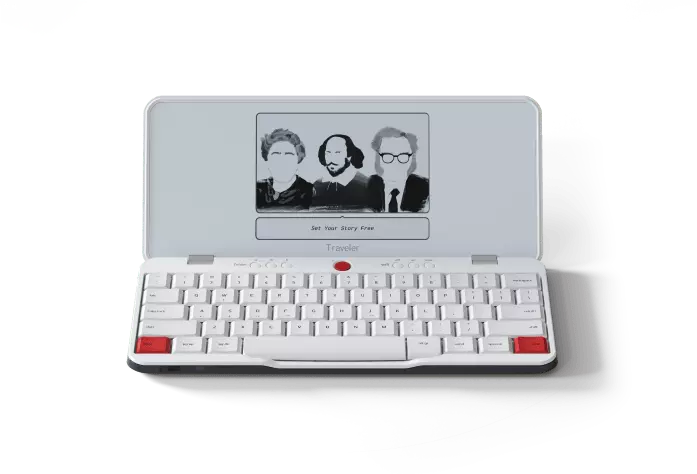
For the release of Sailfish, our new firmware update for Smart Typewriter Gen3 and Traveler, we created a brand-new boot-up animation to surprise and delight our writers.

We worked with talented Danish animator Mathias Lynge to bring our experience of the writer's journey to life.

We had a blast visualizing the writer's journey in this new way. Our engineers also had a blast (or something less than a blast) figuring out how to adjust this fun, playful animation to E Ink's very tricky specifications. Hello, refresh rate woes! But we think the result is pretty fun.

"The little animation made my day when I noticed. I love a good flourish."

- Freewrite user

The process of creating this animation was long and full of Zoom calls where we deeply discussed the writing process. We were struck through those conversations by how much overlap there is in creative processes of all disciplines.

So we sat down to chat with Mathias about his creative process and what it's like being a full-time animator.

ANNIE COSBY: Let's start with the basics. What kind of art do you make?

MATHIAS LYNGE: I'm a 2D animator and motion designer working freelance with a wide range of clients. The style varies depending on the project, but it’s usually either a hand-drawn look animated frame-by-frame on a drawing tablet, or a more digital, vectorized look made in After Effects.

While much of what I do is commercial work, I try to keep up with my own passion projects as well. That could be a 10-second Instagram loop of a nature scene, or an interesting character design I’ve sketched down with a pencil. It’s there that I get to sharpen my skills and try out new techniques, which often find their way into later client projects.

AC: You often share educational content on social media for other artists. Are you formally trained, or did you teach yourself?

ML: I’m mostly self-taught. I’ve been drawing for as long as I can remember, but it wasn’t until I went to university that I realized drawing could become a career.

When I first heard terms like “motion design” and “The 12 Principles of Animation” I was on a student exchange program at UCSB in California, where I had chosen a class called "Introduction to Animation." It was a big eye-opener for me, and from that point I was hooked.

But it’s mainly been online YouTube tutorials and my existing drawing experience that have taught me what I know.

Now, I have a big presence on social media, where I share my art as well as educational content centered around animation in Adobe After Effects, so I guess you could say that I'm also an animation influencer!

I’ve been drawing for as long as I can remember, but it wasn’t until I went to university that I realized drawing could become a career.

AC: That's actually how I first found your work. Do you have any specific artists who inspire you?

ML:In the world of 2D animation, I have a list of personal heroes that inspire me with their unique style: Reece Parker, Ariel Costa a.k.a. BlinkMyBrain, and Tony Babel, to name a few.

I also find a lot of inspiration from illustrators and painters I discover online, on platforms such as Pinterest. Last year I made a sparkling water animation that was heavily inspired by Cornwall-based artist Gordon Hunt. He makes these beautiful nature-inspired pointillist paintings that capture how light hits the ocean using colorful dots of paint. I tried to recreate that effect using After Effects to bring it to life, and it led me to a whole new way of animating within the program.

AC: Where else do you draw inspiration to create your work?

ML: I’m heavily inspired by the nature and cityscapes around me in Copenhagen, and I find that taking long walks through parks or down the streets of my neighborhood really sparks my imagination.

I’ll often carry around a sketchbook to quickly scribble down an idea or a loose sketch of something I find interesting, such as seeing how the light from a lamppost hits the surrounding leaves, or how the wind moves the tree in a certain way.

Then I’ll think to myself, “I wonder if I can recreate that motion using a specific technique in After Effects?”

I’m heavily inspired by the nature and cityscapes around me in Copenhagen...

AC: What does your daily routine look like as a full-time artist?

ML: It varies a lot, but I’m usually either working hard on a client project or tinkering away with a new animation tutorial for my social media channels.

I love being able to switch between the two, and when I’m going through a client dry spell, I find that staying creative and posting animation-related content helps keep me inspired while also putting things out into the world that may lead to my next client down the road.

AC: What's your #1 piece of advice for animators new to the industry?

ML: Keep experimenting and trying out new techniques. There’s no such thing as running out of creativity, and even though many of the things you try don’t necessarily go anywhere, it’s all experience that adds up and expands your toolbox. It’s a muscle that needs to be worked out regularly.

Plus, you’ll have more awesome animation to choose from when you’re putting together your next showreel or portfolio!

There’s no such thing as running out of creativity...

AC: What's one fun fact about you completely unrelated to animation?

ML:I’m a big sucker for history podcasts, especially if they are about ancient civilizations, such as The History of Rome by Mike Duncan.

I find it fascinating to hear how mankind was able to build such great empires without ever knowing what electricity, cars, or the internet are.

--

Follow along on Mathias's creative journey and find his free educational content on Instagram.

To learn more about working together, find him on LinkedIn or visit his website at www.mathiaslynge.com.

Learn more about Sailfish here.