overlaylink

Explorer des procédés littéraires inhabituels pour une prose puissante

septembre 10, 2019 | 8 lire la lecture

Dans le précédent article de cette série, nous avons examiné quelques procédés littéraires populaires qui peuvent faire ressortir votre écriture. Cette semaine, nous allons explorer en profondeur des procédés littéraires dont vous n'avez probablement jamais entendu parler, mais qui peuvent donner une puissance incroyable à votre écriture.

Lorsque j'ai commencé mes études d'anglais et d'écriture créative, j'ignorais l'existence d'autant de procédés littéraires différents. Certes, je connaissais les métaphores et les comparaisons, l'allitération et l'assonance, mais lorsque j'ai découvert des termes comme « épizeuxis », « polysyndeton » et « litotes » , j'étais complètement perdu. Sérieusement, ces mots ressemblent à ceux que quelqu'un aurait plongés dans un sac de tuiles de Scrabble, en aurait tiré des lettres au hasard et les aurait enfilées.

Tuiles de Scrabble

Bien que ces procédés littéraires soient beaucoup moins connus – probablement parce que la plupart des gens ne savent pas les épeler –, j'ai découvert qu'ils étaient en réalité plutôt intéressants. Ils ont renforcé mon écriture, lui ont donné plus d'impact et m'ont permis de développer mon propre style. Je les utilise dans mes fictions, bien sûr, mais je les utilise aussi dans mon travail quotidien de rédacteur.

Dans cet article, je vais explorer mes cinq procédés littéraires les plus insolites et comment les utiliser pour donner plus de force à votre prose. Prêts ? C'est parti !

1. Métonymie

Je trouve les figures de style littéraires comme la métonymie très utiles à l'écriture, surtout lorsque je travaille avec un nombre de mots très limité. La métonymie est une technique que vous utilisez probablement déjà, mais dont vous ne savez tout simplement pas que vous l'utilisez !

La métonymie est une expression qui trouve son origine dans le mot grec metōnymía , qui signifie littéralement « changement de nom ». Il s'agit essentiellement de désigner un objet ou un concept par le nom de quelque chose auquel il est associé ou dont il est un attribut.

Vous connaissez sans doute l'expression « la plume est plus puissante que l'épée ». Eh bien, c'est de la métonymie en action. « La plume » représente l'écrit, et « l'épée » la puissance militaire. En utilisant la métonymie, vous raccourcissez une phrase, « l'écrit est plus puissant que la puissance militaire », pour la rendre plus lisible et plus fluide.

Voyons quelques autres exemples de métonymie :

  • « Hollywood » — utilisé à la place de « l'industrie cinématographique des États-Unis »
  • « Bollywood » — utilisé à la place de « l'industrie cinématographique en Inde »
  • « La Couronne » — utilisé à la place de « roi/reine »
  • « Capitol Hill » — utilisé à la place de « le gouvernement des États-Unis »
  • « Downing Street » — utilisé à la place de « le gouvernement du Royaume-Uni »
  • « Prête-moi tes oreilles » (de Jules César de William Shakespeare) — signifiait autrefois « écoute-moi »
  • « Sueur et sang » — signifiait autrefois « travail acharné »

Utiliser la métonymie dans vos écrits peut présenter plusieurs avantages. Dans de nombreux cas, elle raccourcit vos phrases. Elle permet également d'éviter de répéter fréquemment la même phrase. De plus, elle rend votre texte plus intéressant, surtout si vous pouvez créer vos propres métonymies (ce qui garantit que votre public en comprendra le sens).

2. Polysyndeton

J'adore découvrir l'étymologie des mots. Polysyndeton est un mot qui vient de la racine syndetic , qui signifie connecté. Syndetic vient du grec « syndein », qui signifie « lier ensemble ». Poly , bien sûr, est un préfixe signifiant « plusieurs », donc polysyndeton signifie essentiellement « connexions multiples ». Si vous avez suivi cette brève leçon d'étymologie, vous avez probablement deviné ce que polysyndeton signifie en tant que procédé littéraire.

La polysyndétonie consiste à utiliser de nombreuses conjonctions (connexions) dans une phrase ou un paragraphe, au lieu, par exemple, de virgules. Cela crée un rythme qui rend les passages plus mémorables et intéressants. L'utilisation non conventionnelle de conjonctions (comme et ) attire l'attention du lecteur.

Regardons quelques exemples :

  • « S'il y a des cordes, des couteaux, du poison, du feu ou des ruisseaux suffocants, je ne le supporterai pas. » — Shakespeare, Othello
  • « J'ai demandé : "Qui l'a tué ?" et il a répondu : "Je ne sais pas qui l'a tué, mais il est bel et bien mort", et il faisait sombre et il y avait de l'eau dans la rue et aucune lumière ni fenêtres brisées et des bateaux partout dans la ville et des arbres abattus et tout a été emporté et j'ai pris un esquif et je suis sorti et j'ai trouvé mon bateau où je l'avais à l'intérieur de Mango Key et il était juste, sauf qu'il était plein d'eau. » — Ernest Hemingway, Après la tempête.
  • « Et tout ce qui était sur la surface de la terre fut détruit, depuis les hommes jusqu'au bétail, jusqu'aux reptiles et aux oiseaux du ciel ; ils furent exterminés de la terre. Il ne resta que Noé et ceux qui étaient avec lui dans l'arche. » — Genèse 7:3

Il existe une version inverse de la polysyndétonie : l'asyndétonie, qui consiste à remplacer les conjonctions par des virgules. Sans surprise, asyndétonie vient du grec et signifie « sans lien ». Polysyndétonie et asyndétonie peuvent toutes deux servir à varier l'effet stylistique de votre texte.

3. Litotes

Litotes est une autre figure de style. Utilisée (au moins) depuis l'époque des tragédies grecques, elle vient d'un mot qui signifie « simple » en grec. Je suis presque sûr que vous utilisez déjà cette figure littéraire, mais il peut être utile de connaître le nom des figures que vous utilisez et toutes les façons possibles de les utiliser.

En 2015, le journal The Guardian a déclaré que les litotes étaient « le procédé rhétorique le plus courant dont vous n'avez jamais entendu parler » — et, par conséquent, il n'est pas surprenant de constater que les politiciens aiment utiliser les litotes dans leurs discours.

Avez-vous déjà répondu à la question « Comment allez-vous ? » par un « Oh, pas mal » ? Si oui, vous êtes un utilisateur officiel de litotes (comme la majorité de la population !). Le dictionnaire Merriam-Webster définit la litote comme : une litote où une affirmation est exprimée par la négation du contraire (comme dans « pas un mauvais chanteur » ou « pas malheureux »).

En d'autres termes, si vous utilisez des doubles négations (par exemple, « pas mal » au lieu de « bien »), vous utilisez des litotes. Vous affirmez quelque chose comme positif sans pour autant le dire explicitement. Cependant, les litotes ne se limitent pas aux doubles négations. Prenons quelques exemples :

  • « Elle n’est plus aussi jeune qu’avant » ou « il n’est plus tout jeune » — au lieu de dire que quelqu’un est vieux.
  • « Gardez un œil sur votre mère, dont nous savons tous les deux qu'elle n'a pas les deux rames dans l'eau . » (Jim Harrison, The Road Home) — ce qui signifie que la mère n'est pas tout à fait compos mentos.
  • « Le problème, c'est que, sous David Cameron, nous avons un gouvernement qui, loin de renverser la situation, l'aggrave considérablement. Non pas par accident. Mais parce qu'il est guidé par des croyances totalement erronées sur la réussite d'un pays au XXIe siècle. » (Ed Miliband, ancien chef du Parti travailliste au Royaume-Uni) — il s'agit d'un exemple litote plus complexe où « pas par accident » est utilisé au sens de « volontairement » sans le formuler explicitement comme une accusation.
  • « Il n’y a rien de mal à exprimer son inquiétude quant à l’ampleur du nombre de personnes qui arrivent dans le pays » ( David Cameron, ancien Premier ministre britannique) — ici, au lieu d’admettre qu’« il est juste d’exprimer son inquiétude », l’expression « ce n’est pas mal » est utilisée pour rendre sa déclaration moins controversée.

4. Synecdoque

Comme la métonymie, la synecdoque est une figure de style littéraire qui peut rendre votre écriture plus intéressante. Le dictionnaire Merriam-Webster la définit ainsi :

« une figure de style par laquelle une partie est mise pour le tout, le tout pour une partie, l'espèce pour le genre, le genre pour l'espèce, ou le nom du matériau pour la chose faite. »

Bon, cette définition n'explique pas vraiment ce qui se passe lorsqu'on utilise la synecdoque, n'est-ce pas ? Pour vous aider à comprendre, examinons quelques exemples :

  • « La Russie a remporté la Coupe » — utilisé au lieu de dire « L'équipe de football russe a remporté la Coupe du monde »
  • « Roues » — au lieu de « voiture » (qui dans la définition ci-dessus est une partie mise pour le tout)
  • « Il prend sa main en mariage » — au lieu de « Il va l'épouser » (ce n'est pas seulement sa main qu'il épouse !!)
  • « Pièce » — au lieu de « argent » (l’argent, dans son ensemble, comprend plus que des pièces)
  • « Les planches » — au lieu de « la scène » (comme dans « marcher sur les planches »)
  • « Costume » — au lieu de « cadres d'entreprise »
  • « Shakespeare » — au lieu de « les œuvres de Shakespeare »

La synecdoque est souvent confondue avec la métonymie, car elles sont très similaires. Cependant, la métonymie permet d'utiliser des termes liés à quelque chose, sans qu'ils en fassent nécessairement partie.

5. Épizeuxis

Étant donné la difficulté d'orthographe et de prononciation de ce mot, on pourrait s'attendre à une figure littéraire hautement technique, n'est-ce pas ? En réalité, ce n'est pas le cas, mais l'épizeuxis reste un outil précieux à avoir dans sa boîte à outils d'écrivain.

Alors, qu'est-ce que l'épizeuxis ? En gros, il s'agit simplement de répéter un mot pour accentuer quelque chose ou susciter une émotion. C'est un excellent moyen de capter l'attention de vos lecteurs et de leur faire comprendre que votre propos est vraiment important. On retrouve souvent l'épizeuxis dans les discours politiques (c'est peut-être pour cela que le mot est si compliqué alors que le procédé lui-même ne l'est pas ?!). Par exemple :

« Ne cédez jamais – jamais, jamais, jamais, jamais, en quoi que ce soit, grand ou petit, important ou insignifiant, ne cédez jamais, sauf par conviction d'honneur et de bon sens. Ne cédez jamais à la force ; ne cédez jamais à la puissance apparemment écrasante de l'ennemi. »

  • Winston Churchill

L'épizeuxis existe depuis longtemps, et des auteurs l'utilisent dans l'Ancien Testament de la Bible :

« Saint, saint, saint est l’Éternel des armées ; toute la terre est pleine de sa gloire. »

  • Ésaïe 6:3

Vous pouvez cependant utiliser l'épizeuxis dans tout type d'écrit pour ajouter de l'emphase et de l'émotion. Prenons quelques exemples plus courants :

  • « Je ne supporte pas ça », soupira Hillary. « Il ne fait que râler, râler, râler. Je suis à bout de nerfs avec lui. »
  • William observa le jardin et se prit la tête dans les mains. Par où avait-il commencé ? Tout le jardin était ravagé par les mauvaises herbes, encore et encore.
  • Le meilleur conseil que j'ai reçu à mes débuts m'a été donné par une personne bien plus âgée et plus sage que moi. Elle m'a dit : « La seule façon de réussir en tant qu'écrivain, c'est d'écrire. Écrivez quand vous n'en avez pas envie. Écrivez quand vous n'en voyez pas l'intérêt. Écrivez quand les lettres de refus arrivent. Écrivez, écrivez, écrivez, et ne vous arrêtez pas. »

Comme tous les procédés littéraires, l'épizeuxis peut être surutilisée, ce qui lui fait perdre un peu de son impact. Essayez de trouver le juste équilibre lorsque vous utilisez ce type de procédé littéraire dans votre écriture.

Des procédés littéraires insolites à profusion

Je ne vous ai donné qu'un aperçu des procédés littéraires qui existent et qui peuvent être exploités comme de puissants outils d'écriture. Bien que ce soient mes cinq préférés, il en existe bien d'autres, comme l'hypophore, l'anastrophe, le chiasme, l'isocolon, le polyptoton, l'anadiplose, l'anaphore et l'épistrophe.

Pour donner plus de style à votre écriture et captiver vos lecteurs, utilisez des procédés littéraires, et à bon escient. Bien sûr, il est également important de ne pas en abuser, mais plus vous disposez d'outils, moins vous risquez de dépendre excessivement d'un outil en particulier.
Références

https://www.theguardian.com/media/mind-your-langue/2015/mar/26/litotes-the-most-common-rhetorical-device-youve-never-heard-of

décembre 30, 2025 3 lire la lecture

It’s Freewrite’s favorite time of year. When dictionaries around the world examine language use of the previous year and select a “Word of the Year.”

Of course, there are many different dictionaries in use in the English language, and they all have different ideas about what word was the most influential or saw the most growth in the previous year. They individually review new slang and culturally relevant vocabulary, examine spikes or dips in usage, and pour over internet trend data.

Let’s see what some of the biggest dictionaries decided for 2025. And read to the end for a chance to submit your own Word of the Year — and win a Freewrite gift card.

[SUBMIT YOUR WORD OF THE YEAR]


Merriam-Webster: "slop"

Merriam-Webster chose "slop" as its Word of the Year for 2025 to describe "all that stuff dumped on our screens, captured in just four letters."

The dictionary lists "absurd videos, off-kilter advertising images, cheesy propaganda, fake news that looks pretty real, junky AI-written books, 'workslop' reports that waste coworkers’ time … and lots of talking cats" as examples of slop.

The original sense of the word "slop" from the 1700s was “soft mud” and eventually evolved to mean "food waste" and "rubbish." 2025 linked the term to AI, and the rest is history.

Honorable mentions: conclave, gerrymander, touch grass, performative, tariff, 67.

Dictionary.com: "67"

The team at Dictionary.com likes to pick a word that serves as “a linguistic time capsule, reflecting social trends and global events that defined the year.”

For 2025, they decided that “word” was actually a number. Or two numbers, to be exact.

If you’re an old, like me, and don’t know many school-age children, you may not have heard “67” in use. (Note that this is not “sixty-seven,” but “six, seven.”)

Dictionary.com claims the origin of “67” is a song called “Doot Doot (6 7)” by Skrilla, quickly made infamous by viral TikTok videos, most notably featuring a child who will for the rest of his life be known as the “6-7 Kid.” But according to my nine-year-old cousin, the origins of something so mystical can’t ever truly be known.

(My third grade expert also demonstrated the accompanying signature hand gesture, where you place both hands palms up and alternately move up and down.)

And if you happen to find yourself in a fourth-grade classroom, watch your mouth, because there’s a good chance this term has been banned for the teacher’s sanity.

Annoyed yet? Don’t be. As Dictionary.com points out, 6-7 is a rather delightful example at how fast language can develop as a new generation joins the conversation.

Dictionary.com honorable mentions: agentic, aura farming, broligarchy, clanker, Gen Z stare, kiss cam, overtourism, tariff, tradwife.

Oxford Dictionary: "rage bait"

With input from more than 30,000 users and expert analysis, Oxford Dictionary chose "rage bait" for their word of the year.

Specifically, the dictionary pointed to 2025’s news cycle, online manipulation tactics, and growing awareness of where we spend our time and attention online.

While closely paralleling its etymological cousin "clickbait," rage bait more specifically denotes content that evokes anger, discord, or polarization.

Oxford's experts report that use of the term has tripled in the last 12 months.

Oxford Dictionary's honorable mentions:aura farming, biohack.

Cambridge Dictionary: "parasocial"

The Cambridge Dictionary examined a sustained trend of increased searches to choose "parasocial" as its Word of the Year.

Believe it or not, this term was coined by sociologists in 1956, combining “social” with the Greek-derived prefix para-, which in this case means “similar to or parallel to, but separate from.”

But interest in and use of the term exploded this year, finally moving from a mainly academic context to the mainstream.

Cambridge Dictionary's honorable mentions: slop, delulu, skibidi, tradwife

Freewrite: TBD

This year, the Freewrite Fam is picking our own Word of the Year.

Click below to submit what you think the Word of 2025 should be, and we'll pick one submission to receive a Freewrite gift card.

[SUBMIT HERE] 

--

Sources

décembre 18, 2025 6 lire la lecture

Que peuvent apprendre les lettres personnelles de Jane Austen aux écrivains ?

décembre 10, 2025 6 lire la lecture

Singer-songwriter Abner James finds his creativity in the quiet freedom of analog tools. Learn how his creative process transcends different media.

Abner James went to school for film directing. But the success of the band he and his brother formed together, Eighty Ninety, knocked him onto a different trajectory.

The band has accrued more than 40 million streams since the release of their debut EP “Elizabeth," and their work was even co-signed by Taylor Swift when the singer added Eighty Ninety to her playlist "Songs Taylor Loves.”

Now, Abner is returning to long-form writing in addition to songwriting, and with a change in media comes an examination of the creative process. We sat down to chat about what's the same — and what's different. 

ANNIE COSBY: Tell us about your songwriting process.

ABNER JAMES: The way I tend to write my songs is hunched over a guitar and just seeing what comes. Sounds become words become shapes. It's a very physical process that is really about turning my brain off.

And one of the things that occurred to me when I was traveling, actually, was that I would love to be able to do that but from a writing perspective. What would happen if I sat down and approached writing in the same way that I approached music? In a more intuitive and free-form kind of way? What would that dig up?

AC: That's basically the ethos of Freewrite.

AJ: Yes. We had just put out a record, and I was thinking about how to get into writing for the next one. It occurred to me that regardless of how I started, I always finished on a screen. And I wondered: what's the acoustic guitar version of writing?

Where there's not blue light hitting me in the face. Even if I'm using my Notes app, it's the same thing. It really gets me into a different mindset.

 "I wondered: what's the acoustic guitar version of writing?"

I grew up playing piano. That was my first instrument. And I found an old typewriter at a thrift store, and I love it. It actually reminded me a lot of playing piano, the kind of physical, the feeling of it. And it was really fun, but pretty impractical, especially because I travel a fair amount.

And so I wondered, is there such a thing as a digital typewriter? And I googled it, and I found Freewrite.

AC: What about Freewrite helps you write?

AJ:I think, pragmatically, just the E Ink screen is a huge deal, because it doesn't exhaust me in the same way. And the idea of having a tool specifically set aside for the process is appealing in an aesthetic way but also a mental-emotional way. When it comes out, it's kind of like ... It's like having an office you work out of. It's just for that.

"The way I tend to write my songs is hunched over a guitar and just seeing what comes. Sounds become words become shapes. It's a very physical process that is really about turning my brain off."

And all of the pragmatic limitations — like you're not getting texts on it, and you're not doing all that stuff on the internet — that's really helpful, too. But just having the mindset....

When I pick up a guitar, or I sit down at the piano, it very much puts me into that space. Having a tool just for words does the same thing. I find that to be really cool and inspiring.

"When I pick up a guitar, or I sit down at the piano, it very much puts me into that space. Having a tool just for words does the same thing."

AC: So mentally it gets you ready for writing.

AJ: Yeah, and also, when you write a Microsoft Word, it looks so finished that it's hard to keep going. If every time I strummed a chord, I was hearing it back, mixed and mastered and produced...?

It's hard to stay in that space when I'm seeing it fully written out and formatted in, like, Times New Roman, looking all seriously back at me.

AC: I get that. I have terrible instincts to edit stuff over and over again and never finish a story.

AJ:  Also, the way you just open it and it's ready to go. So you don't have the stages of the computer turning on, that kind of puts this pressure, this tension on.

It's working at the edges in all these different ways that on their own could feel a little bit like it's not really necessary. All these amorphous things where you could look at it and be like, well, I don't really need any of those. But they add up to a critical mass that actually is significant.

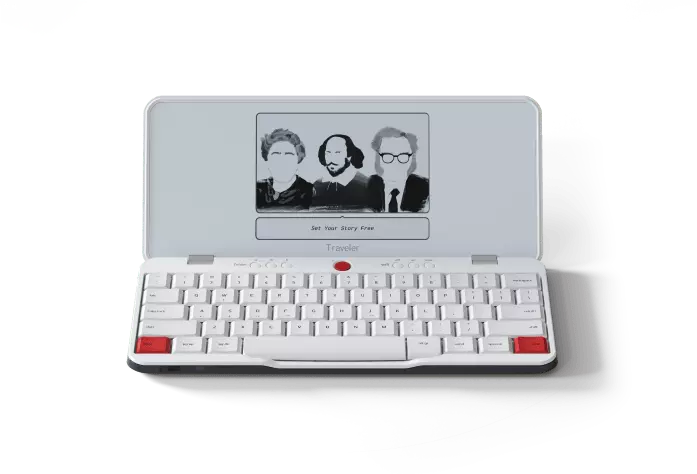
And sometimes, if I want to bring it on a plane, I've found it's replaced reading for me. Rather than pick up a book or bring a book on the plane, I bring Traveler and just kind of hang out in that space and see if anything comes up.

I've found that it's kind of like writing songs on a different instrument, you get different styles of music that you wouldn't have otherwise. I've found that writing from words towards music, I get different kinds of songs than I have in the past, which has been interesting.

In that way, like sitting at a piano, you just write differently than you do on a guitar, or even a bass, because of the things those instruments tend to encourage or that they can do.

It feels almost like a little synthesizer, a different kind of instrument that has unlocked a different kind of approach for me.

"I've found that it's kind of like writing songs on a different instrument, you get different styles of music that you wouldn't have otherwise... [Traveler] feels almost like a little synthesizer, a different kind of instrument that has unlocked a different kind of approach for me."

AC: As someone who doesn't know the first thing about writing music, that's fascinating. It's all magic to me.

AJ: Yeah.

AC: What else are you interested in writing?

AJ: I went to school for film directing. That was kind of what I thought I was going to do. And then my brother and I started the band and that kind of happened first and knocked me onto a different track for a little while after college.

Growing up, though, writing was my way into everything. In directing, I wanted to be in control of the thing that I wrote. And in music, it was the same — the songwriting really feels like it came from that same place. And then the idea of writing longer form, like fiction, almost feels just like the next step from song to EP to album to novel.

For whatever reason, that started feeling like a challenge that would be deeply related to the kinds of work that we do in the studio.

AC: Do you have any advice for aspiring songwriters?

AJ: This sounds like a cliche, but it's totally true: whatever success that I've had as a songwriter — judge that for yourself — but whatever success I have had, has been directly proportional to just writing the song that I wanted to hear.

What I mean by that is, even if you're being coldly, cynically, late-stage capitalist about it, it's by far the most success I've had. The good news is that you don't have to choose. And in fact, when you start making those little compromises, or even begin to inch in that direction, it just doesn't work. So you can forget about it.

Just make music you want to hear. And that will be the music that resonates with most people.

I think there's a temptation to have an imaginary focus group in your head of like 500 people. But the problem is all those people are fake. They're not real. None of those people are actually real people. You're a focus group of one, you're one real person. There are more real people in that focus group than in the imaginary one.

And I just don't think that we're that different, in the end. So that would be my advice.

AC: That seems like generally great creative advice. Because fiction writers talk about that too, right? Do you write to market or do you write the book you want to read. Same thing. And that imaginary focus group has been debilitating for me. I have to silence that focus group before I can write.

AJ: Absolutely.

"I think there's a temptation to have an imaginary focus group in your head of like 500 people. But the problem is all those people are fake... You're a focus group of one, you're one real person. There are more real people in that focus group than in the imaginary one."

--

Learn more about Abner James, his brother, and their band, Eighty Ninety, on Instagram.