overlaylink

Le secret d'initié du dialogue [Indice : volez-le]

juillet 25, 2017 | 6 lire la lecture

Photo de Victor Rodvang sur Unsplash

L'article invité du jour est celui de Jeff Somers . Il a publié neuf romans, dont la série de romans noirs de science-fiction Avery Cates chez Orbit Books, le roman policier hilarant et sombre Chum chez Tyrus Books, et plus récemment des récits de magie du sang et de courtes escroqueries dans le cycle Ustari .


Le film Boulevard du crépuscule (1950) est peut-être la plus grande réussite de Billy Wilder en matière de dialogues, notamment sa réplique culte (prononcée par le plus grand doublage de tous les temps, William Holden) : « Parfois, il est intéressant de voir à quel point une mauvaise écriture peut être mauvaise » (une réplique d'autant plus percutante que le personnage qui parle est lui-même un piètre écrivain). On ne peut s'empêcher de se demander si Wilder ne se faisait pas un clin d'œil à lui-même en l'inventant, malgré le fait que Wilder, un Juif polonais émigré aux États-Unis à la fin de la vingtaine, n'ait appris l'anglais qu'à son arrivée à Hollywood pour y débuter sa brillante carrière de scénariste et de réalisateur.

Le fait que l'anglais ne soit pas sa langue maternelle a peut-être aidé Wilder à créer des dialogues aussi remarquables. Entendre une langue parlée lorsqu'on ne la comprend pas est une expérience totalement différente de la parler couramment ; en 1972, le chanteur italien Adriano Celentano a sorti « Prisencolinensinainciusol », une chanson aux paroles incompréhensibles, conçues pour ressembler à de l'anglais parlé avec un accent américain typique. Écouter cette chanson est une expérience captivante : au premier abord, on a l'impression que le sens de la chanson est incompréhensible, tant les rythmes et les inflexions sont justes. La raison pour laquelle cette chanson sonne juste malgré son incohérence révèle l'astuce fondamentale d'un bon dialogue : le rythme.

Esclave du rythme

Tout écrivain sait qu’il est assez facile de se tromper gravement lors de l’écriture d’un dialogue :

- Monotonie, dans laquelle tous les personnages sonnent plus ou moins exactement de la même manière (si un lecteur ne peut pas dire qui parle sans une balise de dialogue, vous avez un problème).

- Des conversations guindées, chargées d'expositions, remplies de signifiants maladroits comme « Comme vous le savez... » ou de répétitions de faits reformulés pour plus de clarté (les gens ne parlent tout simplement pas comme ça).

- Un dialogue trop proche de la réalité, car dans la vraie vie, nous parlons tous en phrases sinueuses et bégayées, en utilisant beaucoup de sons de remplissage pour gagner du temps - et même si faire en sorte que vos personnages sonnent comme cela peut être réaliste, c'est désagréable à lire (et difficile à comprendre sur la page).

- Des personnages qui ne parlent que dans les points de l'intrigue, n'ouvrant la bouche que lorsque le lecteur a besoin de savoir quelque chose.

Le point idéal pour le dialogue est flou, mais l'astuce consiste à correspondre au rythme d'un discours réel, mais en utilisant une approche beaucoup plus contrôlée des mots réels.

Modélisation de la parole

La clé est de déconnecter un peu son cerveau et d'écouter uniquement le rythme et le déroulement d'une conversation, sans le sens des sons. Une méthode simple consiste à prendre un dialogue d'une source fictive ou d'une conversation réelle, puis à le remplacer par vos propres mots.

CONSEIL : Volez le rythme, sautez les parties ennuyeuses : c'est l'occasion idéale de supprimer les mots « remplaçants » que nous utilisons tous pour gagner du temps pendant que nous réfléchissons, comme « euh » et « ah », ou, si vous êtes italien, allora .

Emprunter à une scène : Imaginez une scène entre deux personnages qui discutent de quelque chose. Pourquoi ne pas emprunter le rythme à l'un des maîtres du dialogue cinématographique moderne, Quentin Tarantino, et à son classique Pulp Fiction ?

JULES : Bon, alors, parle-moi encore des barres de haschisch.

VINCENT : Ok, que veux-tu savoir ?

JULES : Eh bien, le haschisch est légal là-bas, n'est-ce pas ?

VINCENT : Oui, c'est légal, mais pas à 100 %. Tu ne peux pas entrer dans un restaurant, te rouler un joint et fumer. Ils veulent que tu fumes chez toi ou dans des endroits désignés.

Même sans avoir vu le film, le rythme de chaque intervenant est clair et les dialogues rebondissent d'une manière distinctive et agréable à l'oreille – ce qui explique en partie pourquoi cette scène est l'une des plus célèbres d'un film célèbre. Le sujet n'a pas vraiment d'importance (ni pour l'intrigue ni pour quoi que ce soit), mais on peut constater comment l'utilisation de mots vides de sens comme « ok » , « right » et « yeah » contribue à équilibrer le rythme, et comment certains mots sont volontairement omis pour un son plus naturel (comme « ain't hundred percent legal » au lieu de « ain't a hundred percent legal » ). En calquant vos propres dialogues sur ces rythmes, vous obtiendrez le même rebondissement pour vos propres mots.

Vincent Jules Pulp Fiction

On peut aussi s'inspirer de grands livres. Pourquoi ne pas s'inspirer d'un maître de l'art comme Hemingway ou Elmore Leonard ? Leonard avait le don de faire surgir des conversations ordinaires :

CHRIS : Elle ne m'a pas mis à la porte, je suis parti. J'ai téléphoné, tu n'étais pas là, alors je suis resté chez Jerry.

PAPA : Quand tu avais le plus besoin de moi. Je suis désolé de ne pas avoir été là.

CHRIS : En fait, pour aller droit au but, c'est Phyllis qui parle. Elle me donne des informations bancaires sur les différents types de rentes, les fiducies, les fonds d'actifs liquides institutionnels… Je suis assis là, essayant de rester éveillé, tandis qu'elle me parle du monde passionnant des fonds fiduciaires.

PAPA : J'avais un pressentiment. Tu y as réfléchi. Tu réalises que la vie continue.

CHRIS : Je ne sais même pas ce qui m'a attiré chez elle en premier lieu.

PAPA : Tu veux que je te le dise ?

Tous les dialogues de Leonard ont un rythme reconnaissable qui semble magiquement réaliste tout en étant très contrôlé et soigneusement construit.

S'inspirer de la vie réelle : Une approche tout aussi efficace consiste à calquer votre dialogue sur des conversations réelles. Cela peut être plus judicieux si vous cherchez à capturer un rythme culturel emblématique ou si vous recherchez simplement un style plus naturel. Cette approche garantit un rythme crédible et authentique, ce qui représente environ 75 % de la réussite.

Un hybride des deux approches consiste à utiliser la façon particulière dont un acteur interprète ses dialogues pour modeler le rythme d'un personnage. Imaginez un acteur ayant une façon particulière de dialoguer – Alec Baldwin, Meryl Streep, ou même un non-acteur que vous connaissez personnellement. L'imaginer lire chaque réplique que vous écrivez pour un personnage spécifique vous guidera inconsciemment vers un rythme distinctif, mais cohérent, pour chaque réplique de votre histoire.

Ces approches vous apprendront à écrire des dialogues réalistes à chaque fois, sans avoir à vous baser sur le travail de quelqu'un d'autre ou sur les conversations des voisins, et à développer votre propre rythme personnel qui ne repose sur rien d'autre que votre imagination et vos compétences créatives.

Le dialogue est difficile, personne ne dit le contraire. Construire un univers et construire une intrigue peut être amusant, empreint de l'excitation débordante de la simple création. Le dialogue est une affaire délicate. Le secret d'un dialogue réussi ne réside pas dans des vers poétiques scannés et re-scrutés sans cesse à la recherche de virgules erronées ou de comparaisons alambiquées : tout est une question de rythme. Si le rythme de parole de vos personnages paraît naturel à l'oreille, le lecteur aura facilement l'impression qu'ils parlent réellement, même si le dialogue écrit est si différent du dialogue oral. C'est extrêmement important, car faire parler vos personnages de manière crédible permet de vendre même les univers les plus farfelus et les rebondissements les plus invraisemblables. Un mauvais dialogue peut ruiner même l'histoire la plus intelligente, même celles par ailleurs brillamment écrites, et comme dans de nombreux aspects de l'art, réussir un dialogue consiste davantage à se rapprocher de la réalité qu'à la reproduire. Comme dans « Prisencolinensinainciusol », vous trompez vos lecteurs en leur faisant « entendre » ce que vous voulez qu’ils entendent.

Sauf, bien sûr, qu'il est de bonne pratique d'utiliser des mots qui ont du sens. Alors, chers écrivains, dites-moi : quel auteur crée le dialogue le plus adapté à votre propre travail ?


Jeff Somers

Jeff Somers ( www.jeffreysomers.com ) a commencé à écrire sur décision de justice pour tenter de détourner son élan créatif des grotesques génétiques. Il a publié neuf romans, dont la série Avery Cates de science-fiction noire chez Orbit Books ( www.avery-cates.com ) et la série Ustari Cycle de romans de fantasy urbaine. Sa nouvelle « Ringing the Changes » a été sélectionnée pour figurer dans le Best American Mystery Stories 2006 , son récit « Sift, Almost Invisible, Through » a été publié dans l'anthologie Crimes by Moonlight éditée par Charlaine Harris, et son récit « Three Cups of Tea » a été publié dans l'anthologie Hanzai Japan . Il écrit également sur les livres pour Barnes and Noble et About.com , ainsi que sur l'art d'écrire pour Writer's Digest , qui publiera son livre sur l'art d'écrire, Writing Without Rules, en 2018. Il vit à Hoboken avec sa femme, la duchesse, et leurs chats. Il considère que le pantalon est toujours facultatif.
décembre 10, 2025 6 lire la lecture

Singer-songwriter Abner James finds his creativity in the quiet freedom of analog tools. Learn how his creative process transcends different media.

Abner James went to school for film directing. But the success of the band he and his brother formed together, Eighty Ninety, knocked him onto a different trajectory.

The band has accrued more than 40 million streams since the release of their debut EP “Elizabeth," and their work was even co-signed by Taylor Swift when the singer added Eighty Ninety to her playlist "Songs Taylor Loves.”

Now, Abner is returning to long-form writing in addition to songwriting, and with a change in media comes an examination of the creative process. We sat down to chat about what's the same — and what's different. 

ANNIE COSBY: Tell us about your songwriting process.

ABNER JAMES: The way I tend to write my songs is hunched over a guitar and just seeing what comes. Sounds become words become shapes. It's a very physical process that is really about turning my brain off.

And one of the things that occurred to me when I was traveling, actually, was that I would love to be able to do that but from a writing perspective. What would happen if I sat down and approached writing in the same way that I approached music? In a more intuitive and free-form kind of way? What would that dig up?

AC: That's basically the ethos of Freewrite.

AJ: Yes. We had just put out a record, and I was thinking about how to get into writing for the next one. It occurred to me that regardless of how I started, I always finished on a screen. And I wondered: what's the acoustic guitar version of writing?

Where there's not blue light hitting me in the face. Even if I'm using my Notes app, it's the same thing. It really gets me into a different mindset.

 "I wondered: what's the acoustic guitar version of writing?"

I grew up playing piano. That was my first instrument. And I found an old typewriter at a thrift store, and I love it. It actually reminded me a lot of playing piano, the kind of physical, the feeling of it. And it was really fun, but pretty impractical, especially because I travel a fair amount.

And so I wondered, is there such a thing as a digital typewriter? And I googled it, and I found Freewrite.

AC: What about Freewrite helps you write?

AJ:I think, pragmatically, just the E Ink screen is a huge deal, because it doesn't exhaust me in the same way. And the idea of having a tool specifically set aside for the process is appealing in an aesthetic way but also a mental-emotional way. When it comes out, it's kind of like ... It's like having an office you work out of. It's just for that.

"The way I tend to write my songs is hunched over a guitar and just seeing what comes. Sounds become words become shapes. It's a very physical process that is really about turning my brain off."

And all of the pragmatic limitations — like you're not getting texts on it, and you're not doing all that stuff on the internet — that's really helpful, too. But just having the mindset....

When I pick up a guitar, or I sit down at the piano, it very much puts me into that space. Having a tool just for words does the same thing. I find that to be really cool and inspiring.

"When I pick up a guitar, or I sit down at the piano, it very much puts me into that space. Having a tool just for words does the same thing."

AC: So mentally it gets you ready for writing.

AJ: Yeah, and also, when you write a Microsoft Word, it looks so finished that it's hard to keep going. If every time I strummed a chord, I was hearing it back, mixed and mastered and produced...?

It's hard to stay in that space when I'm seeing it fully written out and formatted in, like, Times New Roman, looking all seriously back at me.

AC: I get that. I have terrible instincts to edit stuff over and over again and never finish a story.

AJ:  Also, the way you just open it and it's ready to go. So you don't have the stages of the computer turning on, that kind of puts this pressure, this tension on.

It's working at the edges in all these different ways that on their own could feel a little bit like it's not really necessary. All these amorphous things where you could look at it and be like, well, I don't really need any of those. But they add up to a critical mass that actually is significant.

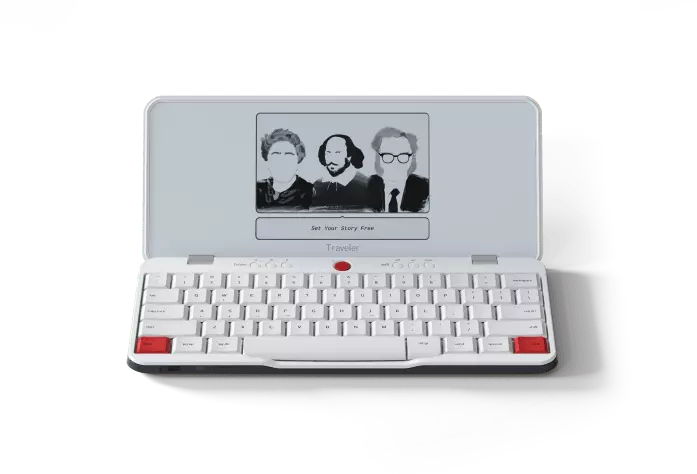
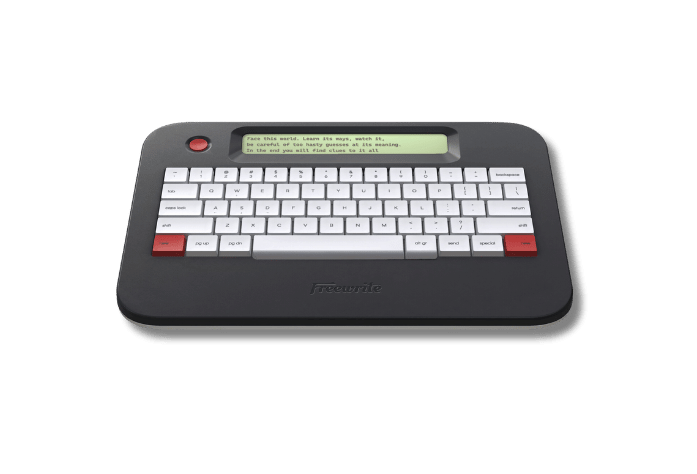
And sometimes, if I want to bring it on a plane, I've found it's replaced reading for me. Rather than pick up a book or bring a book on the plane, I bring Traveler and just kind of hang out in that space and see if anything comes up.

I've found that it's kind of like writing songs on a different instrument, you get different styles of music that you wouldn't have otherwise. I've found that writing from words towards music, I get different kinds of songs than I have in the past, which has been interesting.

In that way, like sitting at a piano, you just write differently than you do on a guitar, or even a bass, because of the things those instruments tend to encourage or that they can do.

It feels almost like a little synthesizer, a different kind of instrument that has unlocked a different kind of approach for me.

"I've found that it's kind of like writing songs on a different instrument, you get different styles of music that you wouldn't have otherwise... [Traveler] feels almost like a little synthesizer, a different kind of instrument that has unlocked a different kind of approach for me."

AC: As someone who doesn't know the first thing about writing music, that's fascinating. It's all magic to me.

AJ: Yeah.

AC: What else are you interested in writing?

AJ: I went to school for film directing. That was kind of what I thought I was going to do. And then my brother and I started the band and that kind of happened first and knocked me onto a different track for a little while after college.

Growing up, though, writing was my way into everything. In directing, I wanted to be in control of the thing that I wrote. And in music, it was the same — the songwriting really feels like it came from that same place. And then the idea of writing longer form, like fiction, almost feels just like the next step from song to EP to album to novel.

For whatever reason, that started feeling like a challenge that would be deeply related to the kinds of work that we do in the studio.

AC: Do you have any advice for aspiring songwriters?

AJ: This sounds like a cliche, but it's totally true: whatever success that I've had as a songwriter — judge that for yourself — but whatever success I have had, has been directly proportional to just writing the song that I wanted to hear.

What I mean by that is, even if you're being coldly, cynically, late-stage capitalist about it, it's by far the most success I've had. The good news is that you don't have to choose. And in fact, when you start making those little compromises, or even begin to inch in that direction, it just doesn't work. So you can forget about it.

Just make music you want to hear. And that will be the music that resonates with most people.

I think there's a temptation to have an imaginary focus group in your head of like 500 people. But the problem is all those people are fake. They're not real. None of those people are actually real people. You're a focus group of one, you're one real person. There are more real people in that focus group than in the imaginary one.

And I just don't think that we're that different, in the end. So that would be my advice.

AC: That seems like generally great creative advice. Because fiction writers talk about that too, right? Do you write to market or do you write the book you want to read. Same thing. And that imaginary focus group has been debilitating for me. I have to silence that focus group before I can write.

AJ: Absolutely.

"I think there's a temptation to have an imaginary focus group in your head of like 500 people. But the problem is all those people are fake... You're a focus group of one, you're one real person. There are more real people in that focus group than in the imaginary one."

--

Learn more about Abner James, his brother, and their band, Eighty Ninety, on Instagram.

novembre 29, 2025 4 lire la lecture

The Great Freewrite Séance: A Ghost'ly Charity Auction Full Terms & Conditions

These Terms and Conditions (“Terms”) govern participation in The Great Freewrite Séance: A Ghost'ly Charity Auction (“Auction”), organized by Freewrite (“Organizer,” “we,” “us,” or “our”). By registering for, bidding in, or otherwise participating in the Auction, you (“Participant,” “Bidder,” or “Winner”) agree to be bound by these Terms.

1. Auction Overview

1.1. The Auction offers for sale a limited number of Freewrite Traveler Ghost Edition units (“Items” or “Ghost Traveler units”), each personally signed and drawn on by a featured author.

1.2. All proceeds, net of explicitly disclosed administrative costs, will be donated to the charity or charitable initiative (“Charity”) identified on each auction item’s page, as chosen by the respective author.

2. Eligibility

2.1. Participants must be at least 18 years old or the age of majority in their jurisdiction, whichever is higher.

2.2. Employees of Freewrite, the participating authors, or any affiliates directly involved in the Auction are not eligible to bid.

2.3. By participating, you represent that you are legally permitted to take part in online auctions and to pay for any bids you win.

3. Auction Registration

3.1. Participants must create an account on the auction platform or otherwise register using accurate, current, and complete information.

3.2. Freewrite reserves the right to verify identity and to disqualify any Participant who provides false or misleading information.

4. Bidding Rules

4.1. All bids are binding, final, and non-retractable.

4.2. Bidders are responsible for monitoring their bids; Freewrite is not liable for missed notifications or technical issues on the auction platform or the Participant’s device.

4.3. Freewrite reserves the right to:

  • set minimum bids or bid increments;
  • reject bids deemed in bad faith or intended to disrupt the Auction;
  • extend, pause, or cancel the Auction in case of technical difficulties, fraud, or events beyond reasonable control.

5. Winning Bids and Payment

5.1. The highest valid bid at the close of the Auction is the Winning Bid, and the corresponding Participant becomes the Winner.

5.2. Winners will receive payment instructions and must complete payment within 48 hours of the auction’s close unless otherwise stated.

5.3. Failure to complete payment on time may result in forfeiture, and Freewrite may offer the Item to the next highest bidder.

5.4. Accepted payment methods will be listed on the Auction platform. All payments must be made in the currency specified.

6. Item Description and Condition

6.1. Each Ghost Traveler unit is authentic, and the signatures, doodles, and messages are original works created by the participating author. These are authors, not artists. By bidding on the Item, you acknowledge that you are receiving a one-of-a-kind unit marked with unique art and messages and you agree to these terms and conditions.

6.2. Because Items are customized and signed by hand, variations, imperfections, or unique marks are to be expected. These are considered part of the Item’s character and not defects.

6.3. Items are provided “as-is” and “as-available.” Freewrite makes no warranties of merchantability or fitness for a particular purpose.

7. Shipping & Delivery

7.1. Shipping costs, import duties, and taxes may apply unless explicitly stated otherwise.

7.2. Freewrite will make reasonable efforts to ship Items within the estimated timeline but cannot guarantee delivery dates.

7.3. Title and risk of loss transfer to the Winner upon delivery to the carrier.

7.4. Freewrite is not responsible for delays, damage, or loss caused by the courier or customs agencies.

8. Charity Donation

8.1. Net proceeds from the Auction will be donated to the Charity designated on each Item page.

8.2. Donation amounts and recipients may be disclosed publicly unless prohibited by law.

8.3. Winners acknowledge that they are purchasing Items, not making a tax-deductible donation to Freewrite; therefore, Winners will not receive charitable tax receipts unless Freewrite explicitly states otherwise in compliance with applicable laws.

9. Intellectual Property

9.1. All trademarks, brand names, product names, and creative materials associated with Freewrite and the Ghost Traveler remain the exclusive property of Freewrite or their respective rights holders.

9.2. Participants may not reproduce, distribute, or publicly display the authors’ doodles without permission where such rights are applicable, except as allowed by law (e.g., resale of the physical Item).

10. Privacy

10.1. By participating, you consent to Freewrite’s collection, use, and storage of your personal data in accordance with our Privacy Policy.

10.2. Freewrite may publicly announce auction results, including Winner’s first name, last initial, city, state/country, and winning bid amount unless prohibited by law or unless you formally request anonymity when possible.

11. Prohibited Conduct

Participants may not:

  • engage in bid manipulation, fraud, or collusive bidding;
  • use automated systems (bots, scripts, scrapers) to place or monitor bids;
  • interfere with the Auction, platform, or other participants

Freewrite may ban or disqualify any Participant violating these rules.

12. Limitation of Liability

To the fullest extent permitted by law:

12.1. Freewrite is not liable for indirect, incidental, special, or consequential damages arising from the Auction or purchase of Items.

12.2. Freewrite’s total liability in connection with these Terms shall not exceed the amount of the Winning Bid actually paid by the Participant.

12.3. Freewrite is not responsible for technical malfunctions, internet outages, system failures, or other issues beyond its control.

13. Cancellation and Force Majeure

Freewrite may cancel, postpone, or modify the Auction due to unforeseen circumstances, including but not limited to natural disasters, system failures, strikes, or events affecting participating authors or the Charity.

14. Governing Law & Dispute Resolution

14.1. These Terms are governed by the laws of Michigan, without regard to conflict-of-law rules.

14.2. Any disputes arising under these Terms will be resolved through binding arbitration or the courts of the specified jurisdiction, as applicable.

14.3. Participants waive any right to participate in class-action lawsuits relating to the Auction.

15. Amendments

Freewrite may update these Terms at any time. Continued participation in the Auction after updates constitutes acceptance of the revised Terms.

16. Contact Information

For questions or concerns regarding the Auction or these Terms, contact: hello@getfreewrite.com.

novembre 25, 2025 1 lire la lecture

This is a great gratitude writing exercise to be done alone or in a group, with people of any age.

How to Play

    1. Designate someone to read out each prompt below. (Feel free to add your own prompts.)
    2. After each prompt is read, set a timer for one minute. (With younger kids, this can be shortened. For older folks who want to freewrite meaningfully, more time can be added.)
    3. Each person freewrites by finishing the sentence and elaborating until the timer goes off. (For little kids, this can be done verbally with an adult recording their answers. Hilarity will ensue.)
    4. Remeber that freewriting — allowing yourself to write with abandon — enables you to let go, tapping into your subconscious to explore your thoughts more deeply.
    5. When everyone is done with all the prompts, take turns going through some your answers. Some people may be eager to share. Others may not want to. Respect their decision.

The Prompts

  • I'm grateful for... [After you've finished this prompt, repeat it five times. Challenge yourself and others not to repeat a singe word with each new answer.]
  • The silliest thing I'm grateful for is...
  • The littlest thing I'm grateful for is...
  • The biggest thing I'm grateful for is...
  • The grossest thing I'm grateful for is...
  • One thing I love about myself is...
  • My favorite thing that happened this year was...
  • My hope for next year is...

This writing exercise has resulted in some sweet answers — and many hilarious ones, too. If you try it out, do let us know.

Write on.